New UK Map from EE Reveals Area for 8Gbps Speed Broadband Trial UPDATE
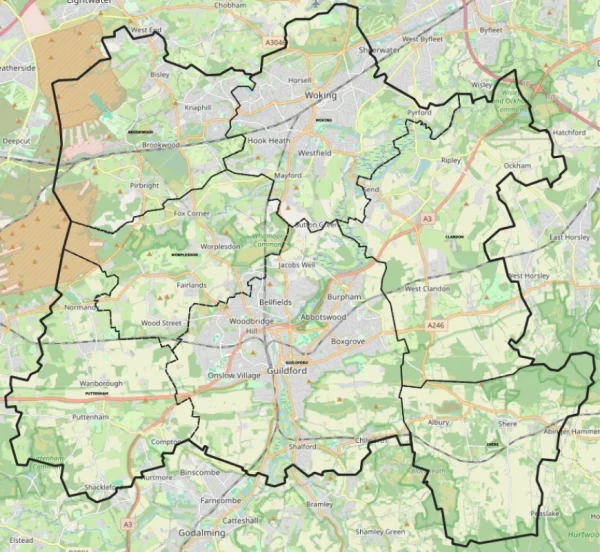
A week has passed since we reported that broadband ISP EE (BT) had started sending out invites to those wishing to help trial Openreach’s new XGS-PON powered Full Fibre (FTTP) technology (here), which is capable of delivering internet speeds of up to 8.5Gbps down (850Mbps upload). The main update this week is that the provider has also detailed which areas are covered by the trial.
Openreach has also previously informed ISPreview that their pilot, which is due to get underway from 23rd March 2026 (details), would initially begin across an area of around 40,000 premises in Guildford and neighbouring Woking. But EE has now confirmed that the trial area also includes the nearby locations of Brookwood, Puttenham, Clandon, Shere and Worplesdon (EE Trial Invite Page).
As stated in our prior report, any EE customers opting to take part in this trial will require another engineer visit to install one of the operator’s latest 10Gbps capable Optical Network Terminals (ONT) inside your home. The ISP may also supply a new router, although exact details on this will depend on what speeds EE allows you to trial.
Advertisement
The provider plans to trial both an 8Gbps and 2.3Gbps service via XGS-PON, with those on 2.3Gbps (230Mbps upload) receiving their top Smart Hub 7 Pro router (supports max of 2.5Gbps via WAN); if they haven’t already got one. But those who get to trial 8Gbps will instead receive an as yet unspecified “3rd party device“. One catch with the 3rd party device is that it won’t support all of EE’s router-based features, so some services may not work.
Customers who agree to take part will also “receive a free broadband trial line for 3 months, plus an Amazon voucher [worth £100] when you complete the trial”. EE says they’ll either install the service as an upgrade to your existing line or as a temporary new line. Existing broadband customers will also receive a credit towards their current account for the duration of the trial.
At present EE is still the only ISP on Openreach’s national network to publicly confirm their participation in the new XGS-PON pilot.
UPDATE 6th March 2026 @ 12:22pm
Advertisement
Sources suggest that the 3rd party router being shipped by EE for testing their 8Gbps tier is an unspecified model from TP Link with a 10Gbps LAN/WAN port. As we understand it, EE/BT are in the process of developing a new Smart Hub router for the full 8Gbps launch (post-trial) with a similar capability, but it’s not yet ready and hence the use of 3rd party kit. EE is only using the TP Link router for the trial.
We should be able to confirm this once the first trial users start reporting what kit they’ve received for the top tier.






Mark is a professional technology writer, IT consultant and computer engineer from Dorset (England), he also founded ISPreview in 1999 and enjoys analysing the latest telecoms and broadband developments. Find me on X (Twitter), Mastodon, Facebook, BlueSky, Threads.net and Linkedin.



























That’s strange as the trial briefing nga200126, only shows 3300/330, 3300/3300, 5500/550, 8500/850
Since there’s no way that Openreach can secretly create a new product for one specific CP, I’m guessing they’ll buy the 3.3 gig service and rate shape it down to 2.3 within their own network.
As the trial statement suggests they don’t have their own router capable of 10G WAN/LAN yet, it would make sense to do this at least as a stopgap. Lets them validate how well the current router works with the new ONTs.
What the point of trial, trial, test, test? Openreach seem so slow far behind than rest of the world!
Really? Details please. Part of the trials are so that IPSs can test their sales and maintenance etc. systems.
Because they have 650+ downstream customers that need to integrate new products with their own systems, and the correct workflows need to be in place to trigger ONT upgrades where required, and the appropriate charging for it.
C’mon, surely that’s not a real question Phil?
Pffff….. and here is me stuck on 1gig, ridiculous!
Be glad you can even get a gig, a lot are stuck with 80mbps or sub 40 still.
I am stuck with only up to 80 for example.
I know right, 1.6Gbps is so 2025! /s
I used to use hyperoptics 1gb service but moved to Vodafone mobile broadband and get a solid 800mbps and more during off peak times so I won’t be going back to fiber anytime soon 🙂
Picking 800Mbps cellular over full fibre is a bold move, Copper. Good luck with that one!
Are there any consumer level devices that can support that speed?
Most limited to a 100/1000 port, or a 2.5gig if you’re lucky (including the modem your ISP supplies).
Have you been living under a rock, of course there is. For example Eero7 Max, Netgear, TP-Link,Asus all have a few that are 10Gig capable
*sigh* this again? yes.
a very valid question. it’s not what anyone would call universal.
The big ticket home items are still gigabit with some preferring to spend the parts budget on WiFi instead, eg the PS5 Pro which is tri band WiFi 7 but still gig ethernet. Some Mac models have 10 gigabit ethernet. 10 gig USBC dongles are relatively expensive. Switches are a still a serious investment as well.
That’s before getting into the state of in home cabling. The 2.5G and 5GbaseT standards are actually several years newer than 10GbaseT. One of the reasons for doing so was that it could be made to run on existing cat5e, whereas 10G requires cat6 minimum (6a for longer lengths) and for it to be properly terminated.
Sorry that might have been rude of me misreading that at night. “consumer level devices” as in end user devices live Ivor point out, I was thinking routers etc
£200 gets you a Asus Router with 4x1Gbps 4x 2.5Gbps and 1x 10Gbps RJ45 and 1 10Gbps SPF+ – all you need is a SPF+/RJ45 adapter and a 10Gbps NIC of some form in your computer and you are good to go.
I would love to know the percentage of uk houses have a cabled network, total guess but I bet it’s less than one percent.
I have been interviewing a lot of school leavers and the majority these days have never used a physical keyboard. Their school gave them iPads to do all their work on and there wasn’t a computer at home. To them the internet is WiFi, they have never seen a LAN cable.
Many on this forum have probably cabled out their house with the latest kit and get all excited about it but that’s because they are geeks and like to brag about pointless benchmark stats.
I note that the trial covers a relatively wealthy area probably with a good number of financial traders that could make use of the higher speeds and presumably lower latency to make split second automated deals from home. Possibly!
Broadband is not fast enough for that kind of trading, and because speed is so important most trading of that type takes places in buildings rented right next door to the stock exchange servers.
The few milliseconds it takes to transmit data from Guildford to London is too great for this to work.
All the areas above are the child exchanges fed from Guildford which would make sense as they said Guildford was the trial which is the parent exchange
No human can trade at a speed where fibre latency from Guildford matters.
The humans are probably just reading the news and setting broad goals. The software that actually does the trading is what needs to reside in data centres with dedicated lines and hardware.
Whether it’s by Virgin’s cable network, CityFibre’s XGS-PON network or Netomnia’s 50G-PON network, Openreach are always being outmatched by someone.
and yet Openreach’s financial performance and takeup numbers outmatch everybody. When did Netomnia get a “50GPON network” – did they actually have any more than a handful of users on it for PR purposes only? (just like Openreach did last year with 25GPON in the shadow of their Ipswich R&D centre)
Even Virgin HFC vs Openreach VDSL was subjective in some ways. Headline higher speeds vs more consistent performance and a choice of ISP.
Indeed
Hmm. Coverage? takeup? Profitability?
Unless you live in an over-utilised area, VM HFC (coax) was miles better than BT’s FTTC (VDSL) ever was. The only part of VDSL that was better was latency, but raw speed could go much higher in terms of download and upload than BT’s FTTC could and was consistent – mostly unaffected by distance from cabinet unless other factors like damaged cable, water ingress etc.
In this scenario, most people back in the day stuck with VM if in their area, unless VM really messed things up and then people (reluctantly) took FTTC, but probably in a lot of cases (not all) re-joined VM at a later date when they took advantage of new customer pricing and offers again.
On the new FTTP networks, BT wins over VM because they do native IPv6, and VM/Nexfibre does not which OfCom should rule on as mandatory, however, VM wins in terms of symmetric speeds, whilst BT continue to drag their heels over trials and proposed tiers of upload speeds at ludicrous pricing, should they even decide to offer symmetric. I suspect the trials are a smoke screen to give enough time for Altnets to disappear, so BT can then say “No demand” was the result from their trial and close it all down and back to asymmetric again and no rush for XGS-PON or better and to sweat assets again like history shows….
@125us, you always bang on about business side instead of what customers want or would benefit by.
1. Of the Altnets providing symmetric (most) then take-up is 100% because those symmetric providers offer it by default at the same speed as the download speed (i.e. no slicing up of upload speeds and prices per ‘tier’). So every customer gets symmetric by default.
2. Had the companies been established like BT, and got assets on the cheap like poles, ducts, chambers and exchanges from the tax payer back in the 80’s, then yes, they would be profitable. Netomnia for example are choosing to bail out now, because of a good offer from VM for their business, the way the government is crashing the economy.
3. Coverage. Had the Altnets been an established player like BT who already had infrastructure, engineers, engineer vans and equipment then yes, their coverage would like exceed BT’s roll-out for Altnets like CityFibre and Netomnia.
When you harp on about business returns, coverage etc, you are comparing apples with pears. One is an established player with decades of infrastructure and process and the other had to set it up within months to get going from scratch.
What did the shareholders pay for BT? All the altnets knew exactly what the market was when the companies were set up. And that there would be competition with maybe 4 other full fibre companies in an area.
These stories always bring out the best in ISPReview’s comment section, don’t you think?
Oh god yes
Alex, we agree. Nobody wants a forum where certain users worship one company like a holy entity without challenging what is stated. When people are not affiliated to any one company, they can give a genuine opinion or balanced view without taint of prejudice.
This is an article about EE offering services using an Openreach XGS-PON trial. Seems uncontroversial to me but then I’m not capable of starting a fight in an empty room.
It is what it is, Peter.
And i’m stuck on mobile data because 1 pole was a pole to far for fttp
@Mark: “Many on this forum have probably cabled out their house with the latest kit and get all excited about it but that’s because they are geeks and like to brag about pointless benchmark stats” — Now you’ve set the cat among the pigeons! 🙂
Hang on, what happened to their symmetric products? Will they ever make it to the market?
Exactly my thoughts! The whole point of it (atleast for me) was the symmertic 3.3gig for ultra fast uploads!
Would be a huge shame if that didn’t reach the consumers…
MSN are reporting this as being a nationwide trial. Thank god there is a decent website out there giving out the right information! ( you)
Yet still on 3Mb adsl here lol!