Amazon Leo Prep New Constellation of 5,105 Satellites for Global 5G Mobile
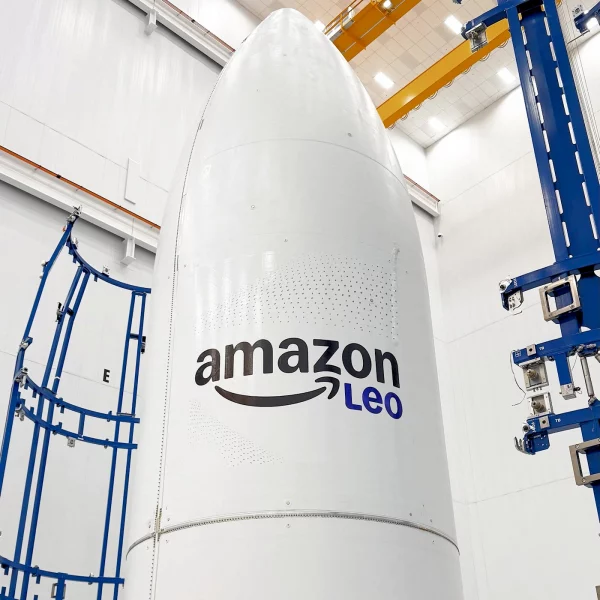
The Amazon Leo (formerly Project Kuiper) service, which is building a new mega constellation of ultrafast broadband satellites in Low Earth Orbit (LEO) for the UK and globally, has revealed plans to launch a “new constellation” of up to 5,105 satellites to connect compatible 4G and 5G mobile devices on the ground directly from space (Direct-to-Device).
Until now all the focus has been on Amazon’s plans for a broadband service, which will be available to homes, businesses and the public sector. This is currently still in its commercial beta phase and will start to launch properly through 2026 and 2027. Amazon Leo currently has approval to deploy and operate their own initial constellation of 3,236 LEO broadband satellites (altitudes of between 590km to 630km). A total of nearly c.400 Kuiper satellites have already been placed into orbit (they need at least 500 for basic global coverage) and many more are due to follow.
However, Amazon has made no secret of their desire to launch a satellite-based mobile service too (similar to Starlink’s Direct to Cell product – as already used by O2 in the UK), which is one of the key reasons why they recently spent $11bn to gobble Globalstar (here). The move gave Amazon access to Globalstar’s existing satellites, radio frequency spectrum, and operational expertise, which will in turn support their plans for adding Direct-to-Device (D2D) mobile services.
Advertisement
The big announcement today is that Amazon Leo has officially filed with the Federal Communications Commission (FCC) in the USA to deploy up to 5,105 new satellites designed to use Globalstar’s spectrum to bring voice, data (mobile broadband), messaging, and emergency services directly to mobile devices on the ground. Deployment for this is tentatively being set to start sometime in 2028.
The new D2D system will operate alongside Leo’s first and second-generation satellite broadband systems—as well as Globalstar’s HIBLEO and C-3 satellite constellations—extending Leo satellite connectivity directly to compatible mobile devices. The system is “designed to reach any compatible mobile device” – including any of the growing number of Smartphones from major manufacturers that have satellite-capable chipsets built in.
Amazon Leo has already announced an agreement with Apple to power satellite services for supported iPhone and Apple Watch models—including Emergency SOS via satellite, Messages, Find My, and Roadside Assistance via satellite—and to collaborate with Apple on future satellite services using the expanded network. Amazon Leo has already announced partnerships with telecom operators like Vodafone, DirecTV, Herotel, and Australia’s National Broadband Network, and more will follow.
AMAZON LEO – How will the D2D network operate?
Leo will distribute its D2D satellites across five orbital shells, each optimized to reach different parts of the planet. The three mid-latitude shells provide dense coverage across heavily populated regions, while the higher-inclination shells extend service toward polar areas.
Here’s how the five orbital shells break down:
Mid-latitude coverage:
• Shell 1: 580 km altitude, 55.7° inclination
• Shell 2: 560 km altitude, 58.2° inclination
• Shell 3: 510 km altitude, 56.3° inclinationHigh-latitude coverage:
• Shell 4: 570 km altitude, 73° inclination
Near-polar coverage:
• Shell 5: 540 km altitude, 84° inclination
The satellites will communicate with mobile devices using dedicated radio frequencies (L-band and S-band spectrum links). Connections between the satellites and Amazon’s ground stations will use separate high-capacity radio links (Ka-band and V-band spectrum) that carry aggregated traffic between the satellite network and the internet, much like a backhaul connection for a cell tower.
Unlike conventional satellites that simply relay signals to the ground (known in the industry as “bent pipe” satellites), Leo’s D2D satellites will process the signals in orbit before relaying them to improve performance. Also, Leo’s D2D satellites will be equipped with optical inter-satellite links—laser connections between the satellites in orbit—to support intelligent traffic routing across the constellation.
The satellites will use digital beamforming and beam-hopping to direct concentrated signals precisely where and when they are needed. This maximizes coverage while minimizing wasted power and interference. Combined with the advanced signal-processing techniques described below, this approach will deliver higher spectrum efficiency than legacy systems:
➤ Tight adjacent-channel performance: The satellites will contain their signal energy within assigned frequency channels with minimal leakage into neighboring bands, protecting other operators while increasing usable capacity.
➤ Dual-polarization reception: The satellites will receive signals in two orientations simultaneously, increasing the information captured from the same frequency band and improving signal quality from low-power mobile devices.
➤ Adaptive modulation and coding: The system will continuously adjust how data is encoded based on real-time signal conditions, delivering higher data rates when conditions are favourable and maintaining reliable connections when they are not.
The Leo D2D System will complement existing mobile networks by filling coverage gaps where terrestrial deployment is impractical, cost-prohibitive, or vulnerable to disruption. Once again this is intended to be directly competitive with Starlink’s current mobile solution, which initially envisages working with existing mobile operators and regulators to deliver the service (likely as an add-on). But Starlink is known to be exploring the idea of launching their own global mobile service, independent of existing mobile operators, which could be another potential option for Amazon to pursue too.
Advertisement
At this stage we don’t yet know what kind of real-world performance such a network will deliver or what its caveats might be, but such details should follow in the future. Starlink’s own mobile service is currently quite app-specific and is only good at common but basic tasks, although they are expanding it and future satellites will be much faster too.






Mark is a professional technology writer, IT consultant and computer engineer from Dorset (England), he also founded ISPreview in 1999 and enjoys analysing the latest telecoms and broadband developments. Find me on X (Twitter), Mastodon, Facebook, BlueSky, Threads.net and Linkedin.












Advertisement
Leave a Reply
Privacy Notice: Please note that news comments are anonymous, which means that we do NOT require you to enter any real personal details to post a message and display names can be almost anything you like (provided they do not contain offensive language or impersonate a real person's legal name). By clicking to submit a post you agree to storing your entries for comment content, display name, IP and email in our database, for as long as the post remains live.
Only the submitted name and comment will be displayed in public, while the rest will be kept private (we will never share this outside of ISPreview, regardless of whether the data is real or fake). This comment system uses submitted IP, email and website address data to spot abuse and spammers. All data is transferred via an encrypted (https secure) session.

















Weird that nobody is here to moan about space junk like they do with Starlink, I wonder why?
It’s all space junk, unless you consider satellites having a lifespan of around 5 or 6 years economically sensible. As far as D2D satellite mobile is concerned, the technology will only be useful in extremely remote areas, since physics determines the available bandwidth, signal strength constraints and number of users in a geographic area.