Vodafone UK and NCA help police smash criminal SIM farm networks
Broadband and mobile operator VodafoneThree (Vodafone and Three UK) has revealed that they recently worked alongside the National Crime Agency (NCA) and City of London Police to help identify and disrupt criminal SIM farm networks in “one of the largest hauls ever recovered” – resulting in 8 arrests and more.
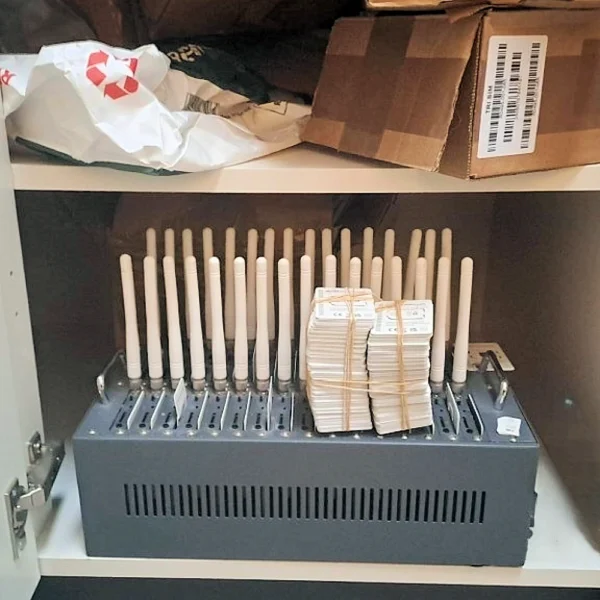
The “SIM farms” being reference above reflect electronic devices that are capable of using five or more SIM cards simultaneously or interchangeably, and which allows the user to send Short Messaging Service (SMS) texts or phone calls in large numbers over the telecommunications (mobile) network. Such “farms” can have legitimate uses too, but they’re frequently used by criminals engaged in fraud (e.g. sending phishing scam/messages that are designed to steal personal or financial data).
Using a new approach developed with law enforcement, VodafoneThree were able to identify suspected SIM farm activity and then share that intelligence with the NCA and CoLP’s Fraud Targeting Cell. The Dedicated Card and Payment Crime Unit (DCPCU), a banking industry-funded unit, used the intel to investigate individuals suspected of using SIM farm systems to target the public.
Advertisement
The investigation ultimately led to the disruption of organised criminal activity and the recovery of what law enforcement has described as potentially the “largest haul of compromised payment details ever recovered“. The effort has so far resulted in eight arrests, the seizure of SIM farm equipment and cash, and the recovery of more than 1 million compromised payment card details ‘phished’ from members of the public.
Rachel Andrews, Head of Corporate Security at VodafoneThree, said:
“Fraud cannot be tackled through protection measures alone. We need to go further, using our intelligence and capabilities to identify and disrupt the infrastructure that allows organised criminals to operate at scale. This collaboration with the NCA shows what can be achieved when industry and law enforcement combine their strengths, disrupting criminal activity closer to its source and preventing harm before it reaches customers and the wider public.”
Lord Hanson, Minister for Fraud, said:
“It only takes one fraudulent text to deprive people of their hard-earned money and SIM farms give fraudsters the tools to target their victims at scale.”
The law we introduced to ban their use is now in force. Those using these devices to defraud the public will not only continue to face the full force of the law but will also be hit with hefty fines.”
Criminals are increasingly working on an industrial scale, so we are meeting them with the same force by partnering with mobile networks and law enforcement to disrupt their operations and hit the scammers where it hurts.”
The announcement comes as new legislation banning the operation of SIM farms finally takes effect in the UK, strengthening powers to tackle fraud and organised crime – enabling earlier disruption, more arrests, and fewer victims. Crucially, SIM farms can hide in plain sight. Recent UK investigations have uncovered the technology operating from ordinary homes and properties in local communities.



Mark is a professional technology writer, IT consultant and computer engineer from Dorset (England), he also founded ISPreview in 1999 and enjoys analysing the latest telecoms and broadband developments. Find me on X (Twitter), Mastodon, Facebook, BlueSky, Threads.net and Linkedin.











Advertisement
Leave a Reply
Privacy Notice: Please note that news comments are anonymous, which means that we do NOT require you to enter any real personal details to post a message and display names can be almost anything you like (provided they do not contain offensive language or impersonate a real person's legal name). By clicking to submit a post you agree to storing your entries for comment content, display name, IP and email in our database, for as long as the post remains live.
Only the submitted name and comment will be displayed in public, while the rest will be kept private (we will never share this outside of ISPreview, regardless of whether the data is real or fake). This comment system uses submitted IP, email and website address data to spot abuse and spammers. All data is transferred via an encrypted (https secure) session.

















That explains why I’m not longer receiving two or three scam calls a day. Makes for a rather lonely day TBH. I do try to keep them on as long as possible as a service to the public.
I’ve entertained myself sometimes when I’ve had scammers call me.
I had a call from Microsoft saying they had detected a problem on my windows computer.
I told the scammer I’m glad you’ve called can you help.
He instructed me to turn on my computer.
I told him I would though my computer was very sluggish.
I said to him my computer is booting up but being slow with the spinning circle on the screen. I kept him on the phone and carried on with preparing my dinner having gone nowhere near my computer. Eventually I went back and said my computer has booted up and is now updating.
He asked me how it going, I said its at 8 percent just gone to 9 percent.
He waited patiently on the phone whilst I went and got a shower.
He asked how ot was going. Now having kept him on the phone for 30 minutes I thanked him for being patient.
After an hour I said the computer had restarted and got to 70%.
More time passed and I told him my computer was at 99%.
I told him it seems to be stuck at 99% and kept him waiting even longer.
Then after another half hour had passed I sat down and had my tea then I told the scammer that a friend had turned up and warned me that Microsoft would never phone anyone about their computer so therfore it must be a Scam. The scammer got upset and I then told him the truth.
I hadn’t been anywhere near my computer and keeping him on the phone for about 2 hours hopefully will have prevented him scamming someone else.I told him goodbye and have a nice day.