Ookla examine performance of 4G calling (VoLTE) and 5G voice (VoNR) mobile tech

Network benchmarking provider Ookla (Accenture), which collects data from consumers via their broadband and mobile Speedtest.net service, has published an interesting examination of the performance differences between voice calls handled by the 4G centric Voice-over-LTE (VoLTE) and 5G based Voice-over-New-Radio (VoNR) technologies.
According to the study, VoLTE remains the gold standard for consistency and speed in mature deployments. For example, South Korean operators in Seoul lead with a 1.06-second median call setup time on VoLTE, faster than any studied VoNR deployment globally, with over 90% of calls meeting a two-second setup target. “This reflects years of refinement in IMS core and radio parameters,” said Ookla.
Granted, the figures in this study for call setup times don’t seem particularly remarkable. But Ookla points out that, psychologically, a setup delay under 2 seconds feels instant, while any delays that exceed 4 to 5 seconds can trigger user anxiety and uncertainty about whether the call has failed.
Advertisement
In the UK two mobile operators, EE and Three UK, delivered VoLTE medians of around 1.4 seconds (1.37s and 1.41s, respectively) and completed over 93% of calls within 2 seconds. O2’s median came in at just under 2 seconds, while Vodafone UK was slightly slower on 2.3 seconds. The UK’s VoLTE penetration stands at roughly 93% of connections. Sadly Ookla didn’t publish any UK specific figures for comparable VoNR performance, but they did do so for other countries.
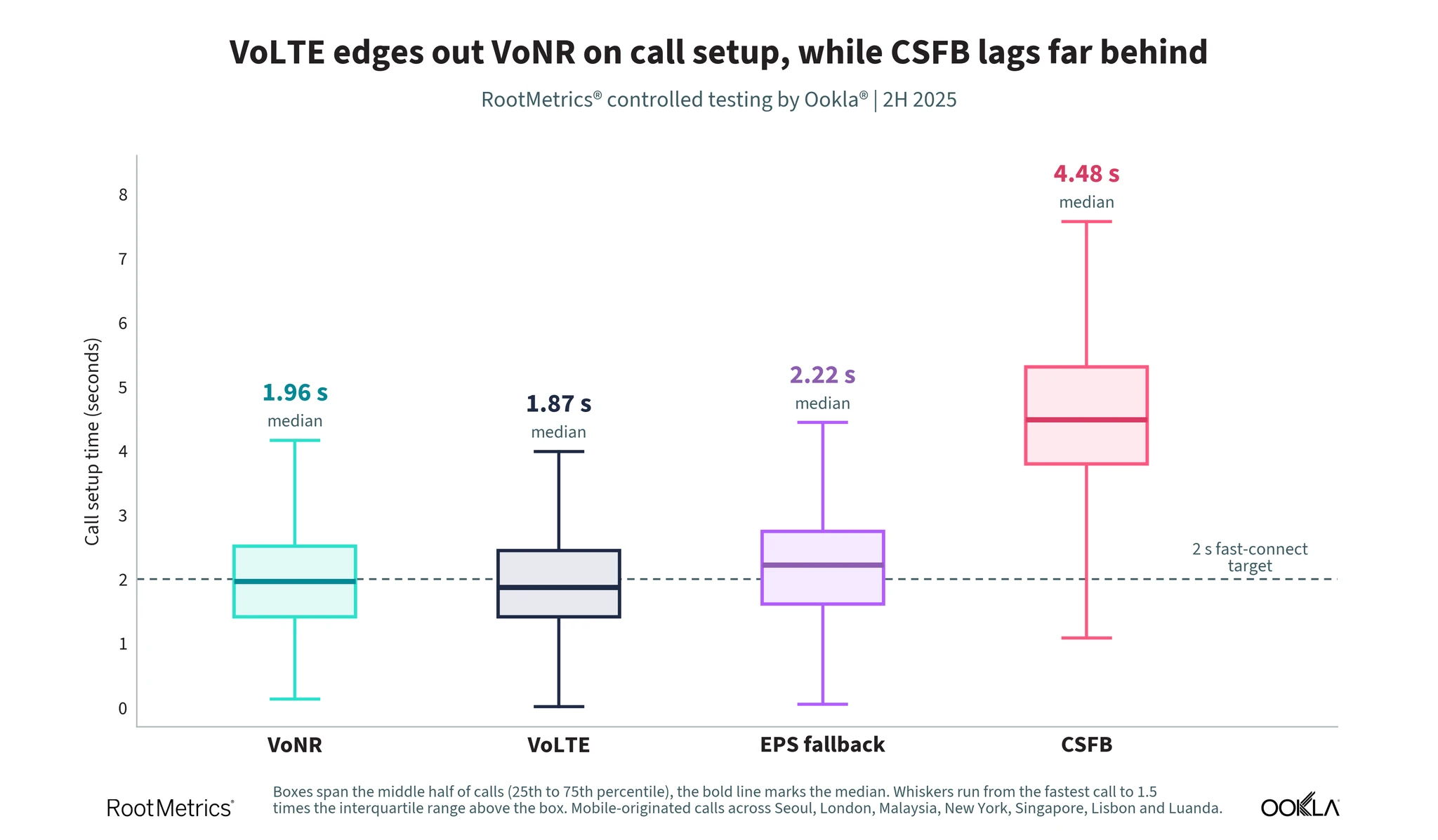
Despite using more modern 5G technology, Ookla found that VoNR’s performance can be more variable and its global overall median delay of 1.96 seconds comes in slightly slower than VoLTE on 1.87s, due to a lack of maturity and optimisation. Across eight operators studied, six connected calls faster on VoNR than VoLTE. Median setup times are often strong, but the slowest 5% of VoNR calls were found to “lag well behind” VoLTE for some operators.
For example, both Singapore’s Starhub and Korea’s KT feature VoNR setup times that trail their respective VoLTE outcomes, with performance 32% and 13% slower respectively. Specifically, for Starhub, while its 1.82 second median on VoNR looks respectable, the 95th percentile balloons that to 6.33 seconds, and only 57% of VoNR samples met the 2 second target.
However, once VoNR is optimised, it can still deliver “material gains“. Singtel posts a 1.07-second VoNR median, outperforming its own VoLTE layer and most comparable networks outside Korea. In Malaysia, YES achieves a 1.6-second VoNR median, over half a second faster than its VoLTE. “These results suggest both operators have optimised their 5G cores to eliminate the legacy signalling issues that can hinder older IMS deployments,” said Ookla.
Advertisement
Legacy 2G and 3G networks are worse
The key thing to remember is that both VoLTE and VoNR are a lot quicker than the fallback solutions for legacy networks. For example, 4G mobile networks often use a Circuit Switched Fallback (CSFB), which outside of VoLTE areas will switch your mobile calling connection back to a legacy 2G network (or 3G, but that’s no longer relevant in the UK).
“The performance penalty of reverting to CSFB, however, is stark. In our testing, CSFB delivers a median call setup time of 4.48 seconds, more than twice as slow as VoLTE’s (1.87 seconds). The 95th percentile reaches 10.75 seconds, meaning 1 in 20 CSFB calls takes significantly longer than most subscribers would consider acceptable. Perhaps most strikingly, 5.5% of CSFB calls exceed 10 seconds, a rate that is 11 times higher than VoLTE (0.49%),” explained Ookla.
Similarly, 5G+ networks will often use the Evolved Packet System (EPS) as their fallback, which will switch you back from VoNR on 5G to 4G Calling. As you’d expect, this is faster than CSFB (EPS delivered a median delay of 2.2 seconds), albeit still slightly slower than directly using VoLTE or VoNR for calling.
Advertisement




 and 5G voice (VoNR) mobile tech - ISPreview.co.uk "Share with Pinterest")

Mark is a professional technology writer, IT consultant and computer engineer from Dorset (England), he also founded ISPreview in 1999 and enjoys analysing the latest telecoms and broadband developments. Find me on X (Twitter), Mastodon, Facebook, BlueSky, Threads.net and Linkedin.













« SpeedGeo Q3 2026 study names Virgin Media fastest for UK broadband
Advertisement
Leave a Reply
Privacy Notice: Please note that news comments are anonymous, which means that we do NOT require you to enter any real personal details to post a message and display names can be almost anything you like (provided they do not contain offensive language or impersonate a real person's legal name). By clicking to submit a post you agree to storing your entries for comment content, display name, IP and email in our database, for as long as the post remains live.
Only the submitted name and comment will be displayed in public, while the rest will be kept private (we will never share this outside of ISPreview, regardless of whether the data is real or fake). This comment system uses submitted IP, email and website address data to spot abuse and spammers. All data is transferred via an encrypted (https secure) session.

















I remember the first time I used a VoLTE call – the connection time seemed mind blowingly fast compared to CSFB!