Openreach Trial Uses UK Broadband Network to Detect 100+ Water Leaks

Network access provider Openreach (BT) has today revealed some of the first results from their ongoing trial of a new technology (here), which harnesses the operator’s existing fibre optic broadband network to detect mains water leaks. In just three months, it’s already pinpointed 100+ leaks and is estimated to be saving 2 million litres of water a day.
The idea of using optical fibre cables, which transmit data using pulses of laser light, to detect and monitor nearby events is nothing new. For example, scientists have already found ways of turning such cables into Earthquake and Tsunami monitors (here and here), which works by detecting changes in the polarization of light as it moves through the cable. We’ve also seen fibre sensing technologies being adapted to detect sabotage against vital subsea cables (here).
Suffice to say that fibre optic sensing technologies have come a long way and they’re continuing to improve, which is likely to offer some new and increasingly interesting opportunities for existing broadband operators. Naturally, any operator with a network the size of Openreach’s is a prime candidate for such things, particularly if it can be successfully adapted to help identify and locate water and gas leaks.
Advertisement
In this case the 6-month trial we’re talking about reflects a partnership between Openreach, Affinity Water and UK technology company Lightsonic, which have adopted Distributed Acoustic Sensing (DAS). The technology converts fibre optic cables into early warning sensors that can “hear and accurately pin-point problems” across surrounding water networks / pipes (gas could also be covered).
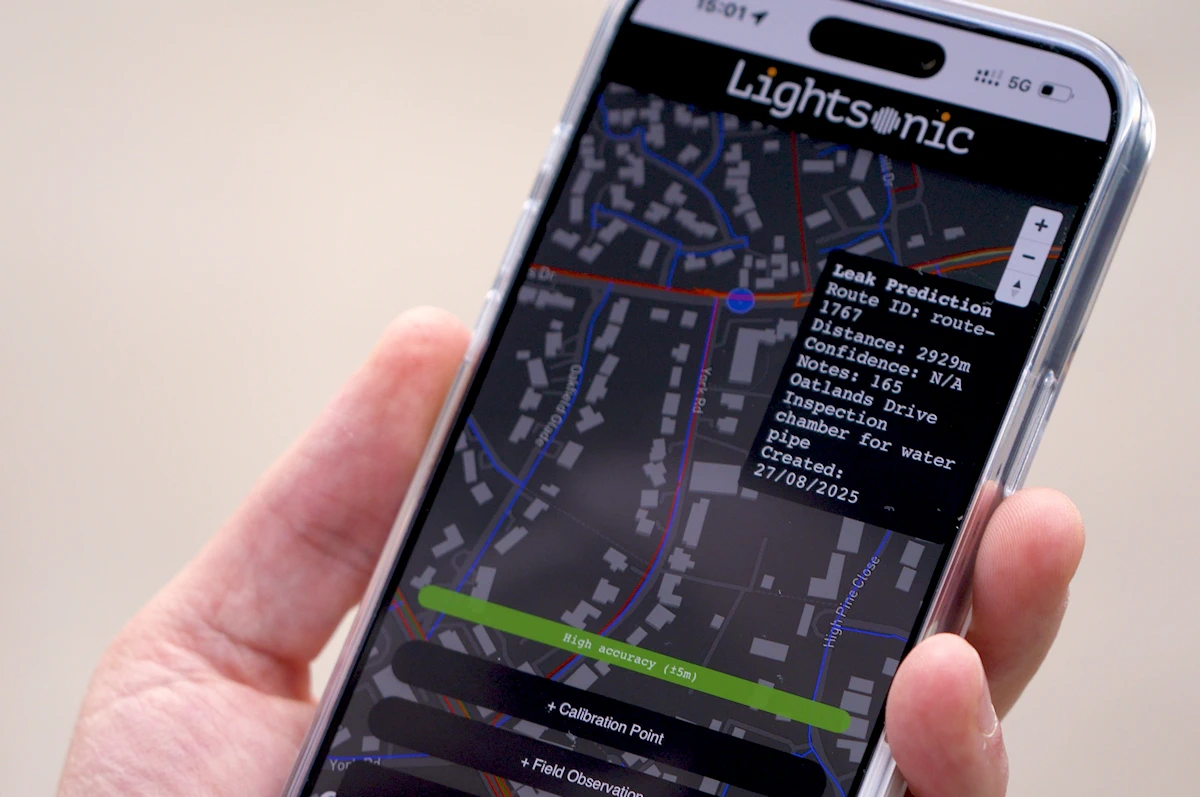
Developed by Lightsonic – the fibre-optic leak detection platform is currently being piloted in five locations – Walton-on-Thames, Hemel Hempstead, Luton, Chesham/Amersham and Ware. By harnessing Openreach’s network, this is currently able to monitor 650 kilometres of Affinity Water’s network.
How does DAS technology work?
DAS technology works by detecting changes in the light signal used in fibre optic cables caused by vibrations from a leak or disturbance in surrounding networks. It uses machine learning to locate the exact point of the vibration, and it trains the system to separate background noise – like the rumble of traffic or roadworks, so that leaks stand out clearly — even in busy streets. The technology has big advantages over conventional detection methods, namely:
➤ Continuous monitoring: Existing leakage detection relies on targeted surveys and skilled field teams working systematically across the network. Fibre sensing complements this approach by providing 24/7 monitoring, so leaks can be spotted sooner and reduce the time between surveys.
➤ No need to dig: It uses the fibre that’s already in the ground — turning it into thousands of tiny “virtual sensors” – making it cheaper, quicker, and more environmentally friendly.
➤ Targeted identification: The system recognises the unique acoustic “signature” of a potential leak and highlights an area to investigate – often to within a few metres, so repair teams are directed to the right spot.
➤ Reduced disruption: By identifying leaks earlier, water companies can address them before they cause significant disruption, cutting emergency callouts and minimising impact on customers and road users.
➤ Easy to scale: Using the national reach of Openreach’s fibre network means the system can be scaled up across throughout the UK.
In its first locations, and in just three months, the fibre sensing technology was able to locate more than 100 leaks – saving 2 million litres of water a day – equivalent to more than 700 million litres every year, enough to supply around 10,000 people.
Advertisement
Trevor Linney, Director of Network Technology for Openreach, said:
“The results of our pilot show that our new full fibre infrastructure can deliver value far beyond broadband – and could prove to be a real game changer in solving real-world challenges like water conservation.”
Around 20 per cent of the UK’s drinking water is lost to leaks with water conservation a significant and growing issue for the nation. And, what’s great about this technology, is that it can be used to detect a whole range of things – from gas leaks to monitoring the health of big structures like bridges and tunnels. It has huge potential.”
James Curtis, Head of Leakage at Affinity Water, added:
“Strengthening how we identify and address leaks is central to our leakage strategy. By working with Lightsonic and Openreach, we’re enhancing our existing detection programme with continuous network monitoring, helping our teams target areas of interest more quickly and reduce the time leaks may run before repair.
This technology complements the expertise of our field technicians, supporting earlier intervention, better planning and reduced disruption for customers — all by using fibre that’s already in the ground.”
As we recall, the trial is currently only using “spare” fibres in Openreach’s network to create a system capable of providing real-time data for multiple utilities, allowing costs to be shared. But the original plan envisaged this solution being expanded to work across Openreach’s active fibre network too, rather than having to install a dedicated sensing fibre network.
If successful, London could potentially end up becoming the first city in the world to deploy an underground early warning system of this type. But the big challenge for this trial has been in adapting the technology to work for a scale deployment. Clearly the early results are promising, although we don’t know much about the costs of implementation and so at this stage it’s hard to judge the true viability.
However, it’s worth remembering that Openreach aren’t the only fibre game in town, and it’s possible that we might see rival networks – belonging to several different operators – being harnessed in the future in order to further improve such systems.






Mark is a professional technology writer, IT consultant and computer engineer from Dorset (England), he also founded ISPreview in 1999 and enjoys analysing the latest telecoms and broadband developments. Find me on X (Twitter), Mastodon, Facebook, BlueSky, Threads.net and Linkedin.



























seems a good reason to install all Openreach cables underground and get an income from other utilities for this service, rather than installing wires on poles in the air.
Could the same technology detect potholes – vibration from wheels hitting the dips through roadside F.O. cables? Nah! Can’t be done as we havn’t got time/funds/inquiries!
If successful, would altnets get involved?
The problem with potholes is a lack of funding to fix them rather than detection.
Not so much a lack of funding as it is, a lack of motivation.
You’ll find that councils are much more prompt at fixing things like potholes if they reasonably think they’re in danger of losing their seats.
I appreciate the innovation behind these fibre‑based sensing trials, but it’s hard not to feel frustrated when our own community is still stuck with failing copper lines, rising line‑rental charges, and no clear plan for improvement.
While Openreach is talking about solving problems for other industries, water leaks, gas detection, structural monitoring, we’re dealing with basic connectivity that drops out constantly and infrastructure that’s been damaged for years.
It would be reassuring to see the same level of urgency and investment directed toward communities like ours, where the existing network is no longer fit for purpose and there are still zero plans for fibre. Before expanding into new sectors, it feels reasonable to expect Openreach to address the fundamental service issues affecting the customers who rely on them every day.
When will there be a concrete plan to replace our degraded copper network and provide the reliable service we’re paying for?
Fascinating approach—using broadband networks to detect water leaks shows how technology can solve everyday problems. At Avantis Direct, we’ve seen how smart tech solutions like this can make operations more efficient and reduce unnecessary costs.
Do you think widespread adoption of these systems could become the norm for utilities soon?