Cisco Trial Seamless WiFi and Mobile Roaming Tech on Orkney
Cisco and CloudNet have begun live trials of their new OpenRoaming technology on Orkney (Scotland) via the wider 5G RuralFirst project, which aims to make it easier for mobile users to stay connected to the internet by allowing them to seamlessly and securely roam between different WiFi hotspots.
The idea of seamless roaming between WiFi hotspots is nothing new and indeed there are existing systems, such as the Wireless Broadband Alliance‘s WISPr 2.0 or the Wi-Fi Alliance‘s Hotspot 2.0 (Passpoint). Likewise some operators already work together between different WiFi network platforms in order to facilitate this, although many of these require you to pay a subscription for a global pass.
Nevertheless the old approach doesn’t appear to have worked all that well since most of us still end up having to sign-up with lots of different WiFi hotspots in order to use them (painful), which is often necessary when there’s no viable 4G or 5G based mobile broadband signal to use.
Advertisement
By comparison the new trial, which forms part of the £4.3m Government funded 5G RuralFirst testbeds programme (here), enables mobile users to automatically and seamlessly roam across WiFi and cellular 4G or 5G networks.
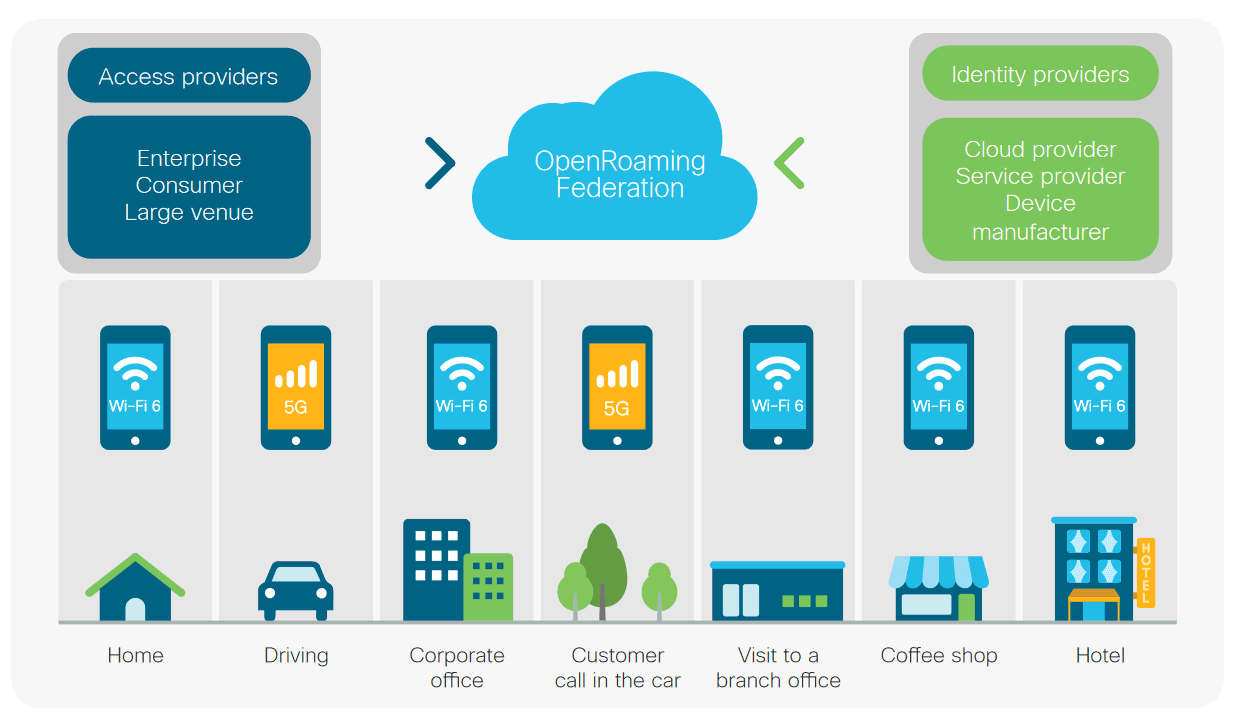
Cisco’s Description of OpenRoaming
OpenRoaming provides mobile users frictionless guest Wi-Fi onboarding by linking together access providers (such as public venues, retailers, airports, and large enterprises) and identity providers (such as service provider carriers, devices, and cloud providers). With OpenRoaming, you’ll be able to get online seamlessly and automatically after signing in just once using a trusted identity provider.
The service will be completely secure and fast, and you’ll never have to guess which Wi-Fi network to use or suffer through a pop-up captive portal again. You will be connected wherever you go so you can download, stream, video chat, and game to your heart’s desire.
The OpenRoaming Federation will be made up of identity providers such as SP carriers, devices and cloud providers and Wi-Fi access providers such as retailers, hotels, and large venues to enable customers to connect automatically. This Wi-Fi connection will be secured using industry-standard Wi-Fi Protected Access 2 (WPA2) protocols and encrypted authentication.
The solution appears to harness some of the existing Hotspot 2.0 approach, although by the sounds of it this will still be dependent upon the many different hotspot providers agreeing to join. As such it remains to be seen how much adoption this gets in the wild but no doubt many people would welcome a system that could actually deliver on the promise of seamless and secure public WiFi connectivity between the many different networks.
The OpenRoaming trial on Orkney appears to be taking place in the largest town of Kirkwall.
Advertisement

Mark is a professional technology writer, IT consultant and computer engineer from Dorset (England), he also founded ISPreview in 1999 and enjoys analysing the latest telecoms and broadband developments. Find me on X (Twitter), Mastodon, Facebook, BlueSky, Threads.net and Linkedin.













« Statkraft UK Moot Wireless Broadband Rollout from Wind Farms














Comments are closed