O2 UK Highlights New Masts to Boost Shetland 4G Mobile Cover
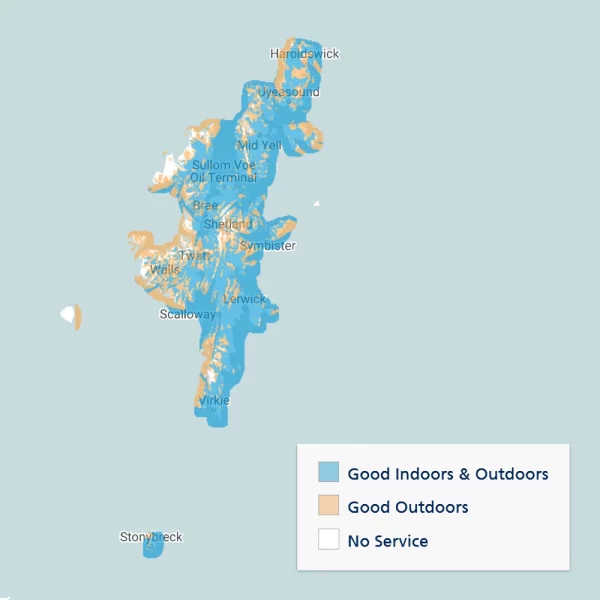
Mobile operator O2 (Virgin Media) has today highlighted the deployment of a new mobile mast to boost 4G (mobile broadband) coverage on the remote rural Shetland island, which sits far away off the north coast of Scotland. Several more masts are due to follow under the £1bn Shared Rural Network (SRN) project.
Large swathes of the islands currently suffer from a patchy mobile signal on O2’s UK network. But the new mast, which has been built in the coastal settlement of Walls (Waas), represents the first of several planned upgrades to improve local 4G coverage. VMO2 currently plan to either build or upgrade a “total of six masts” in Shetland “over the next few months“, although they haven’t named the other sites (we’ve put in a query).
The work is being done as part of the industry-led SRN – supported by £500m of public funding and £532m from operators. The project involves both the reciprocal sharing of existing UK masts in certain areas and the demand-led building and sharing of new masts in others between the operators (MNO).
Advertisement
The SRN aims to extend geographic 4G coverage (aggregate) to 95% of the UK by the end of 2025. But this target is only when the service is available from at least one operator, while the UK coverage forecast for SRN completion for all operators is actually just 84% for the same date (i.e. geographic areas where you’ll be able to take 4G from all providers).
Paul Kells, VMO2’s Director of Network, Strategy and Engineering, said:
“Our Shared Rural Network rollout is making a real, tangible difference to people’s lives. We’re continuing to play our part in bringing reliable 4G coverage to more rural locations across Britain and helping to bridge the digital divide between rural and urban communities.
Rural Scotland is one of the places benefitting most from our investment, with new and upgraded masts already significantly improving the region’s mobile coverage. We are committed to continuing this rollout and bringing reliable mobile connectivity to more rural areas throughout 2024 and beyond.”
The news comes as O2, Vodafone and Three UK are facing criticism from politicians and the media for allegedly falling significantly behind on their commitment to complete SRN upgrades in partial not-spot areas (first SRN phase) by June 2024 (here). By comparison, EE (BT) has been able to boast about achieving the target six months ahead of schedule (here).
The issue is due to be debated this afternoon in Parliament, and it will be followed next month by a review from the National Audit Office (NAO). Ofcom are also expected to publish their own review of SRN progress sometime this year, which should provide a lot more information on how far behind the three operators really are and what they must do to correct that.






Mark is a professional technology writer, IT consultant and computer engineer from Dorset (England), he also founded ISPreview in 1999 and enjoys analysing the latest telecoms and broadband developments. Find me on X (Twitter), Mastodon, Facebook, BlueSky, Threads.net and Linkedin.











« Nintendo 3DS and Wii U Online Services to Shut in April 2024 UPDATE

















I’ve noticed some limited deployment of band 28 4G on O2 in central London. Do we know if these new masts will serve over band 28?
Who knows.
o2 is the worst network, worse than Three.
I see the usual “O2 is crap” comments are back. Boring.
There are only two networks that don’t work indoors. EE and Three.
The physical mast itself isn’t a particularly good indication of specific band support (they’re just a structure), especially band 28 (700MHz) that can be deployed from lots of different kit and sites. Quite what an operator chooses to use / deploy in each location will vary, depending on what they think is the best option.
three is the only network that works indoors for me (B28). Think you’ll find it’s just EE that’s the issue 🙂
o2 should focus on sorting out their totally rubbish coverage in cities in the UK as well.
You are lucky to get 20 Mb/s on 4G with O2, so I’m not sure how beneficial this is?!