Nexfibre Publish Q4 2025 UK Full Fibre Broadband Build Update – 2.6M Premises
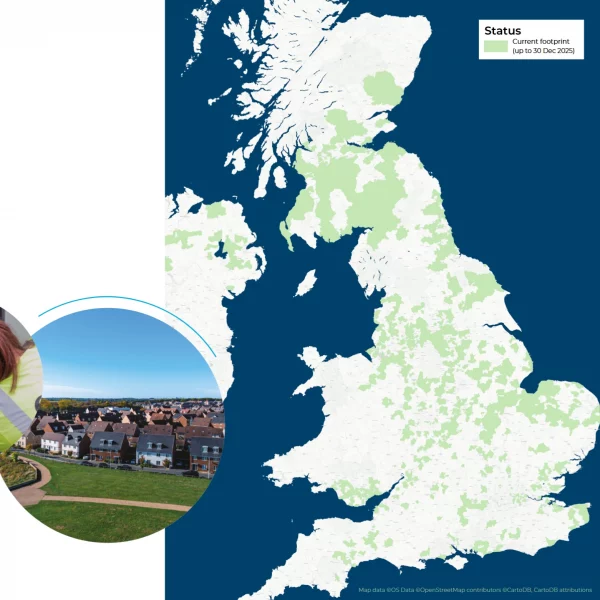
Network operator nexfibre, which shares some parentage with its UK ISP partners Virgin Media (O2) and giffgaff, has just published their latest quarterly Q4 2025 build update and confirmed that their new 10Gbps capable Fibre-to-the-Premises (FTTP) broadband network now covers 2.6 million UK premises. But future expansion looks set to come from consolidation.
Just to recap. Back in 2022 Telefónica, Liberty Global and InfraVia Capital Partners setup nexfibre as a new £4.5bn joint venture (here), which aimed to deploy an open access (wholesale) full fibre network to reach “up to” 7m UK homes (starting with 5m by 2026) in areas NOT served by Virgin Media’s own network of 16m+ premises. The funding reflects £3.3bn of fully underwritten financing and up to £1.4bn in equity commitments.
However, as existing readers will already know, nexfibre’s roll-out plan suffered a significant blow last year after Telefonica launched a Strategic Review of their global business (here and here). The decision has since resulted in nexfibre scaling back their planned roll-out, which in practical terms means there isn’t currently a solid build plan for going beyond the current level of coverage. But as the recent deal to acquire Netomnia’s network shows, the focus now seems to be on expanding coverage through consolidation (here).
Advertisement
The latest Q4 2025 build update from nexfibre reflects the aforementioned change and confirms that their full fibre network has now reached 2.6 million premises as ready for service (up from 2.44m in Q3). But as is clear from their latest roll-out update and map, there’s currently no significant new fibre build planned for 2026 (this may change once the deal with Netomnia is done and they can plan for future deployments).
Rajiv Datta, CEO of nexfibre, said:
“With our network now extending to c. 2.6 million premises, we’re proud to be among the UK’s leading alternative fibre providers.
As we look ahead, I’m delighted that our shareholders InfraVia, Liberty Global and Telefónica have announced an agreement to acquire Netomnia, with more than 3 million fibre premises and 460,000 customers.
The combination of nexfibre, Netomnia and more than 2 million Virgin Media O2 premises, which will be upgraded by nexfibre, will create a scaled, financially secure challenger to BT Openreach, with a full fibre footprint of around 8 million premises by the end of 2027.
When combined with the growing fibre footprint of Virgin Media O2, our two networks will collectively reach 20 million premises, giving ISPs a highly attractive wholesale alternative, and enabling faster access to fibre for millions of homes and businesses across the UK.
I look forward to working with the Netomnia team over the coming months.”






Mark is a professional technology writer, IT consultant and computer engineer from Dorset (England), he also founded ISPreview in 1999 and enjoys analysing the latest telecoms and broadband developments. Find me on X (Twitter), Mastodon, Facebook, BlueSky, Threads.net and Linkedin.











« Virgin Media O2 Satellite Service Goes Live with 4G Mobile from Space
















Zzoomm could be a good target for Nexfibre. Very little overbuild and in a lot of cases butting up to edge of existing VMO2/Nexfibre areas.
Probably not then, they like to go for those that have lots of overbuild
Yes. As from Netomnia deal, they are only interested in competition that is overlapping their areas. Buying it to effectively wipe out competition, and to prevent CityFibre being able to advance.
Time for Ofcom/CMA to enforce proper wholesale access on VMO2/Nexfibre infrastructure and the fttp upgraded areas that were once HFC (coax).
@James, I think he is trying to get something out of me.
I am not bothered, I will stay as I am and if anything changes, then I will decide at the time.
Looking at that map something feels off, I may have misunderstood the article.
However if you look at the South Lanarkshire area on the map above its showing as green but I am not aware of NexFibre being in this area at all. While South Lanarkshire is quite expansive even if I look at my home town and various other areas next to it, I know this is VM areas served by HFC.
Again I could have misinterpreted the article but I haven’t seen anything NexFibre related in these areas whatsoever.
Is it just me or does it get quite murky in terms of what’s built and what’s built near VMs network.
Apologies if I have missed something happy to be correct if I am wrong.
It’s the age-old problem with putting big county-sized blobs of colour to represent coverage in an area where you actually only have a much smaller reach.
Yes that map indicates parts if East Anglia that has no NexFibre, and in the South East, Dover is shown as Nexfibre when it is all HFC. Canterbury has a little Nexfibre, but the map shows a much larger area.
I can only conclude that Netomnia coverage is included already on the map, because those areas that have roads adjacent to Netomnia coverage will get uplifted by Nexfibre from HFC and not what was called Project Mustang a VM project to upgrade HFC to FTTP.
As a resident of South Lanarkshire, the only places I’m aware of with coverage of NexFibre is Strathaven and a really smart part of Stonehouse.
@aaron I didn’t not know that very interesting.
“When combined with the growing fibre footprint of Virgin Media O2, our two networks will collectively reach 20 million premises, giving ISPs a highly attractive wholesale alternative, and enabling faster access to fibre for millions of homes and businesses across the UK.”
‘Highly attractive’ if you’re owned by VM02 parents. VM Wholesale is an illusion.
Yep. If nexfibre wanted to be a true wholesale network, they would have done it already. nexfibre is just a way for Virgin to tell Ofcom they’ve built a wholesale network to alleviate competition concerns, while actually just hosting VMO2-owned ISPs.
Glad you’re both cynical: be a nice surprise for you when third parties are onboarded.
Virgin could have wholesaled their HFC network at any time since their merger in the 2000s and rebranding as Virgin Media. They chose not to. They created a walled garden where the modems and routers were merged together. To use your own router, you had to put the Virgin Hub into modem mode.
And if you think that’s a technical limitation of a coax cable, in their latest XGS-PON set-ups, the ONT and router is once again merged and the Hub 5x doesn’t even feature a modem mode.
Virgin Media are the Apple of ISPs. It’s a walled garden, and nobody else is allowed in.
@Retro: Virgin Media came into existence in February 2007 with a network inherited from multiple cable companies dating back to the 1980s. By that point, it wasn’t a single coherent access network, but a patchwork of around 17 different architectures. There were major regional variations: no street cabinets in Edinburgh because everything was in underground chambers; no green metal cabinets in Cambridge because they were plastic; and elsewhere, cabinets carrying both telephony and HFC. In some areas—including parts of the London Borough of Haringey—homes could receive cable TV but not broadband at all.
Given that starting point, the idea that Virgin Media “should have wholesaled years ago” doesn’t really stand up. It took the company more than 16 years and many millions of pounds simply to rationalise and upgrade this inherited mess to DOCSIS 3.1, a process only completed by the end of 2022. Even then, many cabinets, chambers, and ducts remained congested with layers of legacy cabling going back 30 years or more. Opening such a network to third-party ISPs would have meant exposing all that complexity—and cost—to wholesale customers, with little upside for Virgin Media and significant operational risk.
In other words, this wasn’t a neat national copper network like BT’s, but a deeply fragmented cable system that had never been designed for open access. Expecting Virgin Media to wholesale it earlier would have required massive upfront standardisation before a single wholesale product could realistically be sold.
Where wholesaling does now make sense is on new, standardised fibre infrastructure. In 2024, Virgin Media O2 attempted to formalise this via a standalone NetCo, which was later abandoned in July 2025. Instead, VMO2 launched Fixed Wholesale in September 2025 — an in-house unit focused on selling access to VMO2’s FTTP footprint and the fibre network built by nexfibre.
Virgin Media is the anchor tenant on nexfibre, and giffgaff has already begun offering full-fibre broadband over that network. The recent £2 billion acquisition of Netomnia by nexfibre (Feb 2026) further proves the strategy: VMO2 is now effectively bypassing its own “messy” legacy by acquiring and building a clean, IP-based, XGS-PON network designed from the outset to support wholesale.
The real story isn’t that Virgin Media refused to wholesale for years; it’s that wholesale only becomes viable once the underlying network is fit for it. On HFC, it never really was. On fibre, it finally is.
@Retro – I was under the impression that you can connect a third party router to nexfibre X PON ONTs via SFP+? I could be wrong and please correct me if I am!
If someone needs more than the 5x can offer them, they are more than likely familiar with SFP+ as a standard and willing to work it
“The real story isn’t that Virgin Media refused to wholesale for years; it’s that wholesale only becomes viable once the underlying network is fit for it. On HFC, it never really was. On fibre, it finally is.”
You say that Roger. But, of course, they are barely able to “wholesale” to another company in the same group. Look at the mess preventing switches between the two ISPs on the exact same network. They’ve had a long time to make this happen (if that were in fact the aim) and yet it still just doesn’t work. Is this just another team of chokers you’ve decided to support? ;0)
There was wholesale on the ntl cable network in 2003, Roger.
@Roger_Gooner
But GiffGaff basically is Virgin Media/O2, they own it, just a budget brand name.
This is what I’m talking about. Switching between two ISPs owned by the same company on the so-called “wholesale” nexfibre doesn’t even work. We’ll probably be looking at a situation where people switching to and from YouFibre when it eventually joins the network probably won’t be functional either.
VM02 have had years to make wholesale happen on both HFC, Mustang and nexfibre. They’re not interested.
based on the thinkbroadband article (https://www.thinkbroadband.com/news/what-would-the-next-bold-move-by-nexfibre-look-like-acquiring-cityfibre) Fibrus would be a good focus for takeover as the deployment is still missing from the map in West Cumbria. It was previously down to get Nexfibre but there is now no sign of this. Would be nice to have a symmetrical provider in the county as only Grain and B4rn are the only networks that do this. Fibrus want £240 a month (at last checking) so smacks of we don’t really want to supply this, everything else is Asymmetrical.
They still haven’t integrated any of the former UPP towns into their list
Am I reading it wrong or did Rajiv put 2 and 8 together to make 20?
I think there may be an element of accounting for future build plans too. Netomnia has not stopped its roll-out until the deal is done and their plan currently envisages reaching 5m by the end of 2027, which may be adopted into the nexfibre strategy – albeit perhaps targeting some different areas than previously planned post-merger.
2.6 + 3.4 + 2 = 8
For VMO2 excluding Nexfibre:
16.7 (current) – 2.4 (overlap with Netomnia) – 2.1 (adjacent to Netomnia) = 12.2m
In round numbers 8m Nexfibre + 12m VMO2 looks about right, before any future build or acquisitions.
@CJ Yes including VMO2s existing copper network but we are talking about FTTP only.