MedUX Study Finds UK 4G and 5G Mobile Connections Lagging Behind Europe

Network benchmarking firm MedUX has this morning published the results from a new pan-European study that examined the real-world Quality of Experience (QoE) of mobile connectivity (4G, 5G etc.) across the continent, which unfortunately finds that Great Britain (GB) is lagging near the bottom of most tables.
The new report – ‘Unveiling #1 QoE Countries in Europe‘ – is based on crowdsourced data gathered from over 180 million performance tests and 39 billion radio samples in over 33 European countries. But it’s worth remembering that there can be caveats with this sort of data, although such caveats are shared by all of those countries involved.
For example, mobile data performance remains tricky to pin down because end-users are always moving through different areas (indoor, outdoor etc.), using different devices with different capabilities and the surrounding environment is ever changeable (weather, trees, buildings etc.). Not to mention any differences in backhaul capacity at different cell sites or differing spectrum use between operators and masts etc.
Advertisement
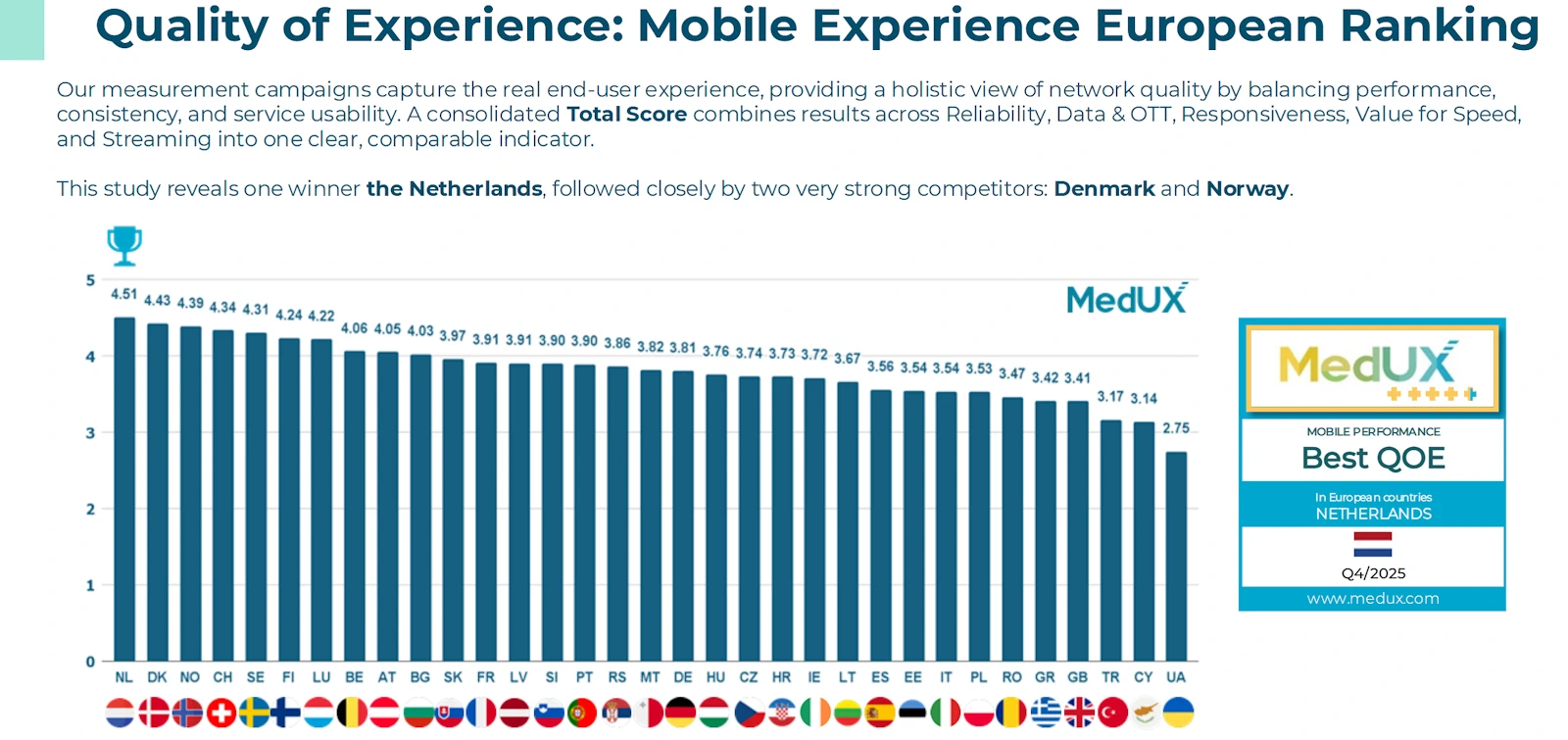
The research reveals that the Netherlands leads the region for overall QoE, a measure of user satisfaction, scoring 4.51 out of 5. Denmark and Norway follow closely behind as strong competitors, with Switzerland completing the top tier of European mobile network performance.
Sadly, Great Britain continues to lag behind most of the other countries and tends to appear within the bottom quarter of all the scoring categories. For example, we place fourth from the bottom in MedUX’s overall QoE table, scoring just 3.41, which compares poorly with the Netherlands in top place with 4.51.
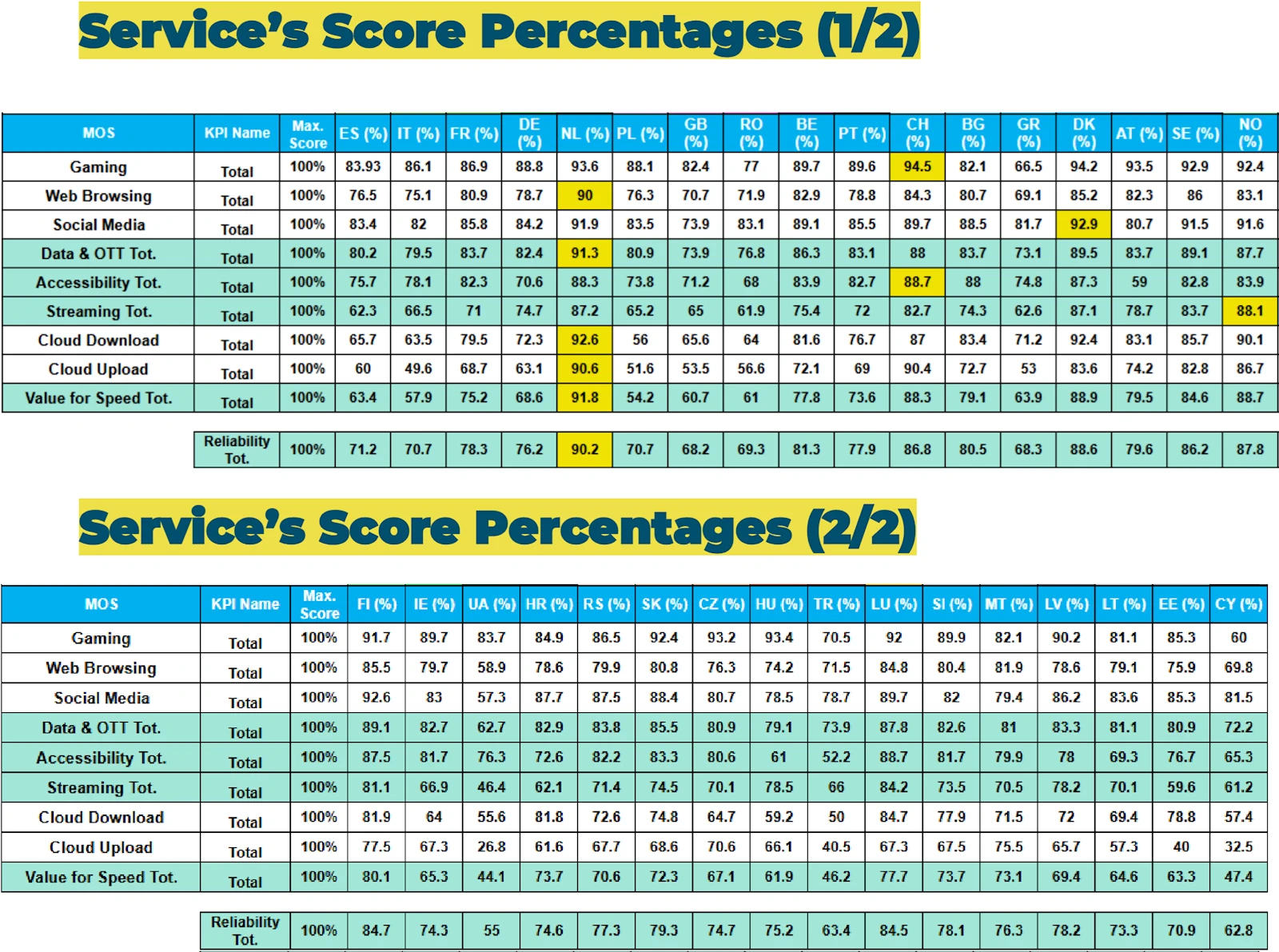
You can get a better idea of where Great Britain places by looking at the total reliability (% out of 100) scores for each of the main performance categories by country.
Advertisement
The UK’s poor situation tends to reflect a combination of issues, such as the previous government’s U-turn to ban Huawei, which caused a significant and costly delay to network deployments – particularly 5G. Mobile operators have also faced restrictions when it comes to upgrading existing masts to 5G and deploying new ones, although recent rule changes may soon start to improve the planning process a bit.
Speaking of the government, both the past and present governments have had a tendency to set some rather easy coverage targets for the latest services, which is because they mostly end up relying on commercial investment to do the job.
For example, the current government retains an ambition “for all populated areas” to have access to the latest 5G Standalone (5G+) based mobile broadband technology by 2030, although this sort of language is potentially open to interpretation and not as effective as a clear geographic target for coverage.
Advertisement
Ofcom recently reported (here) that 5GSA (5G+) networks are now available to 83% of areas outside of premises in the UK, falling to 47%-65% when looking at it as a range across different mobile operators. On top of that, the regulator itself could have also been faster to release more 5G friendly radio spectrum in order to boost capacity and coverage (e.g. we only just got around to releasing the 26GHz and 40GHz bands a few months ago).
At the end of the day, we’ve clearly got some work to do in order to improve mobile network coverage and performance.






Mark is a professional technology writer, IT consultant and computer engineer from Dorset (England), he also founded ISPreview in 1999 and enjoys analysing the latest telecoms and broadband developments. Find me on X (Twitter), Mastodon, Facebook, BlueSky, Threads.net and Linkedin.



























Not surprised – especially in rural areas. Every time my ‘service’ provider makes an ‘improvement’ for one area adjoining areas take a hit and loose coverage. Certainly seems to be he shouts loudest or pays the most gets the best service.
As the available spectrum is limited is a case of to many companies in the name of competition actually causing the poor service problems?
Of course they do. Anyone who has travelled to continental Europe discovered that a long time ago. With O2 in the UK, I can barely get more than 60 Mbps on 5G. I can’t listen to internet radio while travelling because the coverage is patchy. Abroad, I get 200+ Mbps on 4G+, and I can listen to internet radio while travelling through multiple countries. The only interruption is when I’m crossing borders.
And it took a study to tell the British public what we had already worked out years ago. The idiots who run these networks are only in it for what they can get out of it, service and support comes at the very bottom of there list of priorities – assuming they appear on the list at all.
As for service abroad – West coast Malaysia Sept 1st 2023 I had personal experience of 4G LTE returning 568.63Mb d/l and 27.3Mb u/l using Speedtest.net via the DIGI network, so what exactly are these highly paid executives playing at with there expensive pathetic tariffs that do not deliver to the UK.
I found this a considerably more useful analysis than the usual rubbish from Rootmetrics telling us only that EE are the least bad of a very bad bunch but that’s largely speed and stability in town centres related that Rootmetrics track rather than lack of any coverage at all in many rural areas, especially in the busier summer months. that Rootmetrics don’t seem to track at all perhaps because it wouldn’t serve the interests of their friends at EE.
Also how are Three and Vodafone getting away with making out they have already largely integrated their core networks when any attempts to manually roam from Vodafone to Three or viva versa clearly shows this is not the case with all such requests still refuse on my Talk mobile SIM card.
The biggest villain are Ofcom who’s overpaid executives are simply not forcing the mobile companies to spend their considerable profits on installing more mobile network hardware
The Quality of our Mobile networks in the UK, with a Bottom of the rankings listing, doesn’t come a a surprise to many. Our FTTP penetration, is also languishing in the dolldrums. Despite, Boosterish reports, from suspect sources that claim ridiculous levels of real National FTTP coverage. The UK government, it’s policy and UK Telcos have not served us well. It’s time they were given a rocket up the nether regions…