Ookla Examine Impact of Peak Time UK and EU Mobile Network Congestion

Global telecoms network benchmarking firm Ookla, which collects data from consumers via their Speedtest.net service (inc. apps), has published a new report that examines the performance drop of mobile (4G / 5G / mobile broadband) networks during peak times (19:00 and 21:00 local time) across the EU, UK, Norway and Switzerland during Q1 2026.
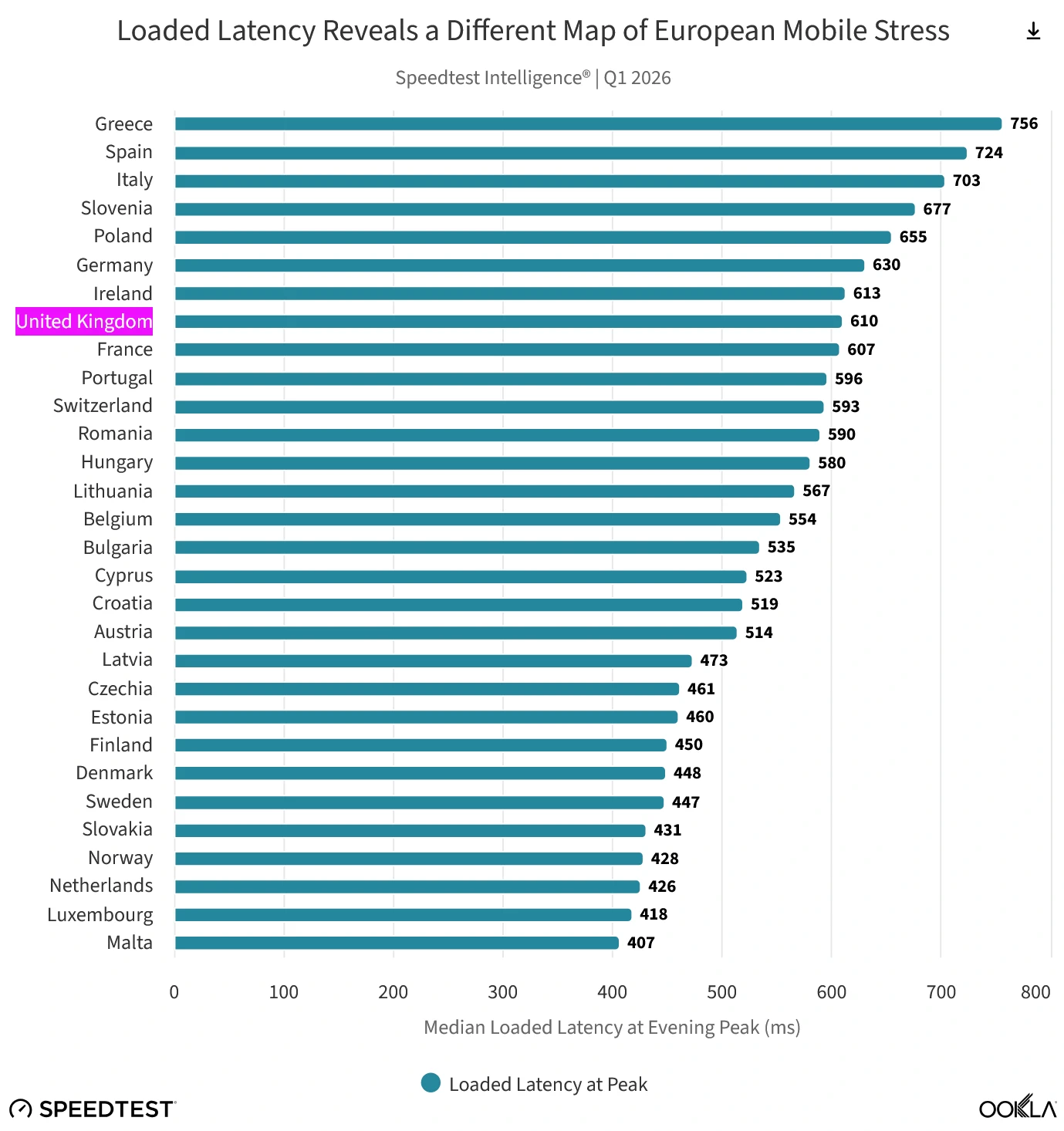
The study, which also identified that the period of lowest network usage occurred between 02:00 to 05:00 local time, found that Spain is Europe’s “most congested mobile market at evening peak“. During this period Spain’s median download speed fell from 161.20Mbps off-peak to 54.10Mbps during peak hours, a 66% drop, while “loaded latency” increased 60% to 724ms (milliseconds).
However, such an experience is not universal, with several countries (Luxembourg, Belgium, Norway, Slovakia, France, and the Netherlands) all being able to deliver “near-flat daily performance” regardless of whether it was a peak or off-peak period.
Advertisement
The use of modern 5G mobile networks perhaps unsurprisingly delivers a better experience when under load, but it does not remove congestion. Across ten high-5G European markets, the average speed drop at peak is 32% for 4G and 27% for 5G. But the more consistent 5G advantage is latency: 5G loaded latency at peak is 12% to 44% lower than 4G in every market tested.

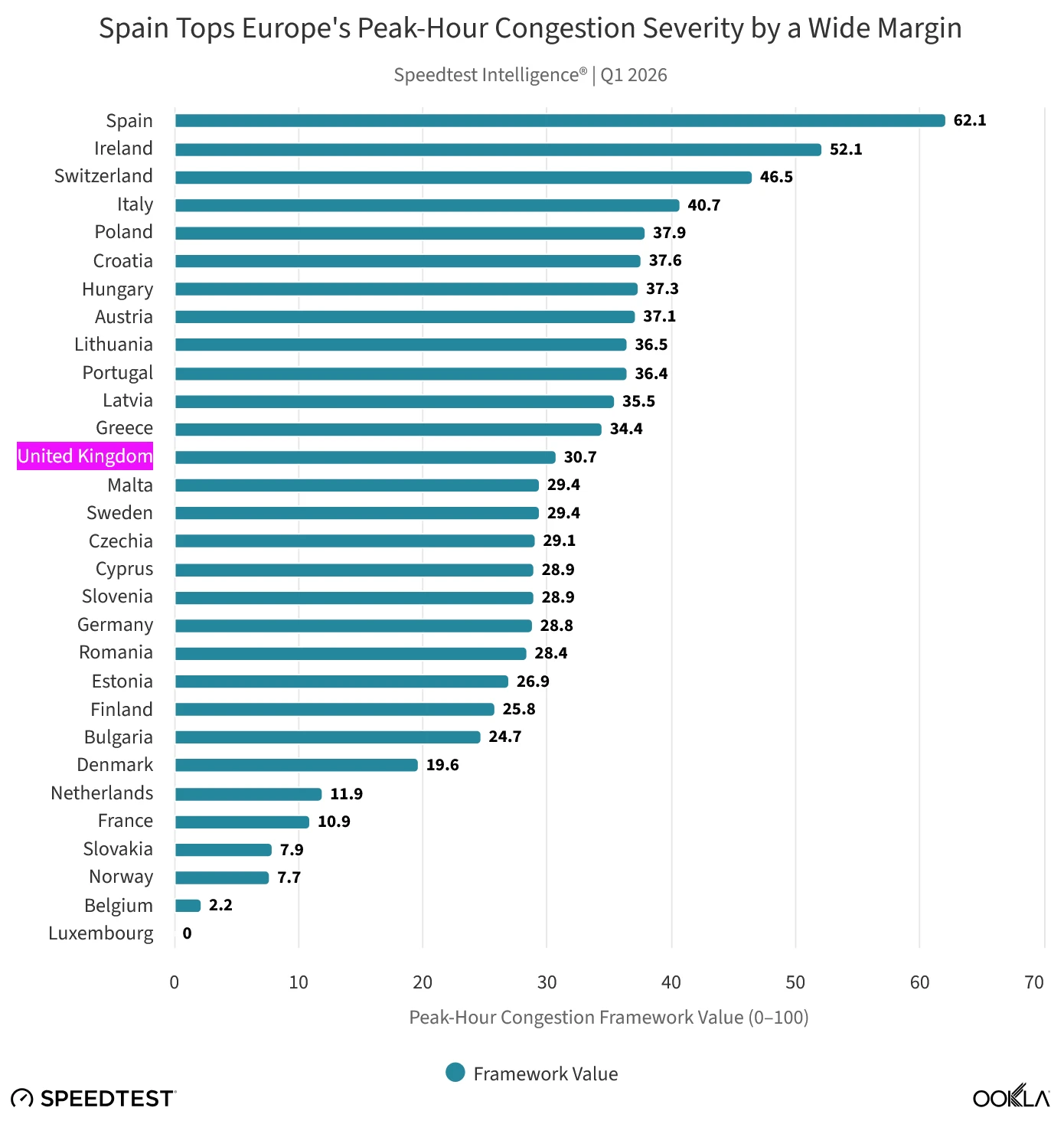
The full report goes into a lot more detail, although there aren’t too many UK specific figures for us to include, but we have pasted a few in the images below. In order to display this Ookla developed a peak-hour congestion framework that combined five dimensions of degradation: median download speed loss, loaded latency inflation, queue growth, jitter increase, and the decline in 10th percentile download speeds.
In short, the higher the value on the 0 to 100 scale of their congestion framework, the more severe the measured peak-hour degradation. For example, Spain’s score as the most congested mobile network was 62.1, while the least congested was Luxembourg on 0, and the UK scored mid-table with 30.7. In an ideal world we’d also be able to see how individual UK mobile operators like EE, Vodafone & Three UK, and O2 perform, but sadly that’s not in this study.
Advertisement
Credits to The Wee Bear for spotting this report on a bank holiday Monday :).






Mark is a professional technology writer, IT consultant and computer engineer from Dorset (England), he also founded ISPreview in 1999 and enjoys analysing the latest telecoms and broadband developments. Find me on X (Twitter), Mastodon, Facebook, BlueSky, Threads.net and Linkedin.











« Lyca Mobile UK Finally Gets Around to Putting Wi-Fi Calling Live
















Comments are closed