Ofcom Change Openreach’s UK Full Fibre Threshold for Copper Retirement UPDATE
The UK telecoms regulator, Ofcom, has today decided to change the threshold at which Openreach (BT) can begin to alter the wholesale prices of copper connections once full fibre (FTTP) broadband lines have become available. In short, the operator will now reach this stage in exchange areas where ultrafast broadband (300Mbps+) is available to 90% of premises, rather than 100%.
The current approach to copper line retirement (i.e. the removal of copper lines/services in favour of fibre optic lines), which has been largely retained by Ofcom for the 2026 to 2031 period as part of their recent Telecoms Access Review 2026 (TAR), is based around two key thresholds. The thresholds reflect the point at which Openreach can stop selling new copper lines and the point at which Ofcom’s price controls are removed from copper-based services.
The Two Copper Retirement Thresholds (Current)
• First Threshold:
Openreach can stop selling new copper lines once it has reached 75% FTTP coverage in an exchange area and has provided 12 months’ notice of its intention to stop selling copper.• Second Threshold:
Openreach is no longer subject to price controls on copper services once (a) it has reached 100% coverage in an exchange area; (b) 24 months have passed since stop sell was introduced; and (c) Openreach has provided 12 months’ notice of its intention to raise prices above the charge controls.
However, Ofcom and a number of alternative broadband networks (altnets) recently clashed after the regulator first proposed to change this (here), with Ofcom desiring to tweak the second threshold by setting a fixed percentage approach to excluding premises; this would be set at 10% of premises in an exchange area (i.e. Openreach would only need to reach 90% coverage, rather than 100%) and would apply from 1st April 2029.
Advertisement
The change is designed to reflect the reality that, in some exchange areas, it may be practically impossible to reach a 100% FTTP build due to a very small number of exceptional premises (e.g. apartment blocks that refuse access, difficulties obtaining wayleaves for certain locations, premises like certain farms that may exist too far away from the road, areas already covered by rival full fibre networks etc.).
The conflict occurred because most altnets and ISPs preferred a different Defined Exclusions Approach (DEA) to the aforementioned Fixed Percentage Approach (FPA). The DEA would define the specific circumstances under which premises could be excluded when assessing whether the second threshold is met (e.g. excluded premises might be those Openreach couldn’t reach or couldn’t afford to reach and those covered by rival networks).
The altnets were largely concerned that taking the FPA approach could place them at a disadvantage, as they may not be ready to compete for copper customers at the point of pricing deregulation, while the DEA method was perceived as reducing the risks to altnets’ ability to win migrating customers. A few other operators also argued that certain premises served by altnets should be treated as exclusions, so as to avoid incentivising Openreach to overbuild their networks.
Ofcom actually agreed that DEA was more “attractive in theory“, but they feared implementation would result in “practical difficulties” due to its complexities and hence appeared to prefer the FPA method for simplicity. In the end the regulator appears to have maintained their FPA proposal. We should point out that Openreach also favoured DEA, so this isn’t the usual altnets vs Openreach situation.
Advertisement
Ofcom’s Decision
A fixed percentage approach to excluding premises, set at 10% of premises in an exchange area.
We have decided to allow Openreach to exclude a fixed percentage of premises from the second threshold coverage requirement, and to set that fixed percentage at 10% of premises in an exchange area. This means that, subject to all other criteria for the second threshold also being met, Openreach would be able to reach the coverage requirement of the second threshold when it reaches 90% ultrafast coverage in an exchange area.
Introduce a date from which these exclusions can be applied.
We have decided that these exclusions can be applied from 1 April 2029 onwards. Prior to this date, Openreach would be unable to exclude premises from the 100% ultrafast coverage required to meet the second threshold.
All of this is necessary because trying to maintain both copper and fibre infrastructure at the same time would quickly become costly and inefficient for Openreach, particularly once most of their old copper line customers have been shifted to full fibre lines. “Retiring the copper network would free up resources that could instead be used to invest in network improvements or deliver lower prices over time,” said Ofcom’s statement. Not to mention the greater performance and service reliability of fibre infrastructure.
However, it should be noted that customers on the Openreach network will “always remain protected” by a charge control. If full fibre is not available at a premises, the existing cap on the price of a copper-based service will remain in place. If the copper price cap is lifted, a charge control will apply to full-fibre connections.
“We expect broadband providers to support customers in finding a new deal for a better service. Evidence shows that people can switch to a full-fibre service and pay the same, or less, than they do for a connection that uses copper“, said Ofcom.
The regulator currently plans to “consider the conditions for further deregulation of copper services” before their next market review period (2031-36). “Our current thinking is that full deregulation of copper-based services could start to take effect from 2031,” concluded the regulator. As we’ve said before, completely removing copper lines and services is going to be a slow multi-year process.
Advertisement
UPDATE 11th Sept 2026 @ 2:57pm
We’ve had a comment from Openreach.
James Tickel, Director of Regulatory Policy & Strategy at Openreach, said:
“It’s a small step in the right direction, but we think Ofcom’s been more cautious than necessary. The framework still relies on exchange level thresholds, which are increasingly irrelevant and risk slowing migration where full fibre’s already available. We’d like to see a faster path that protects customers while helping the UK upgrade from copper to fibre more quickly.
We’re encouraged by Ofcom’s plans to look at further copper deregulation ahead of the next market review. Greater clarity would help create the investment certainty needed to support upgrades and make sure more customers can benefit from faster, more reliable connectivity sooner.”






Mark is a professional technology writer, IT consultant and computer engineer from Dorset (England), he also founded ISPreview in 1999 and enjoys analysing the latest telecoms and broadband developments. Find me on X (Twitter), Mastodon, Facebook, BlueSky, Threads.net and Linkedin.










« Lodestar Networks calls on Ofcom to help fix UK community mobile networks
Advertisement
Leave a Reply
Privacy Notice: Please note that news comments are anonymous, which means that we do NOT require you to enter any real personal details to post a message and display names can be almost anything you like (provided they do not contain offensive language or impersonate a real person's legal name). By clicking to submit a post you agree to storing your entries for comment content, display name, IP and email in our database, for as long as the post remains live.
Only the submitted name and comment will be displayed in public, while the rest will be kept private (we will never share this outside of ISPreview, regardless of whether the data is real or fake). This comment system uses submitted IP, email and website address data to spot abuse and spammers. All data is transferred via an encrypted (https secure) session.















ofcom are always useless and unfit for purpose!
Seems perfectly reasonable to me.
Which part of this proposal do you have concerns about?
Does this mean OR are allowed to increase the price of copper for everyone on the exchange, including the 10% they don’t want to run FTTP to?
If that’s the case, it hardly seems fair that they are penalised for OR’s failings.
It’s covered in the article that people who cannot get FTTP will retain the price cap on copper.
This is to nudge people who insist on staying on a copper-based service where FTTP is available for reasons of their own preferences.
So now Openreach don’t have an incentive to get everyone onto FTTP, they can simply ignore installs with a higher cost while being allowed to charge more for the same copper service.
Needs to be 100% and then only those who refuse to move to FTTP get punished with the higher cost.
Openreach are not a charity or a goverment owned company and operate in a competitive market. Why should they be incentivised by Ofcom to build FTTP to 100% of premises? That is what project Gigabit is for.
You didn’t read the article did you. Read it again. Third paragraph from the bottom.
Be simpler to do what Telus in Vancouver, Canada did – once fibre was installed give everyone 5 years grace to switch over and if you didn’t you got cut off end of. That seems to be the prevailing attitude around the world.
Perhaps some customers like the retro experience of copper broadband – snr issues, disconnects and don’t want the synthetic perfect offering of fibre all the way, so they hang on there 😉
I suspect some customers don’t want aggro of an FTTP install, like drilling holes into bricks or stone work just to alledgedly secure a ladder whilst they bind the fibre to the roof fixture. Filler stuffed into the holes after, isn’t going to go down well with someone who has stones/flint or bricks being drilled into. Even if you offer to hold the ladder on stable flat ground, they say they have to take photos to prove the engineer secured the ladder. Some engineers are more flexible, granted.
A friend has recently made me aware of a relevant edge case that affects this.
Residential properties that do not have mains power supply. (Solar, even with batteries, isn’t always a viable substitute, neither are diesel generators.)
There are more of these than you might think, often clustered in specific areas (more remote Welsh vallues for example), and many also have poor/non-existent 4G phone service.
This kind of property is not well suited to FTTP (even if close enough to a road to be served) or VoIP as these do need constant power to operate (and the standard battery backups can’t work around a 100% gap). The only straightforward and cost effective way to maintain voice telephone service is PDPL/(SOTAP Analogue) / EVAc, continuing to provide a remotely powered analogue connection.
How many such properties would be in a position where they can get an Openreach copper line but can’t (very key word – rather than won’t!) have mains power? I would expect the opposite where mains is available but not telecoms.
It isn’t Openreach’s job to maintain an aging, expensive copper network to satisfy someone’s desires. In an FTTC/FTTP area they generally won’t be able to get a PSTN service installed anyway due to the nationwide stop sell, and PDPL/EVAC are only available through migration of an existing PSTN line
There are apparently up to 2,000 of these in the UK. There are about 30.5 million residential properties in the UK overall so it’s less than 1 in 15,000.
Highly likely some if not most of that 2,000 don’t have fixed line telephone either. Both need cabling.
There are more advanced battery solutions – https://www.diy.com/departments/ezviz-ps600-portable-power-station/6941545617619_BQ.prd – that would give you 24 hours coverage as long as it could re-charge a couple of hours per day
The issue is about withdrawal of a previously existing service to such properties, in situations where the copper technology is specifically well suited and where alternatives are also thin on the ground or need a significant amount of always on wattage (for example Starlink base station is quite hungry, 4G-WiFi router a bit less so but still needs infrastructure).
Easier to run a thin low voltage low amperage phone cable for a mile or two than 60A domestic electrical connection for similar distance.
A technically viable alternative would be a 4G/5G micro-cell nearby; recent articles here highlight the usage in cities but a similar solution might work in rural installs if paired with a line of sight 4G/5G antenna equipment inside, or passive booster to allow a normal phone to be used, but that potentially is still more expensive for both parties than continuing a street cabinet based solution to provide a last mile of copper with -48V and analog to digital converter.
@ Matthew
In theory what you propose is a solution (connected to, say, a 800W plug in solar rig)
In practice, in winter, you could struggle to replenish the battery fully within the day, assuming you even had optimal panel placement on the property.
It’s then all down to the power draw of the in-home equipment to provide a “digital” voice connection as to how many poor weather days in a row would result in no phone at all until the next properly sunny day.
Also requires customer to invest £1000+ overall (panel plus battery) to transition to digital (on top of current phoine line subscriptions which will be similar), and that’s understandably not attractive for some, even if there is “betterment” of an internet data connection (which might only be just good enough for phone service anyway–i.e. 0.5mbs on the end of a long copper line, with likely no chance of a FTTP upgrade unless there was generous government funding or the customer spending many £thousands to fund an FTTP install.)
The better “governm
Correct me if I am wrong, but this is good for myself and others where FTTC is the only available option. Despite the fact we are already paying the cost of an equivalent 1Gbps package (yet we get 50Mbps), I am glad to see the price shouldn’t rise out of control, for now anyway.
What about places they just can’t be bothered to install in even though it is on a main road with a fibre exchange 3 miles max away and has a total of around 50houses all currently paying premiums for a shocking speed over copper with little to no cellular service either.
Open reach neglected the poles used to connect my property for over 20 years and have now condemned them so can’t use them to run fiver cables. My landlord refuses to allow a new pole on the property. So for reasons I cannot control, I will lose the price cap on copper connections?
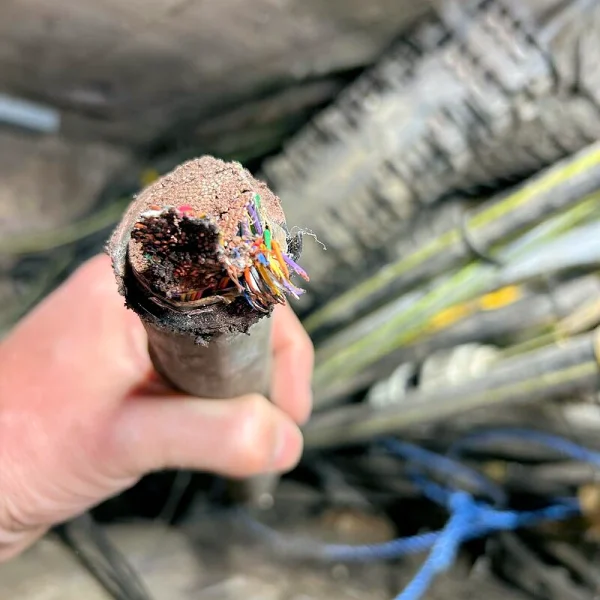
The image of the full fibre cable does rather look like a chocolate ice cream with hundreds and thousands after part has been eaten.
Whilst I agree with the ice-cream sentiment, that is most definitely not a ‘full fibre cable’ and is a bundle of copper pairs. You can see the copper colour on the cut ends.
BT and Openreach, in their current incarnation . . . my impression, from their recent behaviour, is that they are a bunch of monopolistic Cnuts – a now ex-customer of 41 years, who they forced off FTTC in April this year (I presume it was them and not someone manipulating their stupid stove-piped/siloed system). This may have occurred because they did want to bear the cost of extending fibre down my road where FTTC “Stop-sell” had already been declared. The timeline for my service. . Introduced Digital Voice in March 2025, silently declared FTTC stop-sell in September 2025, sent me a duff refurbished Smart Hub 2 in April 2026 which foobarred my connection and on-line account. Executive Complaints were unable and possibly unwilling to help and the appeal to the Ombudsman was just a BT echo service (Their wages are paid by the industry. Redress via ADR is made a mockery by them )
Now on 4G LTE, with speeds 3-5 times higher than their lowest fibre service and at a lower price.