Mayor of London reveals city’s weak spots via new map of mobile network cover

The Mayor of London, Sadiq Khan, has today published a new report and map to help show where 4G and 5G mobile (mobile broadband) networks are falling short. In addition, the mayor proposes ten “practical steps” via a new framework that boroughs can take to support improvements.
Despite plenty of progress being made to improve mobile coverage in recent years (e.g. 4G and 5G deployments across the London Underground), some Londoners still experience weak signals and slow or unreliable mobile data connections. Demand for mobile data continues to grow, and even where coverage is available, the report finds that busy networks can still “struggle to deliver the performance people need“.
The London Mobile Connectivity Evidence Report, developed with support from Ookla (RootMetrics), looks beyond traditional coverage measures to also assess mobile broadband download speed, upload speed, signal strength and latency — the time it takes a network to respond. This provides a more complete picture of Londoners’ experience of mobile services and helps identify where improvements are needed.
Advertisement
The supporting London Mobile Connectivity Map also helps residents to see the different levels of signal strength and mobile broadband performance for where they live, albeit again without enabling you to split the results by operator. In addition, it doesn’t extend down to street or premises level, which in a city is kind of important.
Key Findings
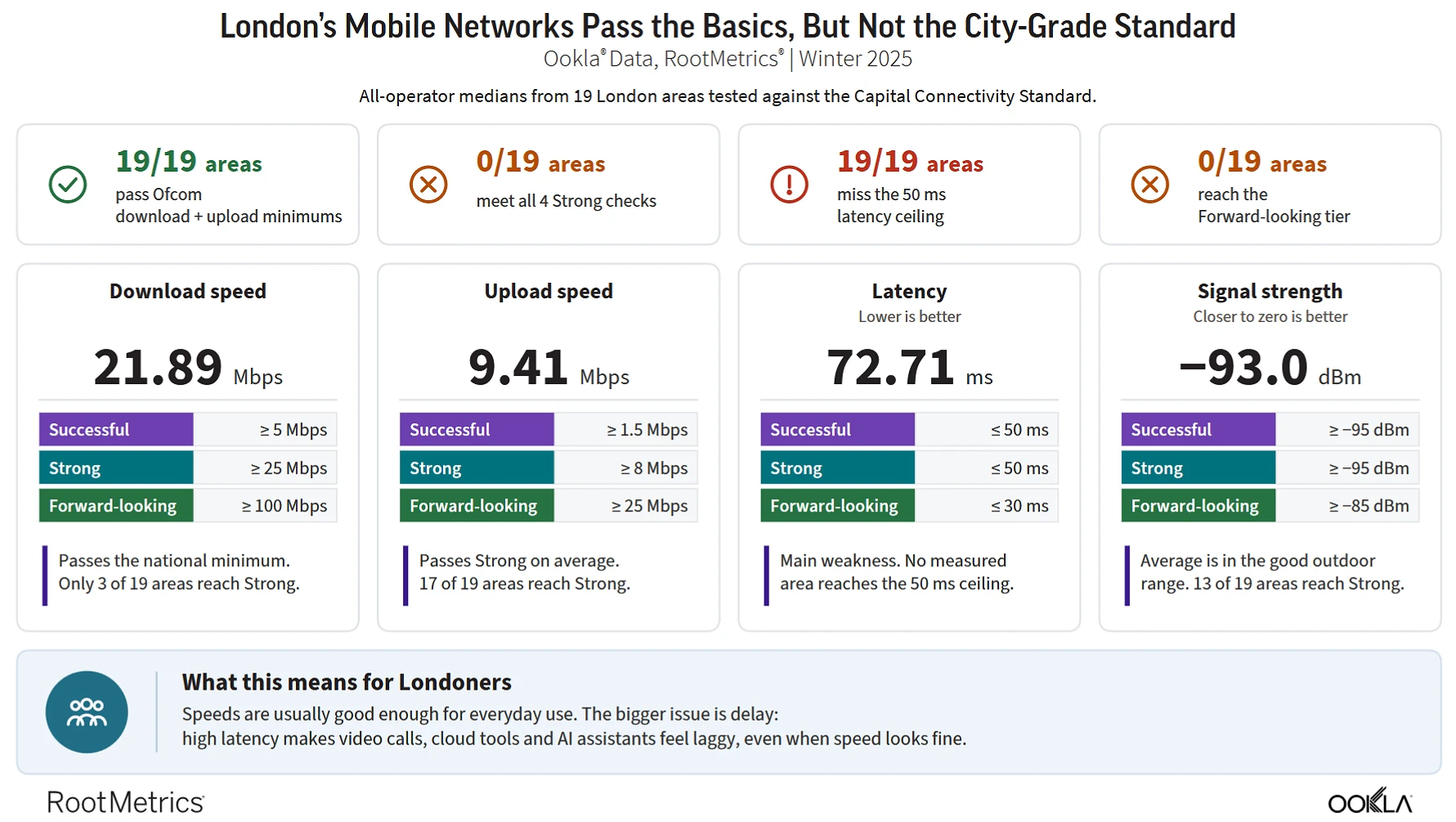
1. London passes Ofcom’s minimum standard on speed in every area we tested, but no area yet passes all four Strong checks. Fleet Street and Cheapside come closest, passing three of four (failing only on latency, where every area in London falls short). Twelve more areas pass two of four. Dalston, and Eversholt Street/Somers Town, fail all four. No area in London yet meets the Forward-looking tier.
2. Network response times (latency) are too high across the city. Latency is the time it takes for your phone to send data and get a response. It was above Ofcom’s 50-millisecond target in all 19 areas. Latency is what makes the difference between a smooth video call, a responsive online game or a natural conversation with an artificial intelligence assistant, and a frustrating, lagging experience. This is a London-wide issue, not a problem with any one network.
3. The quality of your mobile experience depends on which network you use and where you use it. No single network is best everywhere. In some areas one network performs strongly while another lags; a few miles away the picture can reverse. This report does not recommend any particular operator. It highlights that performance varies sharply by location, and that this variation is shaped by infrastructure decisions that the city, planning authorities and operators jointly influence.
4. There is a ‘doughnut hole’ of weak performance in inner north and east London. Most measured areas in Camden, Islington, Hackney and Tower Hamlets sit at or below the Strong signal threshold. By contrast, every area in the City of London, Kensington and Chelsea, Newham, Lambeth, and Hammersmith and Fulham passes (with Leadenhall Market sitting at the boundary). This pattern points to a concentrated cross-borough planning and infrastructure challenge.
5. 5G is widely available but unevenly deployed. Nearly 90 per cent of our tests detected 5G. Where 5G is available, speeds are 4 to 9 times faster than the older 4G technology. But areas such as Brick Lane, Dalston and Eversholt Street have weak or absent 5G coverage, and customers on networks with patchy 5G are systematically worse off in those locations.
Take note that mobile operators are commercial companies and thus responsible for investing in, building and running their own networks. The Mayor does not directly control their network coverage or investment decisions, but can help address barriers to improvements through planning policy, access to TfL assets and coordination between boroughs, landowners, developers and industry.
Speaking of which, the report also introduces the Capital Connectivity Standard, a new benchmark designed to assess whether mobile performance meets the needs of a busy global city. It builds on Ofcom’s existing ‘Successful’ baseline to provide a more demanding measure of connectivity and helps partners identify where further action is needed.
Advertisement

The Mayor of London, Sadiq Khan, said:
“Reliable mobile signal is essential to everyday life in London, whether you’re working, running a business or keeping in touch with family and friends. Although huge progress has been made, many Londoners still experience frustrating gaps in service.
This new evidence and map will help us understand where improvements are needed and work with boroughs and mobile operators to deliver better connectivity, building a fairer and more prosperous London for everyone.”
The new London Mobile Connectivity Framework that accompanies all this sets out ten practical actions boroughs can take to support improvements. These include appointing a dedicated mobile connectivity officer, identifying council-owned buildings and land that could host mobile network equipment, and ensuring plans for major developments consider mobile connectivity from the outset.
The 10 actions at a glance
Leadership
1. Appoint a mobile connectivity lead
2. Collaborate across teams
Planning, assets and infrastructure
3. Create an asset register
4. Review telecoms planning performance
5. Establish regular operator engagement
Planning and growth
6. Assess developments through a connectivity lens
7. Streamline access to rooftop assets
8. Review infrastructure at risk of displacement
9. Include connectivity in growth and regeneration programmes
Monitoring and improvement
10. Report on performance annually
The catch is that this is all advisory and turning such things into tangible practical improvements is rarely an easy task. For example, both O2 and Vodafone have recently been complaining about bad “planning measures“ in the city, such as those that force them to take 4G and 5G network sites offline (masts and other cell sites) – at the request of property owners – without first ensuring an appropriate replacement location (here and here).
However, the flip side of this is that mobile operators can hardly expect to hold much sway over major property developments, particularly when they’re often paying only relatively small rental sums to the landowners. Mobile infrastructure isn’t installed in a vacuum and planning authorities also have to consider public opinion, visual impact, safety and other factors etc. Not to mention the arguably bigger challenge of delays caused by under-resourced planning departments.
Advertisement
So while a lot of the Mayor’s proposed actions are positive, actually changing the core aspects of the planning system that they involve frequently ends up being fraught with difficulty. As usual there are no coverage targets being set here or new public funding being proposed, although identifying what sort of performance Londoners should expect from their mobile operator is a good start.






Mark is a professional technology writer, IT consultant and computer engineer from Dorset (England), he also founded ISPreview in 1999 and enjoys analysing the latest telecoms and broadband developments. Find me on X (Twitter), Mastodon, Facebook, BlueSky, Threads.net and Linkedin.













« Vodafone launch Express Capacity to speed up provision of 100G or 400G links
Advertisement
Leave a Reply
Privacy Notice: Please note that news comments are anonymous, which means that we do NOT require you to enter any real personal details to post a message and display names can be almost anything you like (provided they do not contain offensive language or impersonate a real person's legal name). By clicking to submit a post you agree to storing your entries for comment content, display name, IP and email in our database, for as long as the post remains live.
Only the submitted name and comment will be displayed in public, while the rest will be kept private (we will never share this outside of ISPreview, regardless of whether the data is real or fake). This comment system uses submitted IP, email and website address data to spot abuse and spammers. All data is transferred via an encrypted (https secure) session.
















Regarding mast planning matters, I wonder if the Mayor has the legal powers to set up a Greater London wide “Digital Connectivity Development Corporation” to override local borough planning departments and local plans, to enable swifter mobile equipment installation/relocation and also faciliate “ground level” Fibre rollouts (where these currently have a planning impact).
The Mayor has recently set up a development corporation to force through his vision of pedestrianisation for Oxford Street (subject to some controversy and dissent, extinguishing City of Westminster plans), to the legal framework exists to an extent, unclear if it could be used in a London wide way for a specific category of development without impacting general development.
Perhaps the Mayor should get his own house in order first.
TfL’s rollout of 4g/5g across London is now two years late on the original timeline. With around half of the network still to be covered, TfL continues to say it will be complete by year end. There is no chance they will complete the work in the next 10 weeks – and that’s with infrastructure where they need no planning permissions and have complete operational control over what happens and when.
Conversely the MNOs have to battle a ridiculous planning framework, NIMBYs, council planners that suggest they could locate planned masts a few miles away etc etc.
My proposal that Mayor could take over mobile network planning matters in Greater London (if possibble) would be a relatively quick win (months), being largely administrative and a one off change to address planning delays. Publish a framework of what is and is not acceptable for installations, and then hand off the local paperwork back to councils, such that if the request complies to the framework it gets rubber stamped by officers and doesn’t go to consultation or committee, and minimal oversight at building control/safety level. Permitted development rights/tree preservation order level of engagement.
The TfL problem is not so much that it is taking longer than planned for 3rd party contractors to deliver the work (working near transport infrastructure has many challenges and limitations that impede work), but that the delivery dates are not being reported honestly, and roots causes of delay are not transparent and therefore more difficult to address with changes to process to avoid future delays of the same typoe