Housing Developer Hampers Ferndown Homes from Getting Gigabit Broadband
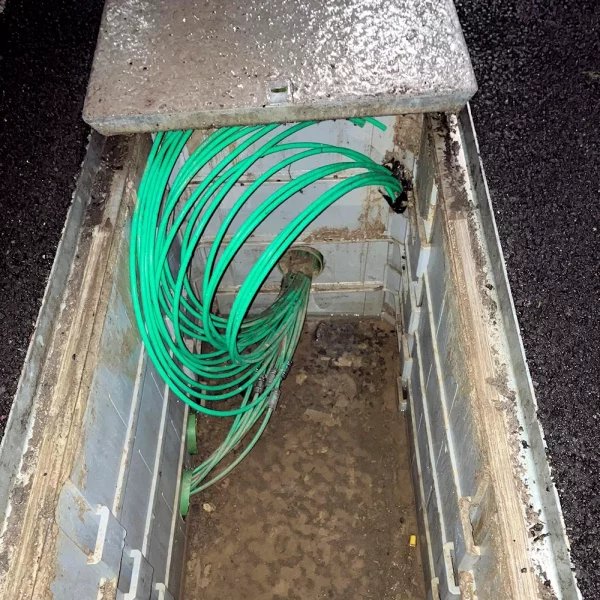
A small group of homes in the East Dorset (England) town of Ferndown have effectively been denied access to a new gigabit broadband network because a local housing association, which owns a crucial piece of land, are only willing to grant Virgin Media’s (nexfibre) engineers a wayleave (legal access agreement) for an individual property; not the wider area.
The issue centres on homes roughly within and around the BH22 8UT postcode area of Ferndown, which is presently surrounded by gigabit-capable broadband networks from nexfibre and Trooli. Network access provider Openreach (BT) has also been building FTTP nearby, but has yet to enter the same poorly served area. Homes in this are thus remain stuck on slow hybrid-fibre FTTC / SOGEA broadband lines.
Back in 2021 the area in question was originally supposed to gain access to a Fibre-to-the-Premises (FTTP) network as part of Giganet’s deployment. But the local roll-out appeared to grind to a halt in 2022 and then got shelved after Fern Trading consolidated three of their altnets, including Giganet, into AllPointsFibre (APFN). Trooli also initially appeared inclined to enter the area, but they too ultimately backed away.
Advertisement
More recently, in 2024, nexfibre (Virgin Media) are understood to have installed their cable ducts down some of the nearby streets, but oddly only some houses were able to order the new service and others could not. A spokesperson for Virgin Media (O2) later confirmed to ISPreview that this was because they were “in the process of obtaining the necessary wayleave from the landowner.”
The front of some of the affected houses is on a green that appears to be owned by Aster Housing, while the back of those properties goes straight onto the public road where nexfibre have dug on the opposite side (Medway Road). A few weeks passed before ISPreview learnt that Aster Housing had denied the wayleave request, which we understood had seen nexfibre/VMO2 seek permission to install to all houses within the postcode (17).
Andy, Resident of Ferndown, told ISPreview:
“[Aster Housing] would only consider granting a way-leave for an individual property. With this in mind, it seems that VMO2 are going to withdraw their way-leave applications in the area. Again, this seems to be a case of the landlord / landowner preventing the rollout of full fibre.”
The difficulty for VMO2/nexfibre in this case is that it wouldn’t make much commercial sense for them to go through all the extra civil engineering involved just to connect a single property, which would at the same time also leave other nearby houses to be excluded. At this point Andy, acting on ISPreview’s advice, involved his local MP (Sir Christopher Chope) in an effort to uncover why Aster had taken this approach.
Feedback from a communication between the MP and Aster Housing appears to indicate that the housing association had declined VMO2’s wayleave because they only operate closed networks, which they indicated would offer locals little or no choice of provider (Aster appears to say that this would effectively have limited locals to Virgin Media’s services).
Advertisement
The above is not entirely correct. Currently, both Virgin Media and giffgaff sell over nexfibre’s network at wholesale (with YouFibre expected to join later in 2026), although both share parents within the same group of companies. Put another way, there is more choice than just Virgin Media, but it’s also true to say that nexfibre’s network isn’t quite as open (yet) as the likes of Openreach or CityFibre etc.
However, whether the above is a valid reason to deny local homes the choice of ANY gigabit broadband network is another matter, since that appears to be the outcome. Aster informed the MP that they were not willing to approve the installation of a network that restricts customer choice, although giving people the option of more than just Openreach’s old copper lines would surely improve customer choice, not restrict it.
Aster also appears to contradict its own reasoning by indicating that they would allow installation to an individual property. ISPreview did attempt to contact Aster for a comment last month, but we received no response. In the meantime, Andy and some of his neighbours have been left to continue their campaign for gigabit broadband.






Mark is a professional technology writer, IT consultant and computer engineer from Dorset (England), he also founded ISPreview in 1999 and enjoys analysing the latest telecoms and broadband developments. Find me on X (Twitter), Mastodon, Facebook, BlueSky, Threads.net and Linkedin.













« FTTH Council Europe Updates on Copper Switch Off Progress by Country
Advertisement
Leave a Reply
Privacy Notice: Please note that news comments are anonymous, which means that we do NOT require you to enter any real personal details to post a message and display names can be almost anything you like (provided they do not contain offensive language or impersonate a real person's legal name). By clicking to submit a post you agree to storing your entries for comment content, display name, IP and email in our database, for as long as the post remains live.
Only the submitted name and comment will be displayed in public, while the rest will be kept private (we will never share this outside of ISPreview, regardless of whether the data is real or fake). This comment system uses submitted IP, email and website address data to spot abuse and spammers. All data is transferred via an encrypted (https secure) session.















I don’t think “we’re looking out for your best interests” should be a valid reason to decline a wayleave. Reject it on technical grounds related to the proposed civils works in a way that you can defend, or approve it. It’s not the job of a land owner to assess whether the impacted properties “need” whatever the company applying for the wayleave wants to install.
It makes you wonder what’s going through the mind of the people working at some of these housing associations.
7 years ago Hyperoptic came out and surveyed the estate I live in. It’s almost 100 flats. They offered to install their gigabit broadband and submitted the proposal with detailed info and photos of how it would be installed into each block etc.
The housing association rejected on the same reason that it’s a closed network. The morons couldn’t grasp that it’s not removing any choice, the openreach network is still there.
The result? we are all still stuck with FTTC that’s slow and unreliable to the point I switched to 5G.
sounds like someone has a vested interest
Money, and this is something that should be sorted by OFCOM. Together with never ending OFNL controlled areas. But looking at OFCOM people competences all they can do is to prohibit VPN – just to cover age verification failure.
I don’t think this will be a popular opinion, but I can see their point – assuming as Fastman alludes to, it’s not due to the typical corruption that exists within Housing Associations.
Hyperoptic probably have equally restrictive terms, meaning the internal cabling cannot be used by any other suppliers (not that they’d want to veer from their own standards).
I’ve seen plenty of sort-sighted decisions with flats built in the last 10 years or so, BT and sometimes Virgin will install their separate cabling to the flats rather than have the building designed with a shared ducting that allows future operators to use that.
I’m leaseholder in the 9 years old building that has Hyperoptic FTTP and Openreach copper from the beginning. Now Openreach wants to upgrade to FTTP but freeholder refuses. Anyway I prefer Hyperoptics, but people should be able to have a choice. On the other for a few years I was renting in a building that had only Openreach FTTP and copper. It took Hyperoptic 4 years to get a permit to build their FTTP.
Ultimately I suspect it’s yet another vanity project. Fear of everything being dug up and left in a mess. Using the “choice limitation” as a smokescreen excuse.
I wish. The estate is 50 years old so it doesn’t live up to the current definition of a vanity project.
The article that Mark kindly wrote mentions our post code. In total, there are at least 60 houses in our road that are affected by this, and also a number of blocks of flats. If you multiply this by Aster’s complete housing stock, you are probably looking at a large number of properties that can’t get full fibre.
What is crazy about the whole situation is that even though we are not in OpenReach’s current build plans (underground cabling – too expensive), they will not let an alternative company who would be willing to provide a service access to install this. From what I have been told by OpenReach, we are probably looking at the next decade for them to do the installations to our properties.
Would it not be possible to ask NF to leave enough space for a future competitor to come along with minimal additional work?
Having competition on the network level can be just as important as the actual ISP choice.
Within the next fortnite I’m switching over to GG/NF because their network offers faster upload speeds compared to OR FTTP.
I doubt they’d want to do this. They are investing many thousands more than likely in building this infrastructure, it’s not worth them doing this so a competitor can come along more cheaply.
Sadly if this was to become the norm, everyone would be waiting for someone else to do the hard work, so they could avoid the expense. This would likely lead to areas just not getting done
If they were to be paid to install open infrastructure from a central pot that might work, although the question then is who funds the pot
@Martin
I get where you’re coming from, although OR seems to be the only viable alternative going by the article, so ironically NF may be able to enter once OR does most of the hard work.
VM arguably might have an incentive though by having a head start at least, don’t know if the HA would agree to some kind of exclusivity agreement.
If central funding is used, well sounds like something Project Gigabit could be used for as I doubt they and OR would be willing to split the costs.
Correction, temporary exclusivity agreement.
Didn’t the government pass a law to stop this kind of nonsense? Or am I getting confused with something else.
Yes, although it only applies to new build homes and isn’t as “gigabit” centric as MPs would have everybody believe. But in this case the local development also pre-dates the law and the issue itself is a bit more complex:
https://www.ispreview.co.uk/index.php/2023/01/new-uk-laws-boost-gigabit-broadband-into-mdus-and-new-build-homes.html
I don’t actually think Nexfibre has any intention of truly wholesaling their network. So far, only Virgin Media and giffgaff operate on it – both owned by VMO2. And now they’re saying YouFibre will become available on it.. YouFibre, that is being bought by VMO2. We keep hearing names touted like Zen that will operate on it, but it hasn’t actually happened.
I think Nexfibre is just a way for VMO2 to say “Look Ofcom, we’ve created a wholesale fibre network!” but it’s actually just a wholesale network for VMO2-owned ISPs.
I’m quite sure you’re mistaken but entirely understand why you’d have that point of view.
Aster may have a point. Giving it to the first one that comes along may not be the best but having no one is worst of all. It is clearly a mess having the overbuilding free for all that is leaving people missed out. It could mean urban areas being left out long after BDUK has covered the rural areas. I wonder whether this will ever be addressed.
Surely they just need to install some poles in the back street, permitted development, and string drops to the back of the houses.
The landlord must give permission for the cable entry hole to be drilled.