Ofcom Define High Density Areas for Sharing Upper 6GHz Band with UK Mobile and WiFi

The UK telecoms regulator, Ofcom, has this morning launched an additional technical consultation to support their recent decision to allow low power indoor WiFi signals and outdoor mobile broadband (4G, 5G etc.) networks to “share” access to the Upper 6GHz radio spectrum band (6425 to 7125MHz). The key focus this time is on how they’ll define “high density areas” for mobile licences.
The Lower part (5925 to 6425MHz) of the 6GHz band is already available for WiFi technologies to harness. But opening up the Upper part of this same band, while also making it available to both WiFi and Mobile network users, requires a more complex approach to avoid interference.
Ofcom’s latest technical consultation is designed to support some of the remaining work required before implementation of all this, including the need to define high density areas for mobile use, as well as their plan to keep the Upper 6GHz band open to new fixed links in the longer term, measures to protect the Radio Astronomy Service’s (RAS) use of the band and, finally, some changes to the authorisations of fixed links and Programme Making and Special Events (PMSE) in the band.
Advertisement
On the issue of high density areas. Ofcom currently plans to adopt a sub-national licencing approach for mobile in the Upper 6 GHz band. The regulator will thus award mobile licences in “high density” areas of the UK and expect to implement a local licensing arrangement (on a first come, first served basis) outside these high density areas.
Proposals in Ofcom’s Latest Consultation
• A set of high density areas for Upper 6 GHz which are an expanded version of those used in the recent mmWave award.
• Changes to the authorisations of fixed links and Programme Making and Special Events (PMSE) in the band, to ensure high density areas are available for mobile use. These changes include:
➤ Providing five years’ notice of intention to revoke licences of those fixed links in Upper 6 GHz that are incompatible with mobile deployments in high density areas. All other links in the band would remain unaffected by this proposal.
➤ Providing five years’ notice that we will remove PMSE access to 7110–7125 MHz from the 7 GHz Programme Making and Special Events (PMSE) allocation. In practice these frequencies will be available for mobile services before the end of the notice period because there is sufficient bandwidth in the rest of the 7 GHz band to meet PMSE demand, except for very few major events – we will consider the supply of spectrum for these separately.
• To keep the Upper 6 GHz band open to new fixed links in the longer term, in locations that are compatible with future mobile use in high density areas.
• To protect the Radio Astronomy Service (RAS) use of the band, by requiring that mobile deployments do not create interference exceeding -159 dBm/50kHz in the 6650‒6675.2 MHz frequencies used by RAS, at each of the six radio astronomy sites currently active in the band.
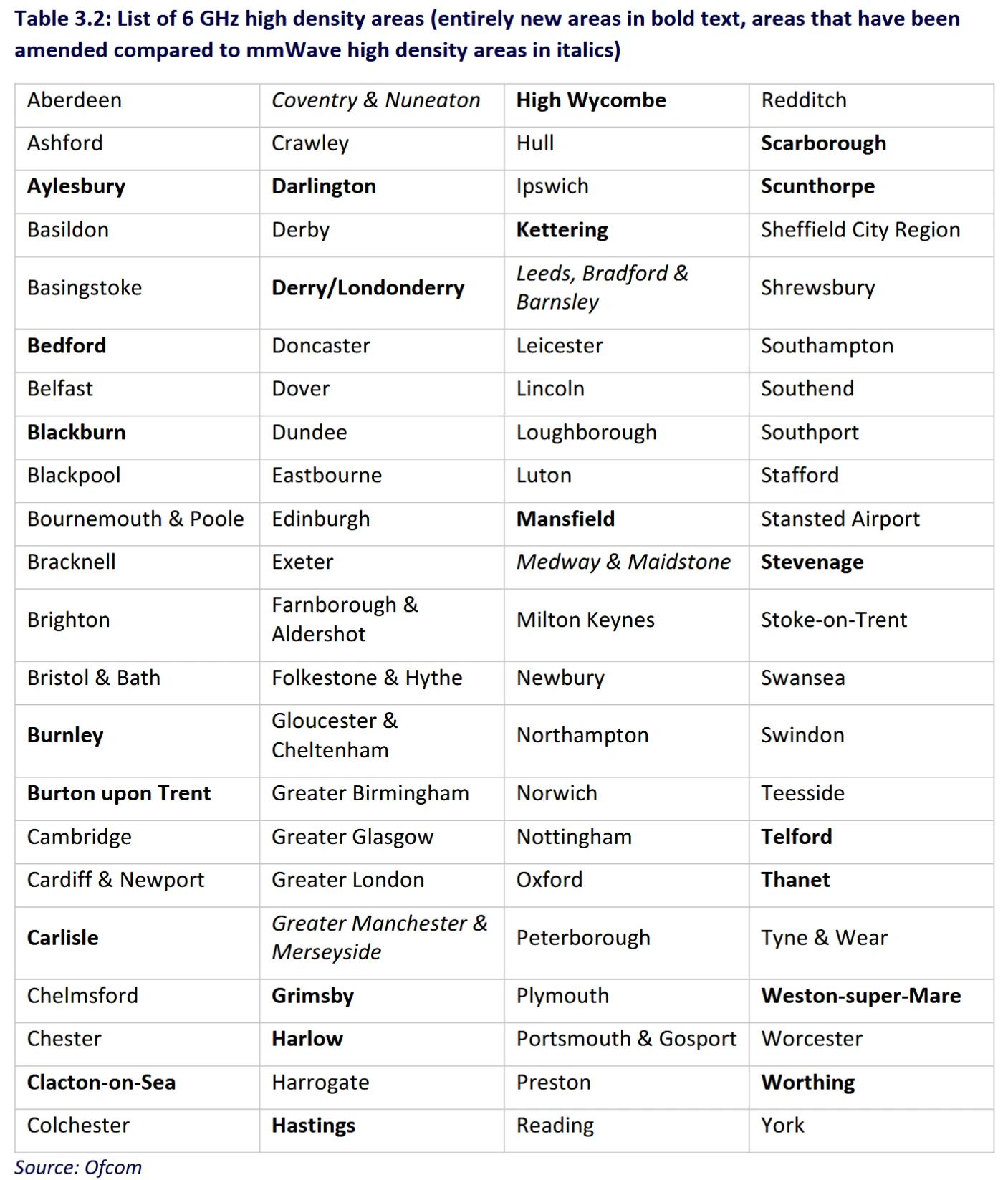
Ofcom’s approach to defining High Density Areas seems to reflect a modification of an approach that they’ve already taken for other mmWave bands like 6GHz. The regulator has included a rough list of 88 locations that fall into their proposed categorisation (see below).
“We also decided in January 2026 that any mobile award for the Upper 6 GHz band will be subnational. This is because the physical characteristics of the band makes it well suited to areas where high volumes of data traffic are concentrated in a relatively small geographic footprint, predominantly urban areas. We will use an approach similar to what we used in the mmWave award by defining geographical “6 GHz high density areas”, which will be the locations where Upper 6 GHz mobile licences are awarded,” said Ofcom.
Advertisement
Suffice to say it’s going to take a few short years to fully implement everything needed for the Upper 6GHz band to become accessible to both WiFi and Mobile users, which is before we even consider the need for supportive hardware on the consumer side. By the time it’s ready we’ll probably be talking more about the next generation of 6G mobile (not to be confused with 6GHz) and Wi-Fi 8 networks.
Otherwise, Ofcom’s new consultation will remain open until 6th July 2026, with the regulator planning to make a final statement on the above by the end of 2026.






Mark is a professional technology writer, IT consultant and computer engineer from Dorset (England), he also founded ISPreview in 1999 and enjoys analysing the latest telecoms and broadband developments. Find me on X (Twitter), Mastodon, Facebook, BlueSky, Threads.net and Linkedin.










« KCOM’s UK Results Reveal Huge £530m Write Down in Value of its Assets












This is going to be a mess.
Instead of assigning the spectrum to Wifi as should have happened, we’re going to have some DFS style trash whereby nobody will actually want to use the spectrum for wifi as you’ll have spurious issues with dropouts etc.
But Ofcom wanted that sweet 5G licensing money….
I think we can all agree that turning off 3G was the start of this mess!
I agree. DFS is a nightmare when you have routers constantly chopping and changing their frequencies. As for MMwave, what is the point of such a system when it can barely penetrate into buildings? The bandwidth is great but not everyone lives outdoors.
I’m sure Ofcom is smarter than you 2 individuals
If by “smarter” you mean “captured by mobile industry lobbyists” yes I agree.
But also behind the Scenes
they also want to turn-off 4G
that is why they are launching 5G Stand-alone
I see Mansfield is on the list, we have no coverage or 1 bar on 4g if you are lucky. main site in the park seems to be on low power or beaming the wrong direction, 6GHz won’t help us.