Ofcom Proceed with Proposal to Share Upper 6GHz Band for UK Mobile and WiFi
The telecoms regulator, Ofcom, has this morning confirmed that the United Kingdom will become the “first country in Europe” to adopt a proposal that allows low power indoor WiFi signals and outdoor mobile broadband (4G, 5G etc.) networks to “share” access to the Upper 6GHz radio spectrum band (6425 to 7125MHz).
Ofcom has already made the Lower part (5925 to 6425MHz) of the 6GHz band available for WiFi, such as under the latest WiFi 6E and WiFi 7 standards (here), yet the Upper part has remained the subject of some debate. Mobile operators want to harness it (licensed) to deliver faster 5G and future 6G based data speeds, while others argue it should go toward licence-exempt consumer WiFi. Existing users of the band (e.g. fixed services, satellite, radio astronomy etc.) have also expressed concerns over the risks from interference.
Suffice to say, both sides of the debate have been able to field strong arguments. However, rather than pick a side, Ofcom has instead spent the past few years exploring the middle-ground option of “hybrid sharing” (details). This could potentially enable, with some performance caveats (i.e. co-existence without causing interference is a challenge), the use of both Wi-Fi and mobile in the same Upper 6GHz band.
Advertisement
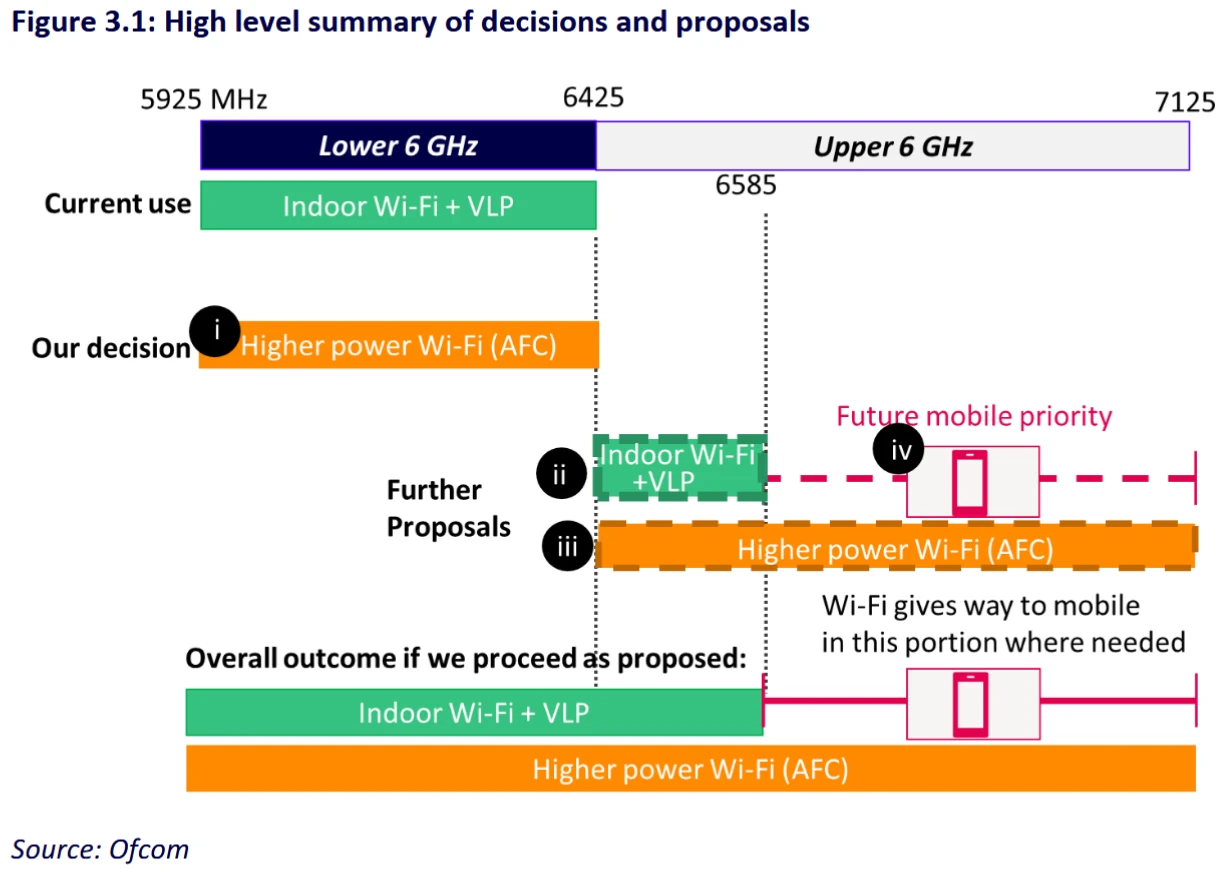
Ofcom’s approach works by dividing up the upper 6GHz band, with Wi-Fi prioritised in one part and mobile in the other, with clear technical conditions and controls attached to limit the risks from interference. The new consultation finalises the regulator’s proposals, although implementation will be a slow process.
David Willis, Ofcom’s Group Director for Spectrum, said:
“Today’s announcements reaffirm the UK’s position as a leader in Europe in getting the most out of the airwaves we all rely on.
Sharing Upper 6 GHz would be a win for businesses and homes across the country who want both better Wi-Fi and mobile networks that are fit for the future. And our decision on lower 6 GHz will boost broadband services across the UK.
Our plans open the doors to further economic growth and investment, while supporting the delivery of crucial innovations like 6G in the future.”
What Ofcom have decided – in brief
• We will authorise, under a licence exemption, use of outdoor and higher power Wi-Fi devices (up to 36 dBm EIRP) in the Lower 6 GHz band (5925–6425 MHz) provided they are under the control of an AFC system.
• As a result, we will require implementation of an AFC system by third parties. We are separately consulting on the details necessary to implement that AFC system.
• Whilst we are consulting further on approaches to enable Wi-Fi in the Upper 6 GHz band (6425–7125 MHz), we will proceed with making low power Wi-Fi client devices available across the Upper 6 GHz band, provided they are connected to an authorised Access Point (“AP”, for example a Wi-Fi router). This decision should allow client devices to be made available for possible future use of the band, thereby helping faster adoption. Use in the band, in practice, will only become possible once we have made a decision on the proposals below to enable Access Points in Upper 6 GHz.
• We will adopt a sub-national licencing approach for mobile in the Upper 6 GHz band in the “mobile priority” portion of the band. We intend to award mobile licences in “high density” areas of the UK and expect to implement a local licensing arrangement (for example, on a first come, first served basis) outside of these high density areas. We will consult further on the specifics of this in spring 2026.
What Ofcom are proposing – in brief
• To implement prioritised spectrum sharing in the Upper 6 GHz band, with:
➤ A “Wi-Fi- priority” portion in the bottom 160 MHz of the band (6425–6585 MHz).
➤ A “mobile priority” portion in the upper 540 MHz (6585–7125 MHz).
• To make the Wi-Fi priority portion available on the same basis as spectrum in the Lower 6 GHz band. This includes indoor and very lower power Wi-Fi, and also outdoor and higher power Wi-Fi provided this is under the control of an AFC system.
• To enable early access for Wi-Fi in the mobile priority portion of Upper 6 GHz. In response to feedback from the February 2025 consultation, we propose to only allow this access for Wi-Fi which is under the control of an AFC system. This will ensure that we can clear Wi-Fi out of the way, in the locations and channels where mobile deploys later on.
Fully implementing all of this is clearly going to take some time, particularly when it comes to the mobile (4G, 5G and 6G) side of things. Ofcom’s approach is partly being linked to wider European efforts to harmonise use of the same band via a similar policy (expected in 2028). But in any case, the regulator doesn’t anticipate hardware support in mobile equipment until around 2030.
On the WiFi front, the need for a new AFC database will also slow down the implementation a bit. AFC works by automatically identifying frequencies that can be used by Wi-Fi without impacting existing services, therefore keeping the administrative burden of spectrum management low. The AFC system is currently in use in this band in the US and Canada, and is under consideration in other countries.
Advertisement
Depending upon your perspective, Ofcom’s approach may seem like either a good or bad move, since neither mobile nor WiFi will be able to fully benefit from the Upper 6GHz band in every location. But we’ll need to see how much of an impact it has in the real-world before really being able to judge.






Mark is a professional technology writer, IT consultant and computer engineer from Dorset (England), he also founded ISPreview in 1999 and enjoys analysing the latest telecoms and broadband developments. Find me on X (Twitter), Mastodon, Facebook, BlueSky, Threads.net and Linkedin.












« London Internet Exchange Updates UK Fees and Service Structure for 2026

















Well this decision sucks. A significant nerf to Wifi in the UK vs other countries. People already avoid DFS channels on 5GHz due to the issues it causes, so this effectively just means we’ve given most of the spectrum to mobile.
Meanwhile, most of the country will probably never see 6GHz mobile. Hell I get 1 bar of 4G and speeds under 2mbit at home on mobile.
Yep,
I bet it will only be used in major city’s like london.
I live in a city.
I just got 5g in sep last year
And still most parts of my city, am lucky to get signal.
Yep, same for me. 1 bar of weak 4G with Vodafone, 1 bar of weak 5G with EE, both equally useless. O2 service is worthless, so is Three. Signal strength and coverage so poor, you can barely send a WhatApp message, let alone use it for work or anything critical.
Utter shambles. Mobile coverage in this country is a total failure.