YouGov Find Limited Support for Nationalisation of UK Broadband and Phone

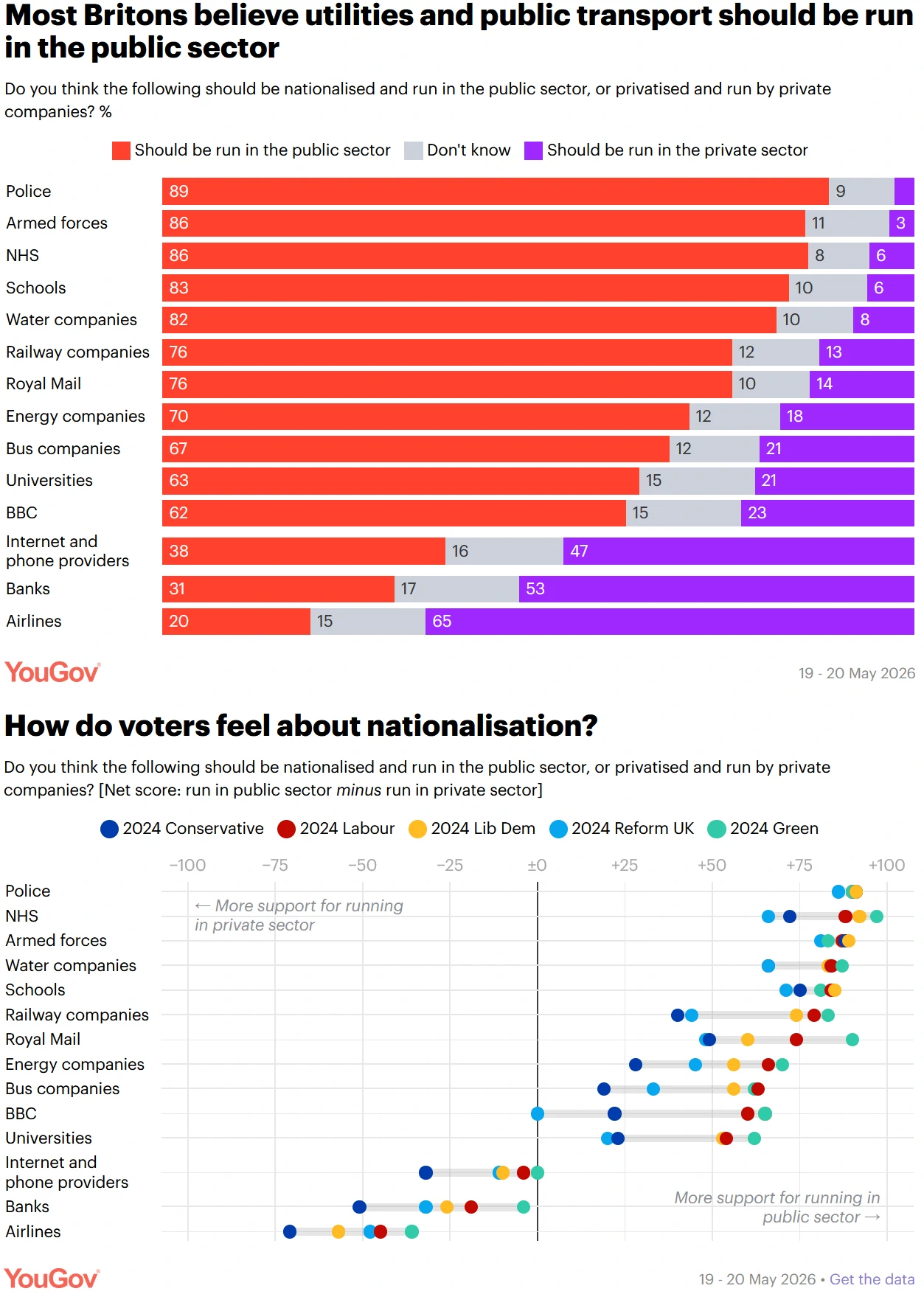
A new YouGov survey, which was conducted during late May 2026 with an unspecified number of UK respondents, has claimed that 82% of Britons believe water companies should be run in the public sector, with 70% saying the same of energy companies. But only 38% said the same for broadband “internet and phone providers” (16% didn’t know and 47% felt they should continue to be run by the private sector).
Regular readers might recall that the current party of government (Labour) has long since have moved away from their heavily nationalisation focused “free full-fibre broadband to all by 2030” pledge of 2019 (here and here), which raised more than a few questioning glances and a fair bit of scepticism from within the industry (here), as well as more widely.
Part of that was because the idea had missed the opportunity boat somewhat, not least since it occurred at a time when commercial builds were finally starting to flood the UK with tens of billions of pounds to help roll out FTTP (i.e. taxpayers didn’t need to foot the full bill) and appeared to misunderstand the complex interconnected structurers of the existing market / networks (BT Group didn’t hold the same grip they once did and that’s even more true today).
Advertisement
The questions everybody should always ask, when talking about either privatisation or nationalisation, is how much will it cost and what are the pros and cons (both approaches have their negatives). Much would naturally also depend on the detail of such a plan and its regulatory framework.
At the end of the day, it is possible to do what was proposed in 2019, but nobody should suggest that doing so would suddenly have produced a magic fix for remote rural broadband connectivity, or that there wouldn’t be significant cost, delay, legal challenges, job losses and disruption involved in that transition. For some, such radical change would still be absolutely worth it, but the industry didn’t agree.
Lest we forget that there are different ways of nationalising something, so it’s possible that the industry might have given a different reaction with a less radical approach in 2019, rather than putting a grenade to the entire market.
Advertisement
In any case, YouGov’s survey appears to indicate that Brits broadly support the current telecoms market being part of the private sector, although this isn’t to say that they agree with everything. For example, above-inflation mid-contract price hikes remain a widely disliked practice. But you don’t need nationalisation to solve that, just a government willing to push Ofcom in the right direction (this hasn’t happened).






Mark is a professional technology writer, IT consultant and computer engineer from Dorset (England), he also founded ISPreview in 1999 and enjoys analysing the latest telecoms and broadband developments. Find me on X (Twitter), Mastodon, Facebook, BlueSky, Threads.net and Linkedin.










« Zen Internet Start Selling Broadband via MS3’s UK Full Fibre Network
















The main reason people don’t want a state-owned ISP is because in a lot of countries where state-owned ISPs are dominant, there seems to be an awful lot of censorship. And then of course there’s the total internet blackouts when something is going on that the government doesn’t want its people to know about.
Yep – much easier for the government to do stuff like that when it has direct control over the infrastructure rather than having to get a private entity to do their bidding via a court order.
The other big downside of course is that it will be lowest common denominator service levels with no escape.
Except the government can do that anyway if they want, an ‘internet kill switch’ is already law.
@tech3475 They do have the power to order ISPs to shutdown but this is subject to all kinds of conditions and restrictions, it is open to challenge, and compensation must be paid. There’s a big difference between this and the government simply flipping a switch on their own servers that we are all forced to use.
Governments can already force ISPs to block certain sites and content but lumping “internet” into one category is wrong, It should be split up into infrastructure and ISPs
The Infrastructure (so the wires in the street, etc) should be publicly owned and ISPs privately owned.
@john_r
In practice I suspect that if the government wanted to shut down the internet for ‘nefarious’ reasons, they’d find a way regardless of whether it’s in state or private hands.
@Mark The argument could certainly be made for this, but even if BT was still publicly owned, private infrastructure providers would still provide a superior XGS-PON service to BT’s GPON.
Broadband & mobile infrastructure is one of those sectors where you can actually have competition, unlike water and rail.
If there’s one privatisation that has worked it’s telecoms. What I would argue for is common ownership of physical infrastructure (PIA) that all operators could access – why should Openreach be the only operator thats required to make its infrastructure available to rivals? It doesn’t necessarily need to be state owned.
Personally I’d prefer having multiple physical providers with wholesale.
It might prevent the situation we’ve seen where a single provider took years to start upgrading the network and still be behind as we saw with BT and even now the lack of symmetrical which even VM is able to provide and hopefully keep each other from abusing their position.
It also gives people a choice if one provider keeps having issues.
Agreed – have the physical mobile and broadband infrastructure nationalised, then sit your network on top of that. The infrastructure would be expanded to cover 100% of the UK, then Tom, Dick or Harry resell that same service competing only on cost and support (same as Openreach-based ISP’s or MVNO’s).
It would be far cheaper and tidier – in most homes now there are at least two incoming internet cables, which go back to different cabinets/poles/POPs which go back to different distribution points. It’s messy, and it’s the same with mobile. Have a single mast network infrastructure beaming out all mobile networks, there should be no different in signal on these networks/MVNO’s.
I think the dilemma is going to come when/if the government commits to a digital TV switch off. That cannot be done in a socially responsible way without free access to some form of broadband, otherwise the offering is a regression for vulnerable persons.
Phone/Intnernet/Mobile infrastructure should all be publicly owned and leased out to private companies to run Phone Companies/ISPs, etc.
Maybe also allow free basic controlled access for things like TV especially if TV is to go streaming along with access government and local council services but no access to the wider internet.
My main issue is how a lot of public funds have been used to roll out a lot of the VDSL and then fibre infrastructure and the public has ended up owning none of it. It took 10s of billions and a promise of a duopoly to Virgin Media and BT to get rollout happening and fibre could have rolled out in the 1980s if the government of the day didn’t stop BT from doing it. The public ought to see a real return from its investments.
Anyone with any knowledge of history and is in touch with world affairs can easily see that literally everything runs better outside the grasp of the incompetent government
India decided to take the communist route in regards to internet and the result was that all competition was crushed and people ended up with very slow speeds while paying for it through taxes
The privatised English water networks blow a stinking hole in your theory.
There is very little difference between the performance of publicly owned Scottish water and the privatised companies in England. That said privatisation of water was completely pointless as there cannot be any competition. It’s an unavoidable monopoly which is not the case for communications infrastructure providers.
It would also be pointless to renationalise water when you can control them through the regulator. People always say Ofwat is not fit for purpose but forget these are the same people that would be running a nationalised system with approximately the same amount of control over the infrastructure.
The campaign group We Own It has information on the scandal of privatisation.
The architect of the Rip Off Britain Project was Margaret Thatcher by privatisation, austerity, deindustrialisation, outsourcing, offshoring, deregulation in the pursuit of shareholder dividends and private corporate profit.