Ookla Study Reveals Quality of 4G and 5G Mobile Signals on London Underground
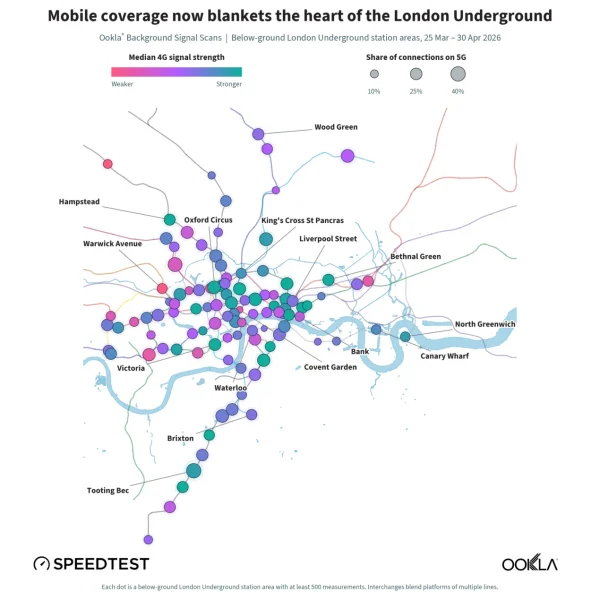
Network benchmarking giant Ookla, which collects data from consumers via their popular broadband and mobile Speedtest.net service, has today published one of the first independent studies of real-world 4G and 5G mobile (mobile broadband) coverage quality on the London Underground. The good news is that it works and exists exactly where TfL says it should.
Boldyn Networks, using kit from Nokia and others, currently holds a 20-year concession deal with Transport for London (TfL), which was signed in June 2021 (here). The agreement allows them to deploy new mobile network infrastructure across the whole Tube (London Underground), DLR and Elizabeth line network.
The project has made good progress over the past few years and is currently expected to complete by around the end of 2026, which makes now a good time to examine whether or not its delivering on its promises. As of August 2026, over 60% of the 121 below-ground stations were live and the rest of the sites are expected to be live by year-end.
Advertisement
To test how real the impact is, Ookla says they analysed more than 50 million background signal scans collected across Greater London between 25th March and 30th April 2026, using a new method that identifies high-confidence below-ground measurements at massive scale (this is needed because otherwise it’s difficult to distinguish below-ground from above-ground signals between users). Overall, the study found that the availability of mobile signals aligns closely with the line sections TfL’s official coverage map show as live.
Key Findings of Ookla’s London Underground Study
➤ Almost one in five below-ground connections is already on 5G.
Some 19.8% of below-ground scans connected over 5G, against 16.5% above ground citywide, because the system was built 5G-ready from day one. Every operator shows a healthy below-ground 5G share, from 12.8% on Three UK to 26.5% on O2.➤ Signal strength below ground is comparable to the street above.
Median 4G signal strength is -96 dBm on below-ground platforms, against -98 dBm at street level citywide (readings closer to zero are stronger). A like-for-like comparison within the same small areas shows the street still wins by 2 to 3 dB, but holding within a couple of decibels of the open street inside 19th-century tunnels reflects a network built into the stations and tunnels themselves.➤ The signal holds to 30 meters down, and 5G is live at the deepest measured platforms.
Median 4G power readings stay between -94 and -96 dBm across the first 30 meters of estimated depth, falling to -101 dBm beyond that, while the share of connections on 5G declines from 21% in the shallowest band to 14% in the deepest. Where 5G is present below ground it is strong, with a median 5G reading of -93 dBm, stronger than the above-ground citywide 5G median of -98 dBm.➤ All four UK operators are live on one shared network, and customers use it in proportion.
Below-ground connections split EE 33%, Three 24%, Vodafone 21%, and O2 20%, with the remaining 2% on MVNOs such as Sky and on international visitors roaming onto UK networks. No other UK mass transit deployment has matched that tenancy mix. London locked it in before the first major post-pilot expansion, with all four networks signed by July 2022 and the Emergency Services Network (ESN) providing a separately funded public service workstream.
Sadly, Ookla’s study was solely focused on signal strength and coverage, but didn’t attempt to examine mobile broadband speeds, latency or call stability etc. In that sense we don’t yet have a good idea of how well the new mobile infrastructure actually performs across the underground and via different mobile operators, but hopefully such data will emerge in the future.
Ookla’s Full London Underground Study
https://www.ookla.com/articles/london-underground-5g






Mark is a professional technology writer, IT consultant and computer engineer from Dorset (England), he also founded ISPreview in 1999 and enjoys analysing the latest telecoms and broadband developments. Find me on X (Twitter), Mastodon, Facebook, BlueSky, Threads.net and Linkedin.









« Feasibility Study on New Subsea Fibre Cable for Shetland Islands Begins
Advertisement
Leave a Reply
Privacy Notice: Please note that news comments are anonymous, which means that we do NOT require you to enter any real personal details to post a message and display names can be almost anything you like (provided they do not contain offensive language or impersonate a real person's legal name). By clicking to submit a post you agree to storing your entries for comment content, display name, IP and email in our database, for as long as the post remains live.
Only the submitted name and comment will be displayed in public, while the rest will be kept private (we will never share this outside of ISPreview, regardless of whether the data is real or fake). This comment system uses submitted IP, email and website address data to spot abuse and spammers. All data is transferred via an encrypted (https secure) session.















It’s notable that the project is now reported to complete “by around the end of 2026” having previously been announced by TfL as due to complete in 2024, 2025 and “fully complete by the end of 2026”.
The rollout has been glacially slow over the last 12 months. There’s no way it will be complete in the next 16 weeks and as with the Piccadilly Line upgrade (£140m over budget and 18 months late), TfL and its partners continue the pattern of project cost and schedule over runs.
The Piccadilly Line budget is mis-understood.
The original approved budget was £3.294bn which is more than it the current projected cost. So it’s actually under-budget compared to that figure.
TfL did do a budget revision though where they revised the projected cost down from the original budget to under £3bn. They’ve since had to revise that projection back up, which of course the newspapers and opposition have jumped on. But it’s still within the original budget envelope.
The colour scale could only be less useful if it was grayscale.