Swish Fibre Complain to ASA Over BT’s Use of Fibre Broadband Terminology
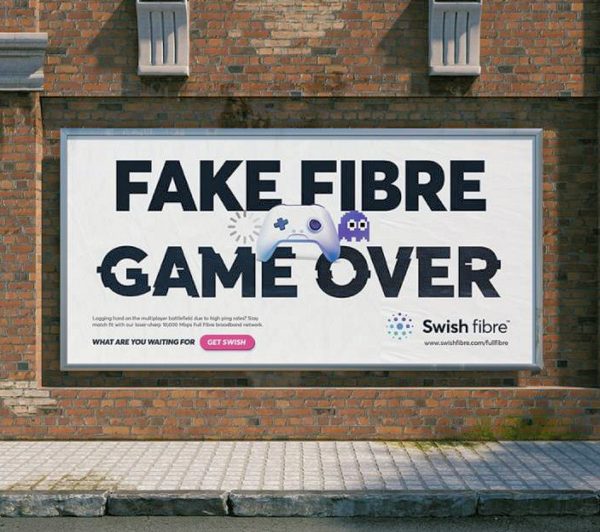
Alternative UK ISP Swish Fibre has continued their “fake fibre” related advertising feud with BT today after they lodged a retaliatory complaint with the Advertising Standards Authority (ASA), which objected to the “confusing” use of the term “fibre broadband” in the incumbents marketing for their “part-fibre” (FTTC) products.
The situation began in July 2021, after Swish launched a new advertising campaign (here), which saw them place a number of billboard posters around the country (see top). The posters “playfully” tried to set their own full fibre broadband service apart by using the “Fake Fibre” phrase to call out significantly slower and less reliable part-fibre services (e.g. FTTC / VDSL2), which still use slow copper lines to connect homes from a street cabinet.
However, Swish’s original campaign didn’t do a great job of defining “Fake Fibre“, which we previously remarked could still make it difficult for regular consumers to understand the differences. As a result, some people may incorrectly end up viewing the term as extending to rival FTTP ISPs too. On top of that, it ignored that some hybrid fibre networks (e.g. Virgin Media and FTTB ISPs) can deliver gigabit speeds. All of this risked creating more confusion.
Advertisement
In response, BT lodged a complaint with the ASA to challenge Swish’s adverts (this is ongoing), which it perhaps did partly in the knowledge that the advertising watchdog had long resisted – quite successfully – attempts to change the situation around the use of “fibre broadband” terminology in adverts for slower hybrid fibre products (here).
Sensing an opportunity, Swish then comically responded by launching a new take on their poster campaign, which introduced the word “Censored” (see below) as a way of alluding to BT’s resistance to its earlier “Fake Fibre” messaging.

Now Swish has opted to take their dispute further and has lodged their own complaint against BT’s use of “fibre broadband” on FTTC products with the ASA, which they note is often also referenced using similar terminology – “Superfast Fibre Broadband“, “Ultrafast Fibre Broadband” and “Faster Fibre broadband“, amongst others.
Advertisement
Back in 2017, fellow alternative network provider CityFibre challenged the ASA on this matter, but the case was dismissed by the courts. However, Swish points out that the market has changed dramatically since then and is now rapidly turning to FTTP methods, thus the ISP claims to be “rekindling the fight by pledging to educate the nation on Fake Fibre once and for all and [to] reverse years of misleading advertising.”
Alistair Goulden, CMO & Director of Swish Fibre, told ISPreview.co.uk:
“When BT use the word fibre to describe their copper-fibre FTTC networks, I say that you can’t call a vegan sandwich a vegan sandwich if it’s got 10% or even just 1% meat in it. Copper reliant FTTC networks cannot provide download speeds much above 80 Mbps and upload speeds of 20 Mbps. In contrast, full fibre’s 100% fibre-optic cables have the capability to offer up to 10,000Mbps today and potentially even faster download and upload speeds in the future.
It’s time for major industry reform around how we talk about broadband with consumers in the UK. We should be channelling all our efforts into championing Full Fibre and powering the UK up the world broadband speed rankings to help the UK economy recover post pandemic.”
The focus here is clearly on FTTC (VDSL2), which is perhaps to avoid the murky waters of conflict around gigabit-capable FTTB and Hybrid Fibre Coax DOCSIS 3.1 networks. But the mention of download speeds maxing out at 80Mbps does overlook that G.fast is also an FTTC style technology and can max out at 330Mbps download and 50Mbps upload, albeit only in ideal circumstances on Openreach’s network.
Despite this, Swish claims there is now increasing evidence that consumers “struggle to differentiate between part-fibre broadband and state of the art full fibre broadband,” such as the recent WIK Consult report for CityFibre. WIK’s study found that 52% of respondents claimed to have a Full Fibre service, despite only 20% of respondents living in areas where that was available at the time.
A recent report from the Gigabit Take-Up Advisory Group (GigaTAG) also warned about similar confusion and called for it to be addressed via a new labelling system (here), although the Government has yet to fully respond to the report’s recommendations. This was seen as important given the Government’s new £5bn Project Gigabit initiative, which could suffer if strong take-up doesn’t follow deployment.
Advertisement
Win or lose, all of this will perhaps partly be seen as another clever way of generating publicity for Swish Fibre’s build. But it will also, once again, force the ASA to tackle an awkward and uncomfortable issue that has previously resulted in plenty of criticism over the watchdog’s decision-making.






Mark is a professional technology writer, IT consultant and computer engineer from Dorset (England), he also founded ISPreview in 1999 and enjoys analysing the latest telecoms and broadband developments. Find me on X (Twitter), Mastodon, Facebook, BlueSky, Threads.net and Linkedin.











« Zen Internet Set to Extend CityFibre FTTP Availability Nationwide
ISP Plusnet Breaks Out Stronger Black Friday Broadband Deals »















Call something “anything” long enough – people believe that’s what its is,
in the 80s and 90s all vacuum cleaners were known as hoovers,
and in 2021 I still call my vacuum cleaner a hoover.
Maybe time for BT / OR to stop calling FTTC GFast ‘fibre’.
Now that simply undermines their own efforts to switch people from FTTC / GFast -> fibre.
Why would you switch from fibre -> fibre?
Would you like fibre Sir?
I’m fine thanks I’ve already got fibre….
There comes a tipping point where carrying on with this nonsense is counterproductive.
Totally agree. A rod for their own back.
Openreach call FTTC ‘FTTC’. They’re not a retailer.
“Alex says:
November 23, 2021 at 9:24 am
Openreach call FTTC ‘FTTC’. They’re not a retailer.”
No they don’t.
They stick “Fibre is here” on their FTTC cabinets. Which is a double joke as fibre is inside the FTTC cabinet but not in the way that taken by extension.
If they removed those misleading stickers your argument might have a little more weight.
They cynicism behind that kind of it is literistially true but misleading behaviour is appalling for a PLC trying to rebuild position and trust.
Why are they so worried if their ‘Fibre’ is so good . Wasting money on legal action etc.
There’s no “legal” action mentioned above, all they’ve done is fill in a form to the ASA, just like BT did – anybody can do that. I suspect it’s more about advertising Swish, albeit off the back of a popular point of debate (i.e. clever marketing).
250k premises I wouldn’t even advertise at all. FTTx coverage is ridiculous in the UK that’s a fact, and those small scattered operators launching in a county or 2 are not the solution.
You might well disagree if you happened to be one of those homes covered by that network, especially if nobody else in your area has done it or can match the pricing. 250,000 premises is nothing to be sniffed at, that’s a big investment on the FTTP front, and every operator has to start somewhere.
On top of that, it’s worth looking at the other ISPs that Fern Trading control. There’s a larger plan at work. But the idea that even smaller networks shouldn’t even bother advertising is clearly not a realistic position to hold. Raising awareness, particularly at the local level of your build, is a key part of generating take-up and interest from investors.
Well said Antwan. Why don’t Swish put their money where their mouth is and roll out full fibre to ALL areas suffering from Openreach’s “fake fibre” aka FTTC? No? I thought not. Talk is cheap.
Seeing as they only have £200M+ in the bank, they’d probably be a bit short of the funding needed to do that across the whole uk Pete. Reality can suck but it’s still reality.
Coverage in the UK is growing rapidly – https://labs.thinkbroadband.com/local/
Pete: where do you suggest a company get the staff from for a national rollout? Or the equipment?
If folks have ways that operators can grow their networks more quickly than they are I’m sure the operators would welcome it. It’s about a lot more than just money.
“where do you suggest a company get the staff from for a national rollout? Or the equipment?”
Exactly the point I was trying to make. “Fake Fibre” (aka FTTC) was rolled out relatively cheaply and quickly and was always a stop gap to full fibre by Openreach. I bet if Swish fibre were in Openereach’s position, they would have done exactly the same, ie ADSL > ADSL2+ > FTTC > FTTP. Like I said talk is cheap.
I could not agree more with this. I had an issue with my FTTc line so had an engineer visit. As always the munter that lives next door appeared complaining about the same issue. Adamant her copper phone line was fibre as this is what BT sold her.
Couldn’t you call ADSL “fibre” too? It is just Fibre to the Exchange.
No because the definitions are always set and defined for this around the ‘Access Network’ (local) side, which tends to mean everything after the exchange / datacentre etc.
To be fair Mark, there is no hard and fast rule as to what constitutes the “access” network, compared to the “core” network. Many consider the demarcation historically was the first point of concentration, which was the (PSTN) exchange. In broadband terms, the exchange became the DSLAM (also in the same building as the PSTN exchange). Once the DSLAM moved to a street cabinet, there is a (in my view very) strong argument that the street cabinet DSLAM is now the demarcation point – especially as some “street cabinet” DSLAMs could have as many customers as very small “remote” PSTN exchanges.
Fair point there.
Bit rich from Swish, considering they don’t provide any routable IP and have a broken carrier grade NAT setup.
I get IPv4 exhaustion, but they don’t even provide IPv6 as a workaround. Oh and they have a broken DHCP implementation which means you have to use there equipment otherwise your own kit will have its internal IP changed every 20 minutes causing connections to be reset.
At least the “fake fibre” at least provide an IP and a working DHCP setup… the basics of an actual internet connection
The billboards look to be photoshop fake.
We tried and failed, to generate interest amongst local residents to register for
Community Fibre Partnership as we’re all limited to FTTC with the DSLAM a mile away.
The vast majority of residents opposed the idea as they stated – “We’ve got Fibre already.. BT said so. They wouldn’t call if Fibre if it wasn’t”….. Erm yes.. Yes they would!
Individuals may be confused by technology but people should also not be mislead onto another technology that they personally will not gain by, especially if they have to contribute. For very moderate data users still wedded to their landline.
My Father-in-law has the full Sky package as he enjoys it, he or his wife hardly use catch-up and their only other use is the occasional visitor. What benefit is it to them to go full fibre currently when they can push Sky for a heavily discounted FTTC broadband.
He will probably be forced onto FTTP in the next two years but will then seek the cheapest available or I’ll set him up with 4G/5G at that time.
hhhhmmmm not sute that thats says more about — the process . the understanding or the messaging to the community about FTTP (interesting you only mention BT and BT could be one of many CP’s offering FTTC Services in your communnity
You shouldn’t even have to organize a community project in the first place, just to get an essential utility like fibre broadband. This show that something is fundamentally gone wrong in this country.
Why now?. Even Cityfibre appear to have given up now OR FTTP is moving forward.
The ASA ruled on this for Virgin Media HFC. They are unlikely to reverse their ruling.
BT used to use the Infinity branding but returned to using “Fibre” on their lower tiers because everyone else was.
It is now a generic term used by most ISPs.
The position now is that if you are in a non-commercial area you will have to simply wait for FTTP and not necessarily OR. In the meantime over 52% of the country has a choice of VM. If speed is that important pay for it.
In areas where Altnets are appearing there is a choice and its up to the Altnet to provide a product that the customer wants (speed/cost). But like insurance you only find out how good your supplier is when things go wrong so inevitably they will go with brands they know or are recommended.
FTTC remains competitive currently for a large percentage of the population, particularly with the offers, regardless of what you call it.
because people like my neighbours think they’ve already got fibre, when FTTP isn’t available here. We got a group together to try to canvas for interest in a community fibre project. Many if not most of the neighbours responded with “We already have fibre” because they had been successfully brainwashed into thinking their FTTC was fibre.
So it’s still valid today to let people know that their FTTC 80mbit is not fibre.
I’m with Swish. There’s only one reason the telco’s called it fibre and that was to confuse the consumer. It worked. Shame on them, and shame on the ASA. Swish is right to call out their buffoonery.
It work to confuse central government.
I sat in a meeting in the Cabinet Office where the most senior person in the meeting, in 2012, thought that fibre was being run to the premises.
It was a PR triumph and a technical disaster.
Lots of interesting points, for me Swish were the only provider in my town for FTTP since BT, Virgin or any other fibre provider hasn’t deployed here and the other altnet advertising aren’t even here yet.
There seems to be a lot of negativity towards the altnets for some reason but isn’t competition no matter how big or small a good thing? The only thing I know it that you’d all be complaining if BT were the only major provider (and technically still are) because Swish have to use their poles and parts of their infrastructure to deploy. If they choose to challenge then let them, I’d love to see some of these guys run an ISP, lots of armchair CEOs in here.
As for the guy saying Swish’s deployment is broken, I’m using my own kit on Swish for the last few weeks and it’s been fine, no resets or anything?! – so I believe he needs to have his facts checked first (maybe use the service) [wink]
Facts checked? I can send you the packet captures if you want it 🙂
Also got emails confirming the fact from their own NOC teams.
More than likely you just work from them based on your response (wink)
It must be confusing, for potential Swish customers, when they Google the name and find adverts for Ultrafast Curtain Tracks.
No more confusing than terms like “Openreach” (what’s so open to customer on this, how is it reaching our to customers?)
And certainly describing copper lines as “fibre” certainly is a lie!
BTW: Unlike Swish Fibre, BT’s fibre (if it is a fibre line at all) isn’t offering symmetric speeds. It’s more like a one-way street!
I’m another happy Swish fibre customer, got it alongside BT FTTC at the moment due to the BT contract not being quite up. I do agree that IPv6 would be good, but BTs IPv6 is broken unless you use your own equipment as they don’t have IPv6 DNS and you cannot set your own. It is supposed to be coming to Swish in the next few months.
As for the performance, I’ve seen a solid 320-400Mbps down at all busy times and a solid 400Mbps up. The upload is key for me as I work from home as an IT professional. Latency is also generally good (3-4ms from Buckinghamshire to central London) though peering to Google does sometimes rise to 15ms or so.
The BT box is now switched off as in 2 months I haven’t had a single outage with Swish.
It also only took them about half an hour to install, pretty impressive!
If the ASA suddenly mandated every ISP to call FTTC “copper”. I think FTTP would get a pretty good take up as calling something “copper” does make it sound a bit naff in comparison to “Fibre”. Imagine the call you can either get Copper or Fibre what would you like. “Fibre please”.
Using terms like :
Broadband. -Adsl
Fiber – Vdsl
Fast Fiber. – Vdsl
Ultrafast Fiber – Fiber
Ultraoptic Fiber – Fiber
Please correct me if i was wrong
How is not brainwashing to say vdsl is fiber?
Don’t even mention Gfast was a joke and attempt to distract people from asking real Fiber and they still to this day are happy to tell us that we dont need speeds greater then 80/mbs.
Perhaps you should learn to spell ‘fibre’ first?
> Ultrafast Fiber – Fiber
Not according to Talktalk. Their “Ultrafast Fibre” package is actually G.Fast.
https://new.talktalk.co.uk/broadband/ultrafast
If you want fibre-to-the-premise then you have to ask for “Future Fibre”. Go figure.
There is no record of Swish complaints or rulings at the ASA and the billboards are photoshopped so I’m thinking this could be a totally fake story.
The ASA only publish the biggest disputes / complaint cases once they’ve been concluded, which can take a very.. very.. long time (maybe next year for all of the above). Likewise, most complaints end up being “informally resolved”, which means we might not even see the outcome.
Have you asked the ASA for comment as the whole story sounds suspect, or ‘playful’ as Swish might call it. The billboard photos are definitely fake.
For the sake of clarity it would be better if the ASA ruled that only the average or minimum speed could be attached as a description to a Broadband product regardless of the delivery method. This would mean that most ISP’s using the Openreach network would be advertising a maximum of 79 mbps. After all when energy suppliers advertise they refer to the fuel supplied not whether gas comes through plastic pipes or cast iron ones or which type of metal conductors carry mains electricity.
The end customer is only interested in comparing their speed requirements to price and reliability of service all else is irrelevant to them.
It’s just a PR and advertising exercise.
It’s been before the ASA before and failed. Why aren’t they targeting Virgin as well, they coined the phrase first.
The thing which bugs me is that BT are sending me advertising for superfast when technically it’s likely to be slower than the 7Mbps I get now because of the different signal falloff over distance
I just got a pamphlet through my door that says “Super Black Friday. Superfast Fibre” Free for 3 months. It has 3 speeds listed – Fibre Essential 36Mbit, Fibre 1 50Mbit, and Fibre 2 67Mbit.
It also says “Nil. Nowt. Nothing….” like the speed of my BT connection 4.5Mbit down, 0.5Mbit up.
Are BT doing this as some kind of cruel joke?
Like others have said, all my neighbours think they have fibre already because of the bullshit the ASA supported.
There’s even Wireless Fibre, apparently.
https://www.welinkuk.com
Just before covid, we had openreach in the area digging up and installing FTTP . it caused a little disruption – traffic lights, roads being dug up and cables hanging from poles, so much so that some local councillors complained as we already have fibre why are openreach causing more issues and a huge amount of disruption ? (Virgin media had also done likewise a few years back – but only a few areas)
The general consensus in the area is ” already have fibre- why pay more”
Well it still is fibre, FTTC still qualifies as Fibre especially when there are still a lot of people still on ADSL full copper connections and most are able to get FTTC. I know someone who took up Shell Energy full copper which is ridiculous considering for £3 more they could access FTTC and all they get is up to 8mb speed.
The entire industry class FTTC as fibre.
Virgin Media have classed their Cable Broadband as fibre despite that most customers who are in the original Cable franchises, their fibre connection is up to the cabinet and from there to the premises is Coaxial Cable.
So Swish should focus on the entire industry rather than just BT.
Swish will one day be taken over by the likes of Vodafone,Sky or TalkTalk, who also call FTTC fibre.
I don’t think most people have difficulty understating this. They may not know or care about the infrastructure but they know it’s about faster broadband. This is is just BS attention marketing grabbing rubbish
Lots of organisations finding that it might be harder to sell broadband than to build it!
G.Fast also does 300M!
City fibre are growing at a crazy rate and are shaking up the whole monopoly between virgin and bt looking at there speeds the top guaranteed speed is 1Gb both down and up very few networks offer this plus they have a diverse network pretty sure virgin and bt are still on branch architecture hence why a lot of well known isp’s are moving across
General consumers care about speed, and price.
They see a speed, they see a price, then they buy. I know what kind of connection I have, but most people don’t give two flying whatevers,they just want it to work.
Actually, most think they just have “wi-fi”.
So not even fibre…