Study Claims 1 Mill Rural UK FTTP Premises At Risk of Openreach’s “uneconomic overbuild”

Consulting firm Cartesian has released a new report on the state of the UK’s fibre full broadband market, which unsurprisingly highlights how challenging it is for alternative networks (altnet) to create sustainable business models. The study also claims that c.1 million rural FTTP premises could see uneconomic overbuild if Openreach is required to meet a high exchange coverage threshold for copper switchover.
At this point our regular readers will no doubt already be familiar with the many challenges in today’s market, such as rising build costs, strong competition from rivals (i.e. overbuild and the challenges of growing take-up) and the difficulties of securing fresh investment during a period of high interest rates (not to mention rising debt repayments).
The situation has already forced many altnets to slow or stop their network expansions and focus more on growing take-up through commercialisation, albeit while still under pressure from debt repayments and the difficulties of raising new investment in a market where investors are already starting to see losses. All of this has nudged many altnets toward greater market consolidation, but that’s proving to be a slow and difficult process.
Advertisement
The new ‘State of UK Fibre‘ (PDF) study, which has been commissioned by Gigaclear, picks up on many of the same beats and states that a wholesale altnet needs to achieve a take-up of 44% to reach a 10% Return on Capital Employed (ROCE) – falling to 33% ROCE for retail altnets.
However, reaching such levels becomes much harder to achieve in rural areas (greater than 50% take-up required, says the report), as well as in areas with three of more networks overbuilding each other. The study also estimates that c.20% of UK premises have a cost of build above the level at which it makes economic sense for two operators to overlap.
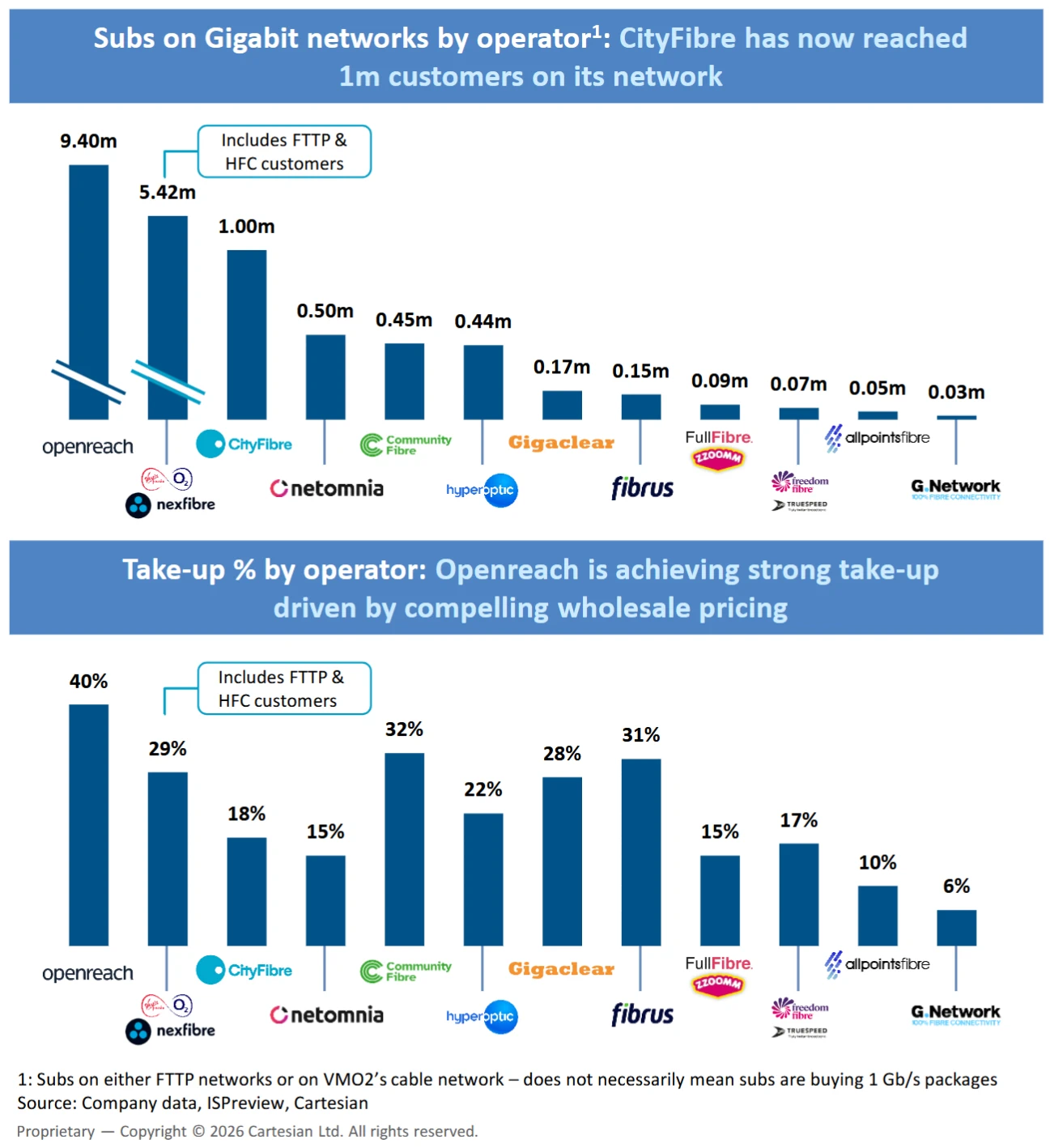
Admittedly these figures will vary depending upon the business models involved and the approach to build. For example, a Community Benefit Society (CBS) like B4RN, which mostly does soft digs through fields and benefits from free wayleaves (legal land access agreements), may have more flexibility than a provider that tackles the same area via a purely commercial model using traditional street works. B4RN is already running at a take-up of c.50%, but they’re too small to feature in the new study.
Advertisement
Key Findings of the Study
• The UK fibre market is often heralded a success story as FTTP coverage has progressed at pace. However, the path towards full coverage and take-up with sustainable network competition is proving challenging given some significant market issues.
• Key market characteristics posing issues for alternative network operators (altnets) are 1) a highly fragmented infrastructure market with growing overbuild – 47% of the UK now has more than 1 FTTP network 2) a concentrated retail market with the top 3 ISPs having over 70% market share and 3) very aggressive wholesale and retail pricing.
• Collectively these make it challenging for alternative network operators to create sustainable business models.
• The market needs to consolidate to improve economies of scale but this is taking longer than expected given valuation gaps, capital structure misalignment and funding issues.
• Our scenario M&A trajectories illustrate that, while the planned nexfibre acquisition of Netomnia would be a significant step forward in consolidating the market, there remain many moving parts to the consolidation path – it is very difficult to give specific predictions.
• Ultimately, we can still envisage a range of long-term outcomes on a 10-year view of the market – from persistent fragmentation through to a 3 operator or 2 operator state.
• In addition to the uncertainty surrounding the path to consolidation, there are also uncertainties on rural coverage and copper switchover.
• Fibre economics are more challenging in rural areas because of the higher cost of build – this can make the business case very challenging if there are 2 or more operators competing for network share in these areas.
• However, the copper switchover framework proposed by Ofcom includes an Openreach exchange coverage threshold at a fixed percentage (90% or 100%) before its copper price controls are lifted. This threshold may drive Openreach to overbuild existing rural altnets on its copper switchover path.
• The proposed framework therefore risks wasted investment in these high cost of build areas, and poses a risk for the sustainability of existing rural alternative network operators, as the economic case only supports 1 network and even in some cases public funding has been used.
• Our analysis indicates 1) around 1m rural FTTP premises could see uneconomic overbuild if Openreach is required to meet a high exchange coverage threshold for copper switchover and 2) achieving a 90% coverage threshold of all existing and published planned exchanges, would consume nearly all of Openreach’s 30m FTTP ambition, potentially leaving up to 1600 Openreach exchanges on copper (unless Openreach extends its FTTP ambitions beyond 30m or uses alternative technologies).
• Potential solutions include adapting the regulatory framework to allow Openreach to include alternative FTTP networks (as in Greece) or technologies (e.g. satellite) in meeting the coverage threshold or to focus on ultrafast solutions for remaining copper customers rather than FTTP coverage.
• Coupled with this we could envisage Openreach partnering, whether through an aggregator model or directly with another operator, to leverage alternative networks and / or technologies, while maintaining consumer ISP choice through Openreach.
• Overall, our view is that each operator, acting independently and according to its own circumstances, should look to ensure that its pricing and customer-experience strategy sustainably covers its own cost of capital; to move forward with M&A with caution and pragmatically (e.g. with like for like mergers if cash deals are out for now), and to consider alternative paths such as partnering especially in higher cost areas to avoid uneconomic overbuild.
Despite being commissioned by Gigaclear, Cartesian said they retained full editorial and analytical independence; “The analysis, opinions and recommendations are those of Cartesian alone and do not necessarily represent the views of Gigaclear,” said the firm. But there’s also no doubt that they’ve focused quite a bit on one of the Gigaclear’s recent points, which reflects the aforementioned Openreach exchange coverage threshold.
Just to recap. Ofcom’s recent Telecoms Access Review 2026 (TAR) also launched an additional consultation on changing the thresholds for when certain measures are triggered as part of the gradual move away from legacy copper-based phone and broadband lines and on to FTTP. The current approach is based around two key thresholds, which reflect the point at which Openreach can stop selling new copper lines and the point at which Ofcom’s price controls are removed from copper-based services.
The Current Copper Retirement Thresholds
• First Threshold:
Openreach can stop selling new copper lines once it has reached 75% FTTP coverage in an exchange area and has provided 12 months’ notice of its intention to stop selling copper.• Second Threshold:
Openreach is no longer subject to price controls on copper services once (a) it has reached 100% coverage in an exchange area; (b) 24 months have passed since stop sell was introduced; and (c) Openreach has provided 12 months’ notice of its intention to raise prices above the charge controls.
Ofcom has essentially proposed to change the second threshold by allowing Openreach to exclude certain premises from the second threshold’s calculation for reaching 100% coverage. Ofcom’s new proposal for this included setting a fixed percentage approach to excluding premises, set at 10% of premises in an exchange area (i.e. Openreach would only need to reach 90% coverage, rather than 100%). But the exclusions could only be applied from 1st April 2029 onwards, otherwise the 100% target would remain.
The change is designed to reflect the reality that, in some exchange areas, it may be practically impossible to reach a 100% FTTP build due to a very small number of exceptional premises (e.g. apartment blocks that refuse access, difficulties obtaining wayleaves for certain locations, premises like certain farms that may exist too far away from the road, areas already covered by rival full fibre networks etc.).
Advertisement
However, the study clearly suggests that around 1.1 million rural FTTP premises (the UK has around 5m premises in rural exchange areas) – those currently served only by an altnet, could see “uneconomic overbuild” were Openreach required to meet a high exchange coverage threshold for copper switchover.
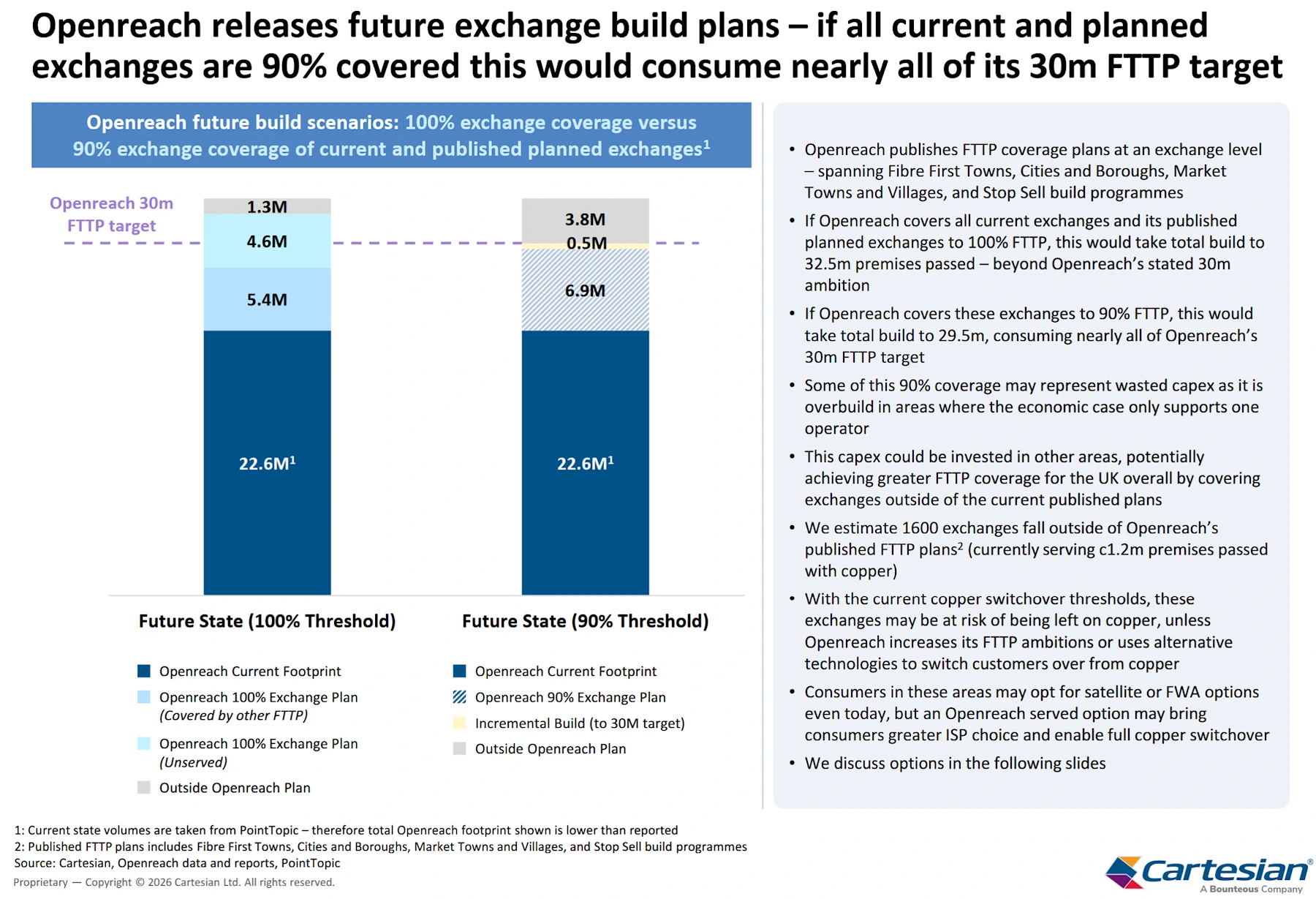
The figures are of course open to debate and different interpretations, and we’ve already covered this issue before (here). Currently, 1.4m premises from rural exchanges are unserved by fibre, but Openreach also has yet to set a firm build plan for going beyond their current target of 25 million premises (due Dec 2026). As such it’s presently unclear whether Openreach will actually reach 30m by 2030 in the first place or scale-back / delay their ambition.






Mark is a professional technology writer, IT consultant and computer engineer from Dorset (England), he also founded ISPreview in 1999 and enjoys analysing the latest telecoms and broadband developments. Find me on X (Twitter), Mastodon, Facebook, BlueSky, Threads.net and Linkedin.








« EE, BT and Plusnet to Reintroduce UK Home Broadband Activation Fees
Advertisement
Leave a Reply
Privacy Notice: Please note that news comments are anonymous, which means that we do NOT require you to enter any real personal details to post a message and display names can be almost anything you like (provided they do not contain offensive language or impersonate a real person's legal name). By clicking to submit a post you agree to storing your entries for comment content, display name, IP and email in our database, for as long as the post remains live.
Only the submitted name and comment will be displayed in public, while the rest will be kept private (we will never share this outside of ISPreview, regardless of whether the data is real or fake). This comment system uses submitted IP, email and website address data to spot abuse and spammers. All data is transferred via an encrypted (https secure) session.















If AltNets are struggling to establish sustainable business models, perhaps they should increase their prices to realistic levels rather than relying on debt-backed funding to keep them afloat.
Not to mention the BDUK money that gets given only for Openreach to overbuild the same premises with their commercial build as happened in North Newington near me.
As you’re aware they have to charge aggressive prices to obtain market share. Their primary goal at the moment is getting their networks connected to as many homes as possible. They don’t have the luxury of pre-existing anchor tenants and wholesale customers with large existing retail customer bases.
They’re obviously going to aggressively go after market share: most of their costs are fixed. Once a customer is installed serving them is very cheap, costs are not linear with customer base.
@Big Dave
BT Group has the customers that justify the deployments. The Altnets are effectively seeking local monopolies to protect their interests.
@Polish Poler
Indeed, the businesses have been operating in growth mode; however, the UK is nearing completion of the rollout, while the growth models have already become invalid. They are, in the main, no longer being funded to the extent necessary to enable them to go aggressively after market share. Thus the players need to transition to sustainable business models by large-scale cost reductions and increased revenues.
The alternatives are continued funding from private equity or liquidations of investments that would facilitate consolidation.
Private equity itself is in an increasingly difficult position, with concerns being flagged all around the world. External funding of UK broadband investments has already largely dried up for both the AltNets and established players, with it increasingly likely that some investors will need to liquidate assets to safeguard their own prospects. Thus, increasing returns on assets now would help facilitate those consolidations by making the assets moreattractive foracqusition.
It makes sense to include altnet fibre in fibre coverage requirements. I wonder what is the rationale for requiring specifically Openreach fibre.
Probably competition, with Openreach you have a wide choice of ISPs, who can either build their own backhaul, or use BT Wholesale. Many altnets have either no ISP choice or very limited.
My own home was until recently VM only for speeds above 10M, and that wasn’t ideal
It would make sense for Openreach to be able to use similar rules to the BT USO, ie being able to dump customers onto an altnet or an alternative where it would be truly unviable to serve using fibre.
It would not make sense for one operator to be required to reach an unsustainable coverage goal. That sort of thinking made sense in the monopoly era but not in the era where Openreach face rigged competition. If the government wants Openreach to fill in the gaps where the cherry pickers won’t go, then they can subsidise it.
Agreed. Here in small town rural Wales, there’s no hope in hell that any altnet will ever build here, let alone out in the country. Openreach have been picking up the pace over the past 2 years in stringing fibre and shed loads of new poles to far out places, and it’s only relatively recently – in the past 6 months – that a lot of sizeable places have been getting FTTP from OR. Rollout had been glacial until recently, with many places on pathetically slow ADSL that constantly dropped (if they could even get that). If Govt want to push everything online, then OR need to be subsidised to push fibre into every nook and cranny, because a lot of rural businesses are on the end of a piece of damp string.
Completely Agree. An Altnet came into my home village with plans to provide fibre to the BT/OR customers premises – in actuality only ‘Cherry Picked’ to village centre and left the rest to Bt/OR. Now all those few people who have moved to the Altnet’s offering are now moving back to OR’s fttc offering as it is cheaper…
Well, people wanted more networks to choose from, this is the consequence. OFCOM know that these Alt nets of left alone in an area will raise prices for consumers unfairly and they don’t trust the national infrastructure will be secure in the hands of a random company. So rather than risk it they will force the one company they can to get coverage everywhere.
Exactly, every time overbuild was discussed here people championed it when others predected these exact issues.
But hey at least some got choice while others got no connection at all.
Regarding “premises like certain farms that may exist too far away from the road” I have always advocated Fibre To The Gate (FTTG).
Some premises are excluded due to the final connection both houses up private roads or remote farms.
Farmers are particularly good at digging their own trenches and I am sure enterprising contractors can assist technically. The ONT can be contained in a suitable enclosure either powered by a Solar power station (as used on electric gates etc) or over PoE from a router or other. Not cheap but cheaper than public subsidy or uneconomic provision.
Ideally there would be more development and general availability of consumer fibre, Gfast extenders etc for long distance ONT to router solutions.
Currently OR nor Alnets appear to offer FTTG as a service.
Either that or issue CSP with a fibre socket allowing a plugin fibre extension to lead from that to the ONT in the farmhouse. It can’t be that difficult to manufacture a socket on the end of a fibre that matches the plug that fits into an ONT.
My assumption is that the Network Provider would want a clear demarcation hence the FTTG ONT. The customer can then choose their own solution which would hopefully be a lot less.
I know personally of two farms in mid Wales where there is FTTP on the top road but they are 800m away down in the valley with no mobile signal. Both are currently on FTTC, one is directly buried armoured copper, and the other OH poles. In both cases the copper is serviceable and therefore quite capable of Gfast speeds. Or jointly they could dig a joint trench splitting to the two homesteads or to a suitable WIFI point on a pole. in sight of the homesteads. There are lots of combinations and approaches that would be rejected by Network Providers.
Extending the network optical cables to a revised ONT position are supported by some providers but normally this is internal and limited to say 10m. Any longer and its back to physics.
@Meadmore – which technology is that which is “quite capable” of providing G.Fast speeds over a copper run of 800m? It’s gonna be fibre or PtP RF (if line of sight is achievable) to manage that.
Pretty impressive for community fibre to get a 3rd of take-up considering they have vast overbuilds with virgin, openreach and hyperoptic
I was surprised at how small G.network is, and their low takeup.
In my part of Zone 2 North London close to Zone 1, my only two fibre options are Openreach and G.network (narrowly missed by Virgin, no change from initial Cable TV install days). If you are taking a landline, currently Sky via Openreach was my cheapest option (customer retention discount, recently swapped from VDSL to FTTP likely subsidised by Openreach, local exchange 500m away is one of the ones that is early on the closure list, to move to 2km away).
Business broadband Voneus also passes my house as a PIA install in Openreach ducts, but that’s not currently an option for a retail domestic connection (unless I wanted to pay lots for a full business install).
I realised that I failed to make one point.
I would be concerned with taking G.network as my sole option, especially since I understand G.network nearly went into administration (bought by a distressed company specialist and “recapitalised”), especially since my OH is self employed and works from home so needs reliable broadband and an ability to retain the current landline number.
Feels like someone needs to take over G.network to market their fibre better and give customers confidence to sign contracts, maybe a network where the G.network properties passed is not too much of an overbuild to their existing network. I think community or city are in nearby streets and are not too overbuilt; not sure I would welcome VMO2 as option (is VMO2 doing PIA? if not that’s would be some digging to extend from closest nearby connection)
Wall Street Brokers have this week started making margin calls on investment funds. It is not widespread at the moment, but if this develops into a trend we might just see some fire sales in the UK broadband sector.