Hints of IPv6 adoption show up at broadband ISP Virgin Media and O2 UK

Nearly a decade has passed since broadband provider Virgin Media (VMO2) first informed ISPreview that they planned to adopt the Internet Protocol v6 (IPv6) addressing standard (here) and we’re still waiting. The situation around mobile operator O2 is similar, with both still relying primarily on IPv4 addresses. But there are signs of a change in the air data packets.
Internet protocol addresses (IP) help connect you and your devices or software with others around the online world – like an ID number for your connection. Unfortunately, the IPv4 address space could only handle 4.294 billion addresses and that supply has long since been exhausted (except for the resale of existing address pools), which means that in the future ISPs will need to use the new IPv6 standard in order to continue adding new connections without compromise (e.g. IP address sharing / CGNAT is a compromise that can cause problems).
Sadly, the longer form IPv6 addresses are not directly compatible with older IPv4 addresses and so the two usually need to be run side-by-side (i.e. at least until the vast majority of the world has enabled IPv6). The good news is that there are various ways to resolve this challenge, but some providers have been dragging their feet for much longer than others, with Virgin Media and O2 being two of those holdouts.
Advertisement
Over the last decade we’ve seen the operator test a number of different approaches to deploying IPv6, some of which were better than others. But for whatever reason they’ve never actually got around to launching it, despite much of their network and hardware now technically being in an IPv6 ready state. But we did spot some hints of IPv6 adoption at O2 back in 2024 via AS35228 (here).
What’s changed?
Several of ISPreview’s readers have in recent weeks directed our attention to APNIC’s latest chart of IPv6 adoption on Virgin Media (AS5089). In short, after several years of not doing much (i.e. IPv6 capability has remained at a low c.0.2% level), the level of IPv6 Capability has started to rise quite quickly over the past month.
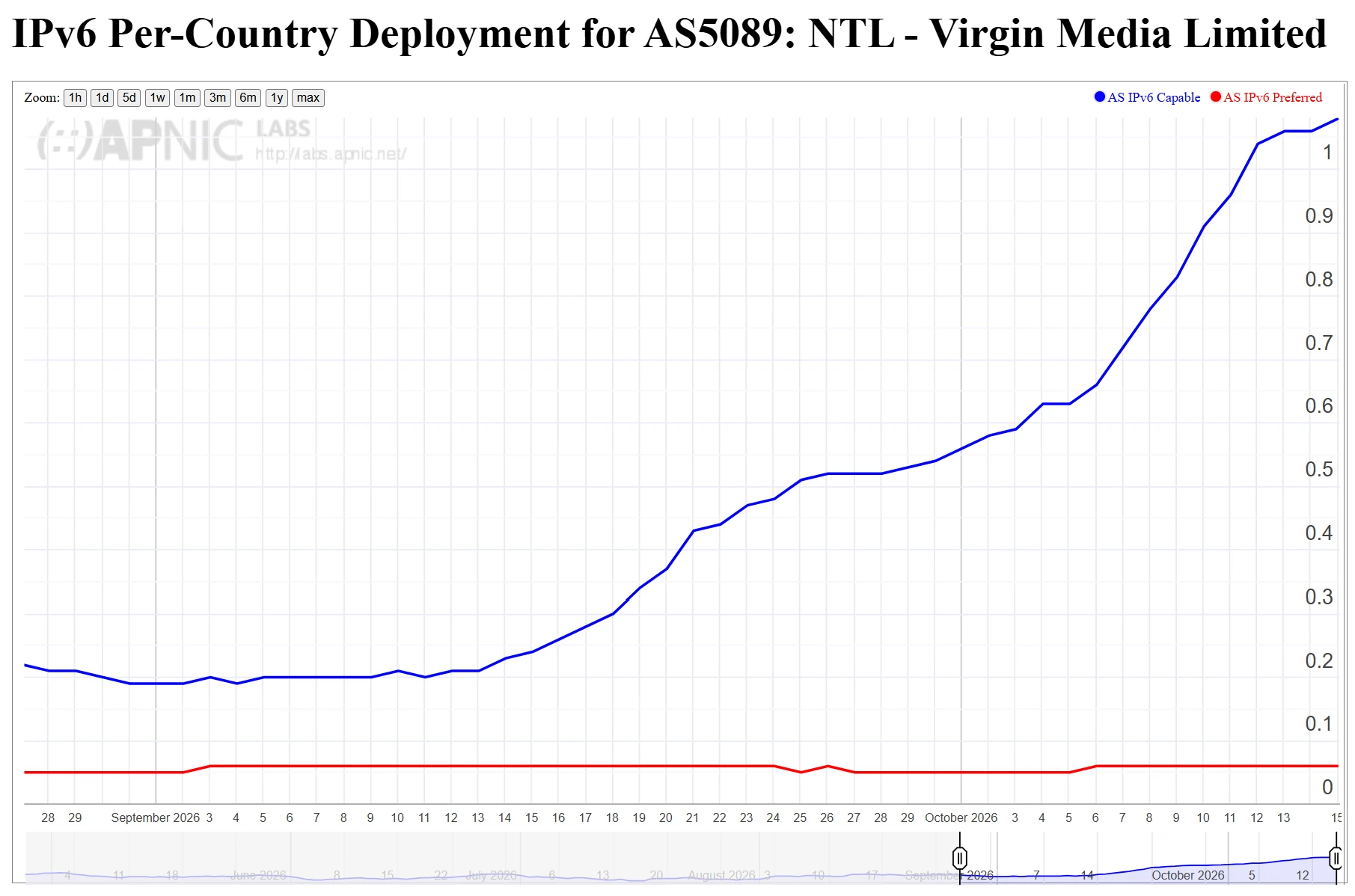
The increase began around the middle of September 2026 and has now reached nearly 1.1%, which in the grander scheme of things isn’t all that much, but after literally years of little change it’s a notable development and reflects an increase of several times the prior value. At present this is continuing to rise on a daily basis, although we wouldn’t be surprised if it began to plateau soon as that would perhaps hint toward a customer trial.
Advertisement
One key thing to point out here is the difference between that blue (IPv6 Capable) and red (IPv6 Preferred) line. The blue line reflects a connection/device that has IPv6 connectivity available and can successfully communicate over IPv6, although it doesn’t necessarily mean IPv6 is being used for the majority of traffic (e.g. you can also get an IPv6 address assigned that doesn’t actually work).
By comparison, the red line reflects a connection that is actually using IPv6 preferentially when communicating with destinations that support both IPv4 and IPv6. The red line hasn’t moved yet, which to us suggests that more of Virgin Media’s network is becoming IPv6 capable, but that those parts aren’t yet activated to fully harness it (i.e. possibly early preparations for a trial or wider deployment).
Similarly, we’ve also recently been seeing a rise in active IPv6 connections over at O2 Broadband / Telefonica UK’s AS35228 network, which has more gradually reached about 1.36% adoption over the past few months after previously hovering around the 0.4% level for some considerable time. ISPreview did query all this with VMO2, but the provide said they had “nothing to announce at this stage“.



Mark is a professional technology writer, IT consultant and computer engineer from Dorset (England), he also founded ISPreview in 1999 and enjoys analysing the latest telecoms and broadband developments. Find me on X (Twitter), Mastodon, Facebook, BlueSky, Threads.net and Linkedin.












« VMO2 may revive defunct UK telecoms brands Virgin Mobile and O2 Broadband
Advertisement
Leave a Reply
Privacy Notice: Please note that news comments are anonymous, which means that we do NOT require you to enter any real personal details to post a message and display names can be almost anything you like (provided they do not contain offensive language or impersonate a real person's legal name). By clicking to submit a post you agree to storing your entries for comment content, display name, IP and email in our database, for as long as the post remains live.
Only the submitted name and comment will be displayed in public, while the rest will be kept private (we will never share this outside of ISPreview, regardless of whether the data is real or fake). This comment system uses submitted IP, email and website address data to spot abuse and spammers. All data is transferred via an encrypted (https secure) session.















“Nothing to announce at this stage” aka know one knows what they are doing and waiting for an email to go through to 27 different departments before the PR team know?
when I was on O2 recently I noticed that their DNS servers were DNS64 – maybe another sign?
Wow, that surprised me. I thought Virgin would have vbeen using IPv6 long ago.
Granted for the most part it makes little difference to most people, maybe it is because of ISPs holding back that it is taking so long for Ipv6 to be adopted.
It is almost entirely an ISP issue. Most people will take whatever addresses they’re given. All modern hardware and software works with IPv6. It’s purely a case of whether your provider hands you an address or not.
@Andrew Ducker, yes i know it is a ISP issue, well to supply IPv6 to consumers, but maybe if they have moved their behinds, then more sites would be using Ipv6, but they are not going to because they will lose most of their visitors.
My ISP have been using Ipv6 since they started as far as I know, but it makes no difference I don’t think to me.
I was surprised to find an IPv6 address on my Vodafone mobile last week and it seems they also started doing something
I have also occasionally had working IPv6 on Vodafone mobile. Hopefully this will become the norm soon.
Not on Smarty, I don;t know if that is because the three network don’t support it or that smarty don’t support it.
Those that have seen IPV6 appearing on their kit, what IPV6 settings are required, particularly if running their router in modem mode. I have seen Unifi kit prompting that IPV6 is available.
you never get a proper response.
there was a reddit forum the other month saying someones ubiquity router said ipv6 was available on virgin but iirc they never explained their settings
I have a ucg-ultra connected to my hub5 that is in modem mode.
I’ve just tried enabling ipv6 with SLAAC & DHCPv6 and still no IPv6.
to be honest I’m in no rush to jump onto ipv6.
I get IPv6 via apples private relay & so long as my stuff works, who really cares.
we are entering a time when the actual IP of the service you connect to is irrelevant, its all about DNS.
load balancers mean the IP your machine connects to isn’t actually the IP of the site, it’s just the IP to access the site!!
Most of us connect to internet services via https/tls & SNI means an unlimited number of of tls websites can be hosted on an individual IP so the main issue becomes client side.
yes client address is important to ensure traffic gets back to the requestor but IP overdrive (aka NAT) is sorting that for most hence why no one is in any particular rush for IPv6 as everything is just working fine.
I’m surprised by this. I’ve been on BT for a few years now and they’ve always had native IPv6. My Windows 11 PCs use it preferentially, and performance is noticeably poor if they drop back to IPv4 for some reason. Websites take significantly longer to load.
You’ve got to laugh or else you’d cry.
About time Offcon made it mandatory for ipv6 for all ISPs giving thats its at least a couple of decades established protocol.
I remember attending a presentation on the launch of 3G after the very expensive spectrum auction in 2000. At the time IPv6 had been mandated for every 3G device.
It was realised this was going to be virtually impossible to implement in time and NAT was used to manage the limited pool of IPv4 addresses.