Streetwave compare Northern Ireland’s rural vs urban mobile broadband speeds
Telecoms network analyst firm Streetwave has today published the results of a new study, which uses data collected from bin lorries to show how real-world mobile network (4G, 5G) coverage and data speeds vary across Northern Ireland between rural and urban areas, as well as via different mobile operators. Suffice to say, rural connectivity has a lot of catching-up to do.
The company usually works by harnessing waste bin (refuse) collection lorries to map mobile network coverage and data speeds across various parts of the UK (e.g. here, here, here, here and here). In this setup, rubbish collection trucks are installed with several off-the-shelf Smartphones using special software, which run continuous network tests (once every 20 metres in rural areas and 5m in urban areas) as the vehicles go around their routes. But in this case Streetwave used their own drive testing teams to conduct the work.
The data they collect is often then used by local authorities to help identify areas that may require additional intervention in order to improve local mobile coverage and or network capacity, while also giving local people free access to some of this data via address-based coverage checkers and interactive maps (https://app.streetwave.co/coverage-checker/).
Advertisement
The latest study into mobile broadband performance and signal strength across Northern Ireland, which was run between September 2025 and June 2026, is based on drive testing conducted across over 20,000km of road driven and 4.4 million test cycles on EE, O2, Vodafone and Three UK. The overall results and then split by two measures – ‘Basic Performance‘ and ‘Good Performance‘.
Basic Performance reflects locations where mobile networks provide users with broadband speeds of above 1Mbps download, 0.5Mbps upload, and less than 200ms (milliseconds) of latency / RTT (i.e. supporting only the most basic of use cases or needs). Good Performance is defined as the percentage of locations surveyed where a user receives at least 5Mbps download, 1.5Mbps upload speeds and less than 100ms latency (RTT) – allowing most use cases like HD video streaming or conference calls to be run.
The results for Northern Ireland
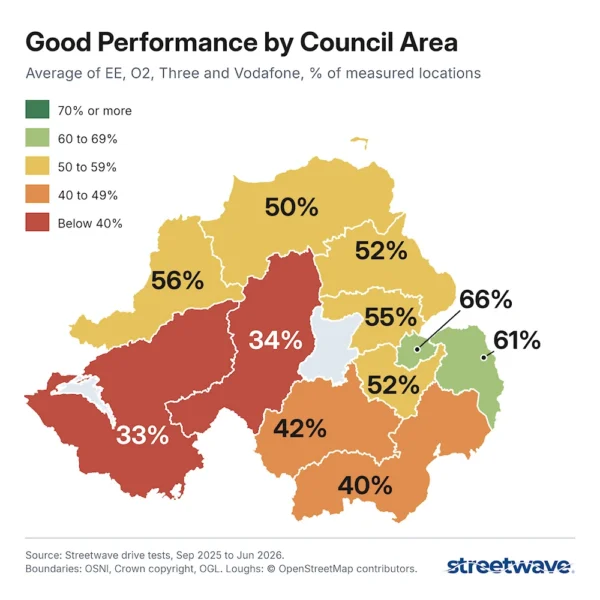
Overall, Good Performance was found to have reached 66% of measured urban locations, but this fell to only 39% for rural ones. Similarly, 45% of rural measured locations on Northern Ireland’s roads missed Basic Performance, needed for a call over data or an email, against only 19% in urban areas that missed the same basic measure.
No network reached Good Performance at even half of rural measured locations. Vodafone came closest at 44%, with EE at 43% and O2 at 38%. Vodafone also had the best rural Basic Performance result, though it still missed that standard at 39% of rural measured locations.
Advertisement
Good vs Basic Mobile Performance (N.Ireland)
| Good Performance (%) | Basic Performance (%) | |||
| Urban | Rural | Urban | Rural | |
| All Networks (average) | 66 | 39 | 81 | 55 |
| EE | 72 | 43 | 86 | 59 |
| O2 | 66 | 38 | 81 | 53 |
| Vodafone | 72 | 44 | 85 | 61 |
| Three | 54 | 31 | 70 | 46 |
The two most rural council areas, Fermanagh and Omagh and Mid Ulster, had the two lowest results on every network. There, the best network reached Good Performance at 39% and 40% of measured locations respectively. Belfast led on all four networks, with EE reaching Good Performance at 73% of measured locations.
Mobile Performance by Council Area and Operator
| Good Performance (%) | Basic Performance (%) | |||||||
| EE | O2 | Vodafone | Three | EE | O2 | Vodafone | Three | |
| Belfast | 73 | 66 | 72 | 54 | 88 | 81 | 85 | 70 |
| Ards and North Down | 67 | 59 | 65 | 51 | 82 | 75 | 79 | 66 |
| Derry City and Strabane | 64 | 52 | 59 | 47 | 74 | 65 | 73 | 64 |
| Antrim and Newtownabbey | 58 | 56 | 58 | 47 | 75 | 71 | 78 | 65 |
| Lisburn and Castlereagh | 57 | 49 | 57 | 45 | 76 | 66 | 75 | 61 |
| Mid and East Antrim | 58 | 50 | 55 | 44 | 73 | 66 | 70 | 60 |
| Causeway Coast and Glens | 54 | 52 | 58 | 36 | 70 | 67 | 74 | 51 |
| Armagh City, Banbridge and Craigavon | 42 | 46 | 49 | 32 | 61 | 64 | 65 | 48 |
| Newry, Mourne and Down | 41 | 38 | 43 | 39 | 56 | 54 | 58 | 55 |
| Mid Ulster | 40 | 35 | 38 | 22 | 55 | 49 | 54 | 35 |
| Fermanagh and Omagh | 39 | 29 | 37 | 25 | 54 | 43 | 56 | 41 |
On top of this, the College of Policing notes that a live stream from a body-worn camera (bodycam) needs a strong, stable signal and may be unreliable where connectivity is poor. Police commanders use that live video to monitor incidents remotely and give officers tactical advice sooner.
Advertisement
On average, the four networks were ‘Ready’ for the above use case at 58% of urban measured locations and 33% of rural ones. Switching to whichever network worked best at each location would not close the gap. At a third of rural measured locations, even the best network was ‘Not Ready’.
Take note that in order to be considered ‘Ready’ a mobile network must support uploads of at least 3 Mbps and round-trip latency of 200 ms or less, enough for a high definition stream at a medium frame rate. In order to be considered of ‘Marginal’ readiness, the network must support an upload of at least 2 Mbps and round-trip latency of 300 ms or less. Anything else is ‘Not Ready’ due to low picture quality or unreliable streams.
Angus Hay, Chief Executive Officer and co-founder of Streetwave, said:
“Delivering mobile coverage in rural areas is commercially challenging, and this survey is clear evidence that more needs to be done. We join Mobile UK in urging government to treat mobile networks as critical national infrastructure and support the reinvestment of annual spectrum licence fees in rural coverage. Mobile connectivity is the bedrock of the rural economy, essential to businesses and communities.”
The full Urban vs Rural Mobile Network Performance report can be found here.



Mark is a professional technology writer, IT consultant and computer engineer from Dorset (England), he also founded ISPreview in 1999 and enjoys analysing the latest telecoms and broadband developments. Find me on X (Twitter), Mastodon, Facebook, BlueSky, Threads.net and Linkedin.












« Fibrus faces objection to its broadband poles from Barrow Town Council
Advertisement
Leave a Reply
Privacy Notice: Please note that news comments are anonymous, which means that we do NOT require you to enter any real personal details to post a message and display names can be almost anything you like (provided they do not contain offensive language or impersonate a real person's legal name). By clicking to submit a post you agree to storing your entries for comment content, display name, IP and email in our database, for as long as the post remains live.
Only the submitted name and comment will be displayed in public, while the rest will be kept private (we will never share this outside of ISPreview, regardless of whether the data is real or fake). This comment system uses submitted IP, email and website address data to spot abuse and spammers. All data is transferred via an encrypted (https secure) session.















Basic should be 10mbs and good should be 50mbs.