Openreach Consults UK Broadband ISPs on Copper Switch-Off UPDATE
Openreach (BT) has today officially launched its first major industry consultation on the process of switching from their old legacy copper broadband and phone lines to new ultrafast Fibre-to-the-Premises (FTTP) infrastructure, which includes discussions over how they should “eventually retire the existing copper network.”
At present the network access provider is in the process of deploying “full fibre” FTTP technology to cover 3 million homes and business by the end of 2020 (March 2021 financial) and after that they have an ambition to reach 10 million premises by around 2025, although the latter is still contingent upon some degree of industry, Government and Ofcom agreement over how this is done.
Pure fibre optic networks like this typically run their optical fibre cables all the way to your doorstep and use laser light to deliver significantly faster speeds (e.g. multi-Gigabit), as well as a much more reliable service. At present a lot of countries are busy deploying FTTP networks like this and at some point that means the older, slower and less reliable copper lines will need to be switched off (too costly to keep both running side-by-side).
Advertisement
Suffice to say that this move from a heavily regulated copper network to a new FTTP platform presents more than a few challenges. Some of that work, such as the gradual switch from analogue phone (voice) services to an all-IP (VoIP etc.) style network, are already taking place and should complete by 2025.
However the physical switch-off of copper will be a much longer and more complicated process. Indeed it’s highly likely to take longer than the Government’s current aspiration of 2033 for “nationwide” coverage of FTTP.
Scope of their New Consultation
Openreach is seeking input from Communications Providers on three key areas:
* How it builds the new network, which is growing fast.
* How the industry should migrate customers smoothly onto the Openreach network, once it’s built and;
* How Openreach should eventually retire the existing copper network.
Within the consultation, Openreach has also outlined a number of guiding principles, which it says will be crucial to achieving a successful transition. These include:
* Building contiguous footprints within its exchange areas to avoid creating new not-spots.
* Working closely with CPs to upgrade every customer in those areas quickly once the new network is built.
* Offering a compelling, simple portfolio of products that supports new retail voice and broadband services.
* Upgrading the large majority of people voluntarily, whilst developing an industry process for late adopters.
* Withdrawing copper-based services progressively.
* Developing a consumer charter with industry and Ofcom that encourages transparent communications to homes and businesses affected, and includes protections for vulnerable customers.
Openreach has previously indicated that ideally they’d like to gradually switch off the old copper network as the new FTTP one goes live (exchange by exchange), which would reduce their maintenance costs and thus turn “full fibre” into a much more attractive investment. If only it was that easy.
As usual there are some big roadblocks here in terms of both regulation and competition. For example, FTTP is a more expensive service and not all customers will be happy about being forced to pay extra for something that they might not need. Not to mention the extra disruption of a new fibre line installation. A lot of modern regulation is also based around copper infrastructure and this will have to be overhauled by Ofcom.
Advertisement
Several ISPs have also invested heavily in unbundled copper lines (e.g. Sky Broadband, TalkTalk, Vodafone) and might be reluctant to let go of that asset, which is further complicated by the fact that some of those same providers are already building their own rival FTTP networks. Competitive interests and regulatory complexity are tricky areas to tackle, leaving plenty of scope for legal fights and delays.
Katie Milligan, Openreach MD for Customer, said:
“More than 16 million homes and businesses could order better broadband connections over our network right now, so we’d encourage everyone to check the services available to them and upgrade today.
At the same time, we’re consulting with broadband providers to decide how and when we upgrade customers to even faster, more reliable and future-proof, full fibre broadband.
Our new network will place the UK at the forefront of the global digital race and provide a major boost to the UK economy, so we’re determined to create a plan that will benefit of every UK community, by upgrading customers quickly, smoothly and affordably.
We believe this consultation is crucial to that process, and it will support further investment from across the industry. We’re really ambitious about upgrading the UK to the fastest, most reliable broadband there is.”
Margot James, UK Minister for Digital, said:
“We’re building a Britain that’s fit for the future, and our plans for a national full fibre broadband network underpin our modern Industrial Strategy. Upgrading to gigabit capable connections will benefit homes and businesses all across the UK.
I welcome Openreach’s consultation on how to make this process as simple and efficient as possible whilst ensuring a competitive market is in place for all consumers and infrastructure providers.”
At this point it’s worth noting that a lot of other countries in Europe, while broadly well ahead of the United Kingdom in their FTTP roll-outs (here), have only made “limited progress” toward the copper switch-off. At least that was the view of a recent report from the FTTH Council Europe on this very issue (here).
Naturally those who aren’t reached by FTTP in the UK until 2033 will still need to use that copper network (e.g. FTTC, G.fast broadband), which means a complete switch-off would be unlikely to happen until after FTTP has reached all corners of the country on Openreach’s own network (likely to be years after 2033 since that date won’t be met by Openreach alone – other operators are also deploying fibre).
Indeed consumers will need to be given some time to adapt and consider their options, particularly when confronted by the possibility of another price rise and more work on their property. Explaining this to vulnerable users (pensioners, those with a disability etc.) may prove to be particularly difficult. Providers will no doubt fear a hostile reception from some customers.
Advertisement
However the prize for getting this right is not to be overlooked. As Openreach says, “the transition will also deliver huge benefits to the industry and UK in general, providing greater broadband speeds and reliability, a significant boost to productivity and competitiveness, and a digital platform that’s expected to serve homes and businesses here for many decades to come. ”
The new consultation will be open for six weeks until 3rd May 2019. After that, Openreach will publish a summary of responses along with its next steps. We should add that there are are 5,500 Openreach exchanges across the UK and around 1,300 of those serve 75% of premises. A typical exchange area in a town or city serves 20,000 to 30,000 premises.

UPDATE 1:58pm
We’ve now had a chance to read through the private consultation document and have noted a few useful pieces of information, although it should be said that this is all very much subject to change. Openreach have only just begun the process of consulting upon and designing a solution.
Firstly, the operator will soon start to trial their exchange-based approach to migration. Under this approach they will upgrade a town or city in 2019 and then work with ISPs to trial migration, with the target being to achieve a complete move to FTTP by the end of 2022. A location is still to be selected, although Salisbury sounds like a viable option given this week’s universal coverage news (here)
Secondly, upon reaching the “stop sell” point, Openreach said they would first need to declare an exchange as being “ultrafast enabled” (target for this is 24 months after roll-out starts).
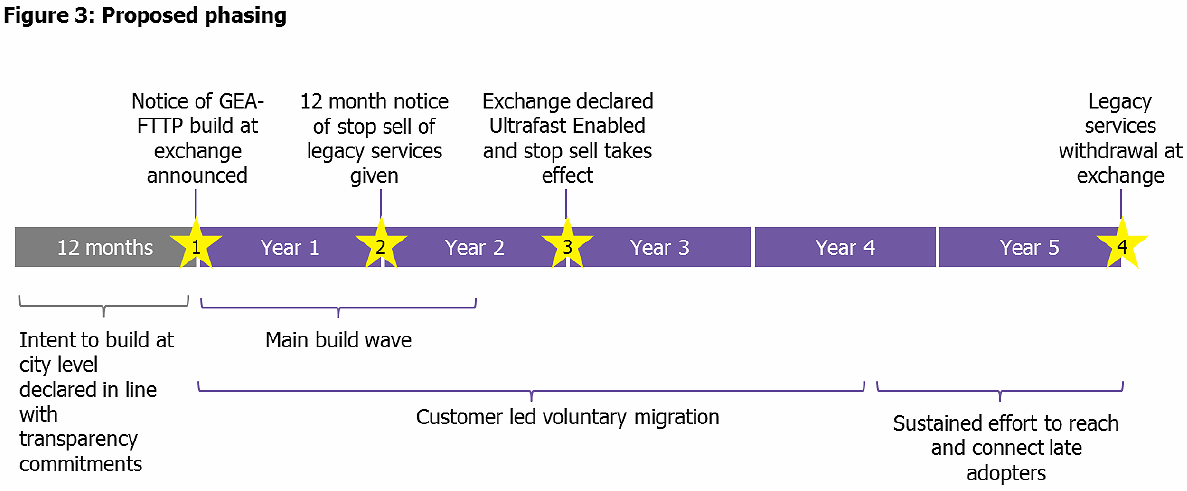
In reality this status would be achieved once 75% of premises in that exchange are able to receive an “ultrafast” service, which they say could be via FTTP, G.fast and oddly even “vectored VDSL” (FTTC). After this it may be another 3 year wait before legacy copper services are fully switched-off.
The current FTTC/VDSL2 product only goes up to 80Mbps and Openreach never universally implemented (only selectively) Vectoring on that (this could push it over the 100Mbps+ “ultrafast” level), which was due to various technical and regulatory problems. Some of those issues still exist and VDSL2 would struggle to hit 100Mbps on a lot of lines, so we suspect this may not be a serious large-scale option without big changes.
Thirdly, Openreach have already reduced their G.fast roll-out plan from 10 million to 5.7 million premises by 2020, which was due to their greater focus on FTTP. Today’s consultation notes that they might in the future need to take an even more targeted approach to G.fast deployments (i.e. only using it in specific areas as part of the FTTP roll-out strategy). Put another way, the roll-out may shrink or perhaps they might do deeper FTTdp based G.fast (closer to homes via smaller nodes).
Fourthly, the proposed plan seems to involve Openreach offering a revised “anchor” service at the 40Mbps (10Mbps upload) level for FTTP, which could be used to entice customers off slower copper ADSL2+ broadband lines. This product could be at a regulated price (like the same tier on FTTC today), albeit probably with a “small premium” over slower alternatives to reflect the greater value of FTTP. They may also offer this via G.fast too.

Mark is a professional technology writer, IT consultant and computer engineer from Dorset (England), he also founded ISPreview in 1999 and enjoys analysing the latest telecoms and broadband developments. Find me on X (Twitter), Mastodon, Facebook, BlueSky, Threads.net and Linkedin.












« Openreach Replace Graffiti on Sheffield UK Street Cabinets with Art

















Comments are closed