Openreach Records 10 PetaByte Peak in UK Internet Traffic

Openreach (BT) has reported that data traffic over their UK network reached its highest peak in the last 90 days on Wednesday 29th April 2020, which saw the operator hit the daily 10 PetaBytes (per hour) level “for the first-time since lockdown.” The peak was driven by the COVID-19 impact and some video game software updates.
Ordinarily there wouldn’t be much point in remarking on new peaks in traffic since data consumption is almost constantly on an upward trend (i.e. new records are always being set), although the current increase in daytime traffic from domestic broadband ISP connections – due to the COVID-19 (Coronavirus) crisis (more people working and playing from home) – makes everything a bit more interesting.
We’ve already seen how major software releases and updates can have a significant impact on internet traffic, such as with the release of the free ‘Call of Duty: Warzone‘ game on 10th March 2020 (here); that occurred just before the hard lockdown period began. We also note that since around late February Openreach’s weekly UK data traffic has increase by more than 20% (here).
Advertisement
However that combination of the COVID-19 lockdown and a double whammy of video game updates (both ‘Call of Duty’ and ‘Fortnite’ saw big content releases) have just managed to eclipse many of the previous peaks, which pushed traffic beyond the 10 PetaBytes level.

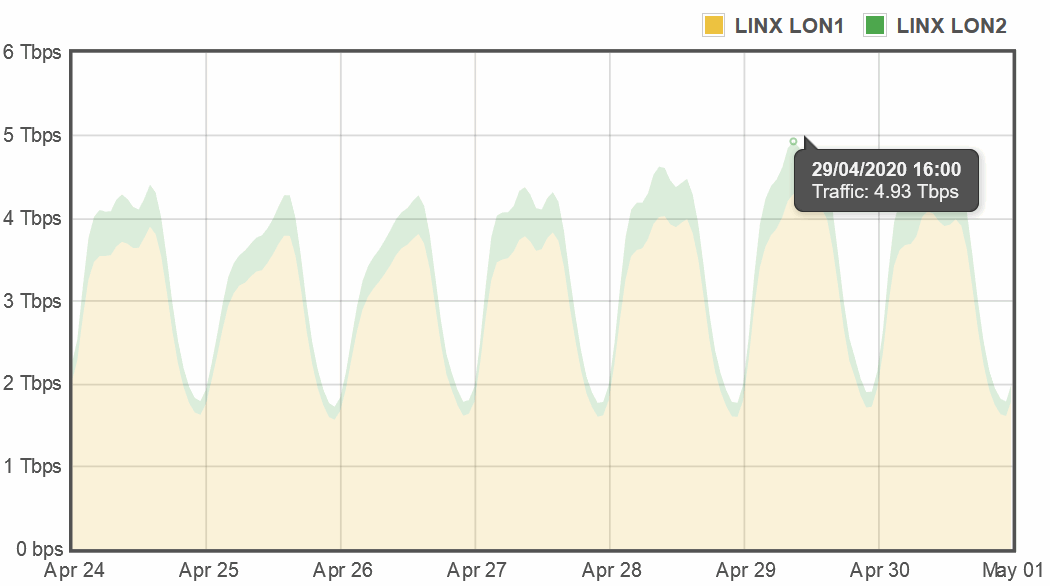
Just for some extra context we’ve also added a summary of traffic passing over the London Internet Exchange (LINX) below, which covers the past week and shows traffic over both their primarily LON1 and LON2 switches achieving 4.93Tbps (Terabits per second) on 29th April at 4pm (during normal times the peak would be later as people come home from work and school etc.). This is still lower than the 5.1Tbps+ we’ve seen before but it remains an impressive surge.
As usual we didn’t see any major increase in complaints from consumers about slow broadband speeds, which is partly because any associated decreases – if they occur at all – would usually only be very small. Likewise UK ISPs have by now completed most of their main core network tweaks to boost capacity (mostly as a result of the COVID-19 impact on domestic connectivity).
Advertisement















« Three UK Zero Rates NHS Video Consultations for All Customers















Comments are closed