Ofcom Adds 39GHz as Option for Supplying WiFi on UK Trains

Ofcom has today updated their advice to the UK Government on spectrum bands suitable for providing “trackside to train connectivity,” which adds the 39GHz band as a possible option. In the future this could be used to support on-board ultrafast broadband capable WiFi access points or mobile (4G, 5G) small cells for commuters.
Back in December 2017 the UK Government pledged to make “uninterrupted” WiFi and Mobile (5G) broadband speeds of up to 1Gbps (Gigabits per second) available on-board all UK mainline train routes by 2025, although since then we’ve rarely seen this mentioned anywhere and earlier this year the National Infrastructure Commission (NIC) similarly questioned whether it will be achieved on time (here).
As part of that the Government asked Ofcom to provide technical advice in order to help identify which radio spectrum bands might be suitable for providing related track-side to train connectivity. The regulator’s updated advice continues to recommend the potential use of the 26GHz (24.25-27.5 GHz) and 66-71GHz bands, but they’ve now also added the 39GHz band as an option.
Advertisement
The regulator’s broad view is that “spectrum availability is not a barrier to improving trackside connectivity.”
The best spectrum options to provide trackside to train connectivity supplying backhaul for Wi-Fi access points or mobile small cells on passenger trains are likely to be the 39 GHz band (39-40 GHz), and the 66-71 GHz band. These bands:
• can support large bandwidths (so could be used to support the amounts of data traffic we expect rail passengers will need by the mid-2020s and beyond); and
• are relatively lightly used (so it would be easier to find spectrum in these bands than in other bands for trackside to train connectivity without causing significant problems for existing users elsewhere).
In addition, relevant equipment to make use of these bands is already available, or is expected to become available soon.
In addition to the two bands mentioned above we continue to believe that the 26 GHz band (24.25-27.5 GHz) is also suitable. We are currently considering our future licensing approach for this band to facilitate its use for 5G. Part of this consideration will be how we might facilitate its use for trackside to train connectivity if there is demand for this.
The other bands discussed in our 2018 advice are much less suitable. This is because we don’t think they will be able to support the high data speeds that are likely to be needed to provide passengers with a good wireless connection by the mid-2020s.
Just to be clear, we’re talking about the capacity supply to a moving train, rather than the end-user link itself. Connections to mobile devices and laptops on-board would thus still be made (distributed) to you via the normal mobile and WiFi bands (e.g. 2.4GHz).
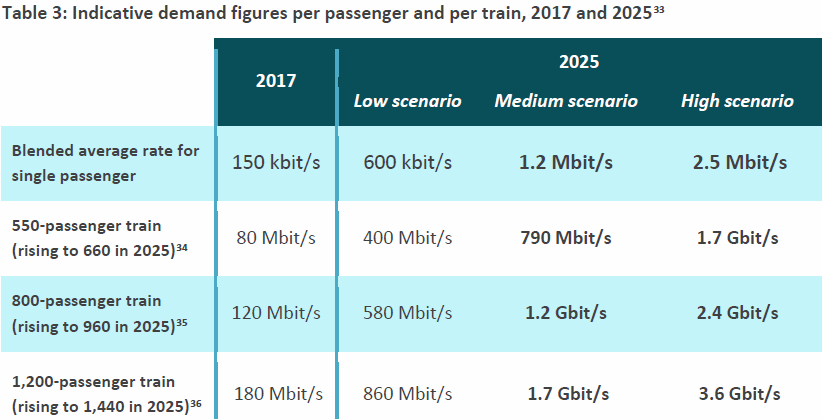
We should remind readers that the original report also calculated how much data (bandwidth) the average passenger might require if demand in 2017 was “unconstrained“, which resulted in a figure of just 150Kbps (0.15Mbps). This might seem low but it’s akin to a bare minimum (i.e. if every user was active at the same time and transferring data), which in practice doesn’t usually happen (i.e. fewer users tend to share the capacity).
Ofcom said this meant that a 550-passenger train in 2017/18 may need to be fuelled by 80Mbps of capacity, before rising to 120Mbps for 800 passengers and 180Mbps for 1,200 passengers. But come 2025 the expectations were that such demands would have risen significantly, with an individual passenger now needing between 0.6Mbps to 2.5Mbps (i.e. the capacity needed for a 1,200 passenger train could hit 3.6Gbps).
Advertisement
















« Openreach Build New Drone Training Area to Help FTTP Rollout
















Comments are closed