BT Hit 100% Renewable Electricity Target as Openreach Buys EV
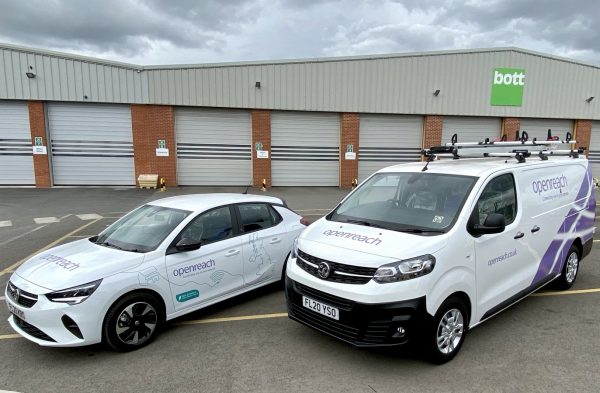
As expected, the BT Group has today announced that they’ve achieved their target of buying 100% of their electricity worldwide from renewable sources. At the same time Openreach has revealed that they will change a third of their 27,000 UK vehicles (engineer vans and cars etc.) to electric by 2025.
At present BT has already pledged to become a net zero carbon emissions business by 2045 and has set targets in line with the most ambitious aim of the COP21 Paris Agreement – linking its targets to limit global warming to 1.5°C. As part of that the operator has just confirmed that their network, offices and shops worldwide are now being powered with 100% renewable electricity.
Making the switch to 100% renewable electricity will help BT to reduce its carbon emissions in the year to March 2021 by an estimated 54,000 tonnes compared to the last financial year, which they claim is the “equivalent of taking around 21,000 combustion engine vehicles off the road for a year.”
Advertisement
Speaking of combustion vehicles, Openreach has already conducted trials with a number of different EVs from Renault (here) and Vauxhall (here), while BT has tested several hybrid electric vans from LEVC in London (here). The good news is that Openreach has now taken the decision to switch a third of their 27,000 strong fleet to EVs (overall the BT Group has a total fleet of 33,000 vehicles).
Cyril Pourrat, BT’s Chief Procurement Officer, said:
“As an organisation that consumes nearly 1% of the UK’s electricity, it is important for BT to demonstrate its commitment to a green recovery. Our team has worked hard to secure renewable electricity contracts for our sites globally, a crucial step towards the Paris agreement’s 1.5°c target.”
Sadly, the announcement doesn’t clarify precisely how long Openreach will take to change so many vehicles, although they have previously called on the UK Government to target 100% electric car and van sales by 2030. On top of that they want to see grants for EVs and charging points to be extended through to at least 2023 and for the Government to speed-up the rollout of public charging-points across the UK.















« O2 UK Boosts 4G Mobile Capacity for 33,109 London Postcodes














Comments are closed