Openreach Consult on Closure Plans for 4,600 UK Exchanges

Network access provider Openreach (BT) has today launched a new consultation on their plans to close 4,600 exchanges across the United Kingdom, which is largely reflective of the inevitable move away from copper-based broadband lines and toward a Fibre-to-the-Premises (FTTP) orientated future.
As we recall Openreach has around 5,600 exchanges at present, but only c.1,000 of these exchanges – so-called Openreach Handover Points (OHPs) – are used to provide nationwide coverage of “fibre broadband” services (FTTC, FTTP and G.fast).
In other words, the rapidly increasing moves toward “full fibre” connectivity (here and here) have long been expected to precipitate somewhat of a consolidation in this area, since fewer such hubs will be required to deliver the new services (i.e. as copper services are slowly withdrawn, then so too will the number of exchanges shrink).
Advertisement
Nevertheless, the removal of any exchange remains a highly complex and long-winded task, which needs to be carefully planned well in advance. Indeed, the new consultation (here) talks about a 20+ year programme of exchange evolution, which sounds about right as a lot of other changes have to be completed first (e.g. ISPs moving consumers to all-IP networks and boosting fibre coverage + take-up).
David Belcher, Openreach’s Strategy and Transformation Directors, told ISPreview.co.uk:
“We’re launching a consultation today to get our customers’ views on proposals to close 4,600 exchanges throughout the UK.
Today these exchanges support traditional copper-based phone and broadband but, as we prepare to take the next step in upgrading the UK’s from analogue to digital, we’re investing in new, fibre-based networks that will support upgrades to faster speeds and digital voice services. That means many of these exchanges will eventually become unviable for both Openreach and Communication Providers (CPs) to operate from, so their closure will be a natural next step.
This is a complex, long term issue with implications for the whole industry, so we want to work closely with our customers and the wider industry to help determine our strategy and plans.”
The proposed plan indicates that Openreach may aim to exit at least 100 exchanges by December 2030 and full decommissioning of all equipment would then follow one year later. After that the process would speed up until the other 4,500 have been completed, which could all occur during the early 2030s. Maintaining continuity of service for end customers will be a key part of all this.
We suspect that concerns may be raised around those exchanges where rival ISPs, such as Sky Broadband and TalkTalk, have invested in unbundling in order to gain more control. Likewise, a large number of exchanges are also used to provide leased line services. As we say, none of this is going to be easy.
Openreach intends to prioritise exchanges where the potential benefits of exit are highest (e.g. those with very high running costs), and to focus on those first. Exchanges like this must also have been well covered by FTTP and must have achieved the relevant FTTP milestones for copper withdrawal by the mid-2020s. No doubt their trials in Salisbury and Mildenhall will provide some useful insight for all this.
Advertisement
The operator will not be withdrawing exchanges in areas where doing so would leave existing customers disconnected (i.e. no fibre or FTTC alternatives).
The First 100 Exchanges (Dec 2030)
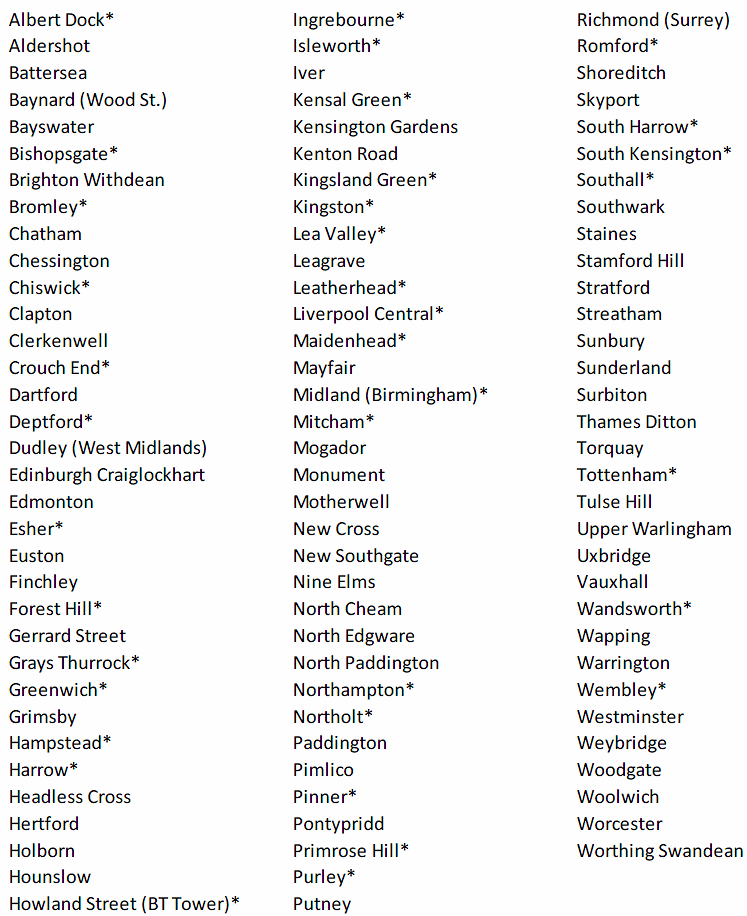
The 36 exchanges marked with an asterisk above are currently Openreach Handover Point exchanges, but only a very few of those will need to be consolidated into other OHP sites and so we don’t expect many more to go the same route (Openreach expects to end up with c.960 OHPs).
Advertisement



Mark is a professional technology writer, IT consultant and computer engineer from Dorset (England), he also founded ISPreview in 1999 and enjoys analysing the latest telecoms and broadband developments. Find me on X (Twitter), Mastodon, Facebook, BlueSky, Threads.net and Linkedin.










« Ofcom UK Rules Out Cost-Based Prices for Full Fibre Until 2031 UPDATE















As usual BT’s policy is upgrade London and a few token cities in the North and completely ignore East Anglia.
BT currently has no money to undertake such a massive project, the exchanges they have already closed far exceeded the budget to do so and the risk was crazy. Legacy systems such as red care alarms, megastream and kilostream which are still in service not to mention the MoD services will all need shifting. PSTN is still a key service and System ‘X’ or ‘Y’ exchanges are fragile so either a technology investment is needed or the exchanges just wont close.
Oh and remember most of the mobile networks, emergency services and coastal systems back off to BT services so any roll out of 5G could be impacted. I looked at this almost 20 years ago so i suspect this is more a statement than a real objective, BT would be better off investing in the core network.
Has anyone managed to get into the Consultation document to find out out which other exchanges are facing closure? (https://www.openreach.co.uk/orpg/home/updates/briefings/generalbriefings/generalbriefingsarticles/gen10720.do)
Or is that list available publicly? Not having any luck myself..
Would someone kindly help me understand if the list provided (100 exchanges) in the published article confirms explicitly that those sites will be retired, closed and fully exited.
I am keen to understand if the Brighton Withdean site will be closed and sold off or repurposes for FTTC.
The outcome will impact me in regards to any post site closure building development plans.
Thanks
Been to well over half of those exchanges working for Monterey and Mitie. As previously stated a lot of exchanges are in a poor state of repair. Shame I miss going around London and the home counties doing a 12 hour night shifts chasing router and cable thefts lol