Ofcom Make Part of 1900MHz Band Available for 5G Mobile on UK’s Rail Network UPDATE
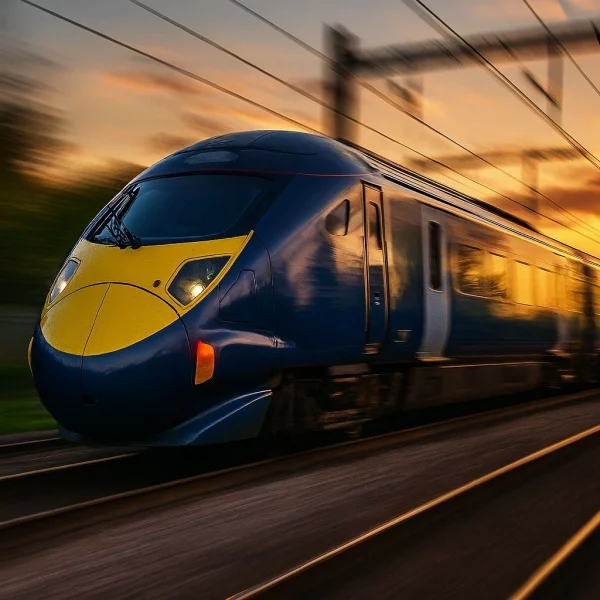
As expected, Ofcom has today confirmed that they will make part of the 1900MHz radio spectrum band (1900-1920MHz), which had previously gone unused by mobile operators, available for use by both the UK’s rail network (5G / data services) and to extend coverage for the 4G Emergency Services Network (ESN).
Mobile operators do in fact make use of the 1900MHz band, just not the 20MHz slice of unpaired spectrum in question (i.e. they lacked an ecosystem for deploying higher-power services). In addition, the need for a guard band against paired spectrum (reducing an already limited pot of spectrum) and the limited bandwidth it offers were also seen as discouraging factors.
Suffice to say that, in March 2024, Ofcom ended up revoking existing licensees’ access to the band with 5 years’ notice, thereby enabling authorisation of new users from 4th April 2029. Instead, the regulator believes the “optimal use” of the first 1900–1910MHz spectrum in the future will be for the latest 5G mobile technology for rail networks: the Future Railway Mobile Communication System (FRMCS).
Advertisement
On top of that, they’ve today decided that the “optimal use” of the next 1910–1915MHz slice in Great Britain will be for providing extended coverage for the Emergency Services Network (ESN), through the use of “gateways” installed on emergency vehicles such as ambulances. But Ofcom is NOT yet proposing to authorise any use in the final 1915–1920MHz part of the band, “primarily because of the power restrictions necessary to protect the mobile band above 1920MHz from interference, as well as uncertainty over demand for the spectrum“.
Authorise 1900–1910 MHz for operational rail communications to enable the rollout of FRMCS throughout the UK. The new FRMCS licences will:
• Be restricted to the provision of operational rail communications.
• Contain technical conditions suitable for the deployment of FRMCS.
• Authorise a geographic area covering the applicant’s rail infrastructure, which would be determined on a case-by-case basis.
• Require technical coordination with other existing or future FRMCS licensees in overlapping or neighbouring geographic areas.
• Have an annual fee of £1,458,000 for a licence covering Great Britain, and £42,000 for a licence covering Northern Ireland. Licences for smaller rail networks would pay a smaller fee, scaled by the length of the rail routes covered.
• Come into effect on or after 4 April 2029.
• Be issued via a simple process, with checks on applicants’ ability to comply with key licence conditions.
Authorise 1910–1915 MHz to enable the use of Emergency Services Network (ESN) gateways in Great Britain. The licence will:
• Be restricted to the provision of ESN gateways by the provider(s) contracted by the UK Government to supply these gateways (currently BT/EE).
• Have a fixed duration, aligned with the contract to supply ESN gateways.
• Allow use throughout Great Britain.
• Contain technical conditions consistent with the requirements of the ESN.
• Have an annual fee of £364,500 for a licence covering Great Britain.
The commencement date for the ESN gateway licence is subject to a further consultation.
At present, we are not authorising use of 1910–1915 MHz in Northern Ireland where the emergency services have different communication arrangements to Great Britain.
We are also not authorising 1915–1920 MHz throughout the UK, primarily because of the power restrictions necessary to protect the mobile band above 1920 MHz from interference, combined with uncertainty over demand for the spectrum.
Despite the April 2029 date, Ofcom are now seeking views on whether or not they can allow access to the 1910–1915MHz spectrum for ESN Gateway use ahead of that date. Finally, FRMCS itself will support greater digitalisation of the UK’s railways by replacing existing 2G technology and “enabling trains, signalling and railway staff to be better connected than before, helping to improve the operation of the rail network“.
UPDATE 26th Jan 2026
Ofcom has now officially decided to make the 1910–1915 MHz spectrum available for the emergency services prior to 4th April 2029, which will include a condition in the ESN gateway licence that ESN gateways must operate on a non-interference, non-protection basis prior to 4th April 2029 (after this date, the condition will fall away).
Advertisement






Mark is a professional technology writer, IT consultant and computer engineer from Dorset (England), he also founded ISPreview in 1999 and enjoys analysing the latest telecoms and broadband developments. Find me on X (Twitter), Mastodon, Facebook, BlueSky, Threads.net and Linkedin.









« BDUK Summarise Progress of UK Project Gigabit Broadband Rollout Contracts














Interesting. GSM-R uses 900mhz in the UK. The use of 1900mhz for FRMCS implies they’ll need to build quite a few more masts to get complete coverage
Why charge for ESN licensing? I know a private company operates the network, but isn’t that ultimately going to be passed on to all of us via general taxation as ultimately, that’s how the emergency services are funded?
Also, will the train operating companies even be interested in that spectrum? If they have something that already works, why would they, or Network Rail want to have to shell out £1.4 million a year to use it? Again, if it’s Network Rail that push this out, that’s also funded by us tax payers.
The current GSM-R Network is restricted by very limited bandwidth and technology. New spectrum is needed to facilitate migration and increase in the need for bandwidth primarily to allow development of new signalling systems for ERTMS