EU Reveals 2026 Gigabit Broadband and 5G Coverage Progress vs UK

The European Commission (EC) has published their annual 2026 study of broadband and mobile network coverage in Europe, which reveals how the EU’s fixed gigabit broadband (FTTP and Hybrid Fibre Coax) and 5G mobile networks compare across all of its 27 countries. We compare this with the United Kingdom below.
Just to recap. The EU’s main goal for digital infrastructure, which is very similar to the UK, is for every European household to have access to gigabit (1000Mbps+) connectivity by the end of 2030. The new report, which is largely based on data from last year (mid-2025), is intended to help gauge the progress toward achieving that and other related goals.
The EU’s Broadband and Mobile Targets (“Digital Decade“)
The previous vision for 2025 relied on three main strategic objectives:
➤ Gigabit connectivity for all of the main socio-economic drivers;
➤ uninterrupted 5G coverage for all urban areas and major terrestrial transport paths;
➤ access to connectivity offering at least 100 Mbps for all European households.
The ambition of the Digital Decade is that by 2030:
➤ all European households are covered by a Gigabit network (e.g. DOCSIS 3.1 + FTTP);
➤ all populated areas are covered by 5G (at least).
By comparison, the UK’s £5bn Project Gigabit programme currently aims to extend gigabit-capable broadband to reach around 99% of UK premises by 2032 (recently delayed from the original goal of 2030). The public funding for this is focused upon aiding the final 10-20% of hardest to reach premises, where commercial deployments may struggle.
Advertisement
According to Ofcom’s latest data to January 2026 (here), some 98% of UK premises can access a 30Mbps+ (“superfast“) connection (unchanged from last year), while 89% (up from 86%) are able to access gigabit broadband (via FTTP and DOCSIS 3.1+) and that falls to 82% (up from 74%) when only looking at “full fibre” FTTP. Take note that, in the UK, DOCSIS 3.1 largely reflects Virgin Media’s urban Hybrid Fibre Coax (cable) network.
As for mobile networks, over 99% of UK premises (outdoor) have access to 4G (unchanged) and between 76-94% of premises (outdoor) can access 5G (up from 62-85%) – falling to just 73% when looking at geographic 5G coverage from at least one operator (up from 62%). However, it’s important to stress that the EU’s comparative data below is about 6 months older than Ofcom’s data above.
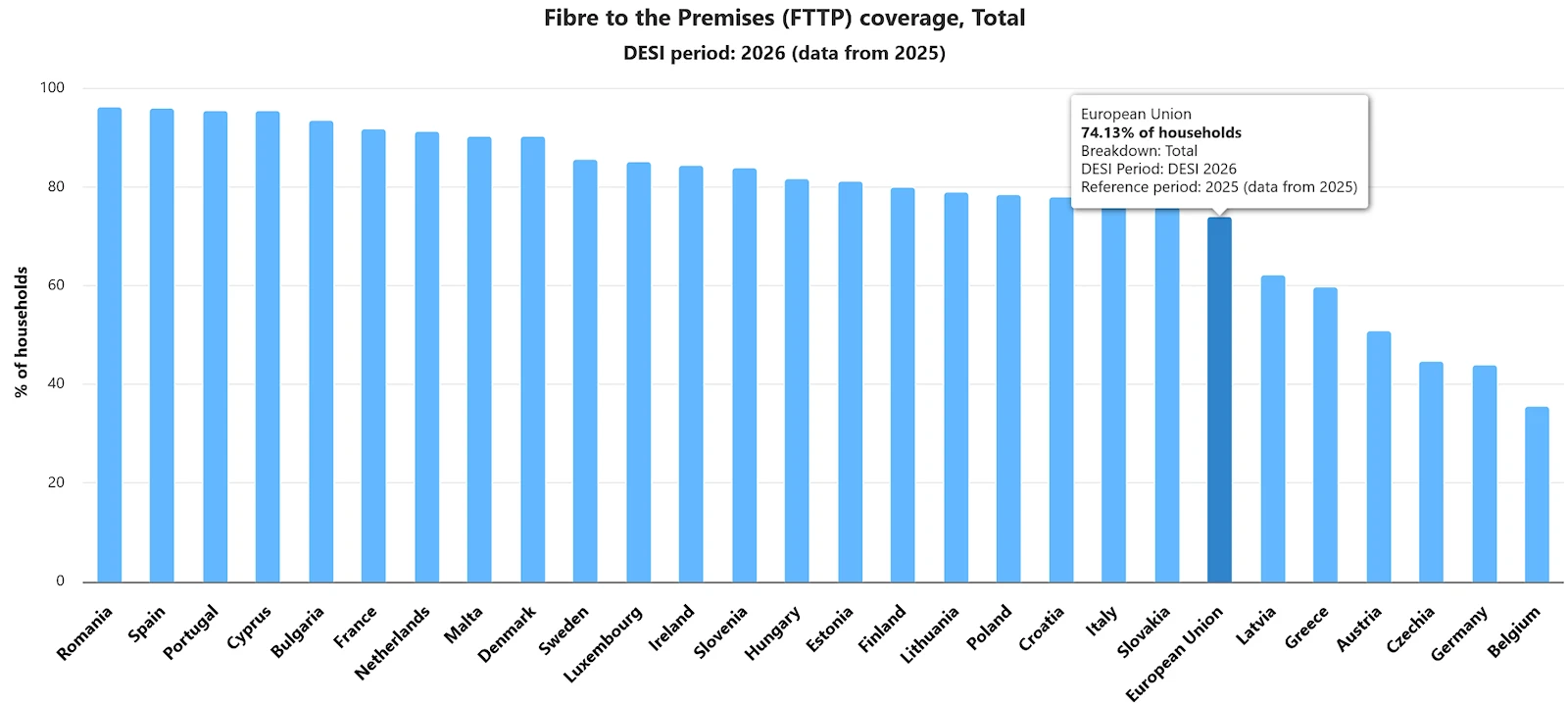
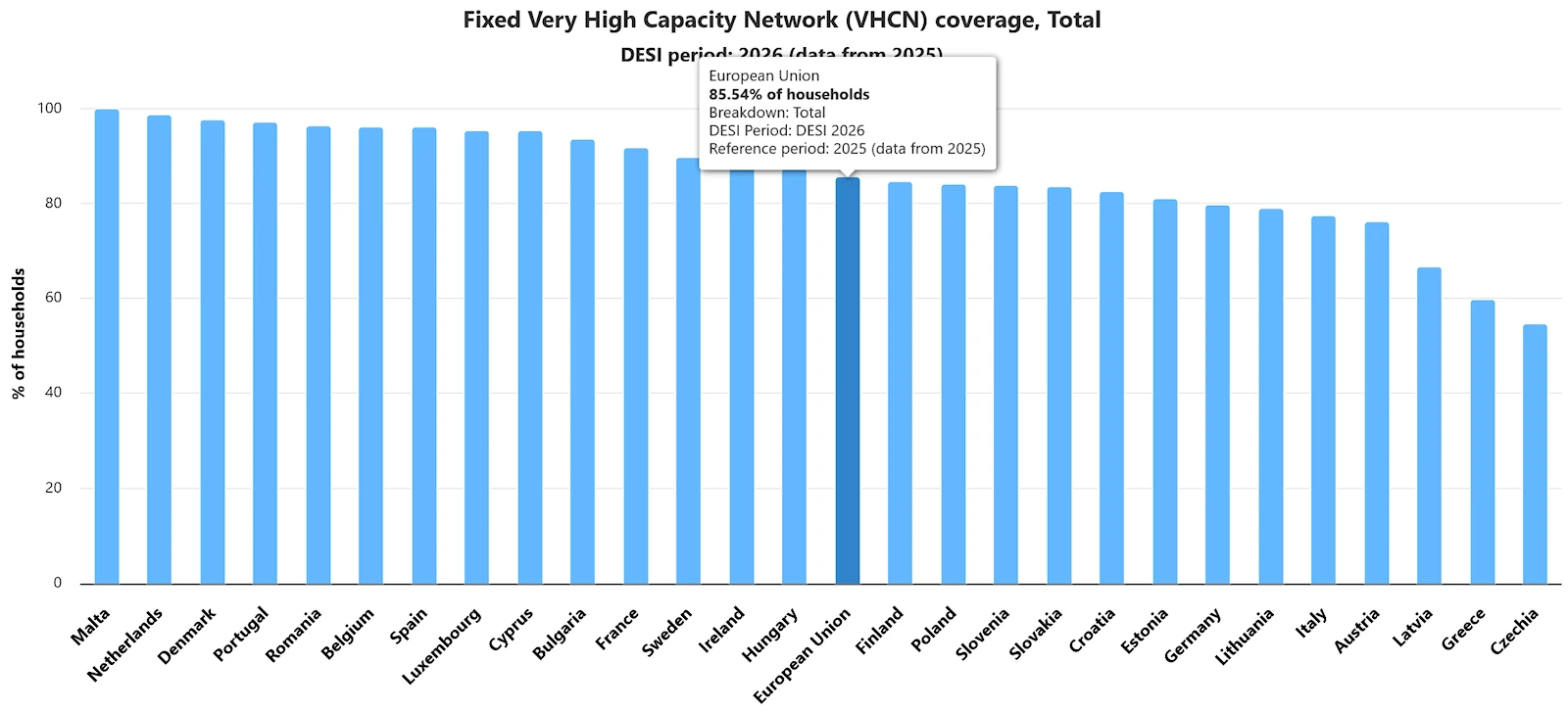
Overall, the EU is now in a roughly similar sort of place to the United Kingdom, with total FTTP coverage of 74.13% (up from 69.24% last year), gigabit (VHCN) broadband coverage of 85.54% (up from 82.49%) and 5G population coverage of 96.79% (up from 94.35%). But we do have to remember that quite a few EU states have been building FTTP, at scale, for 5-10 years longer than the UK, although we’re clearly catching up and even exceeding quite a few countries.

Advertisement
The main focus of the EU’s report is on 5G and gigabit / VHCN (FTTP + DOCSIS 3.1) coverage, with the differences between EU states and the UK becoming much clearer in these areas once we drill down to the individual country level. In both cases, the UK would now reside in the middle to upper half of the tables below (not too long ago we would have been around the bottom).

Advertisement
The other thing to consider is the split between rural and urban coverage. In the UK, some 62% of rural premises have access to a gigabit-capable broadband network (up from 57%), which drops to 61% for FTTP (up from 55%). By comparison, only 62.6% of EU households living in rural areas were reached by fibre in 2025, up from 58.8% in 2024 (+6.5%).
The full report contains a lot more data.
Broadband Coverage in Europe 2026 (State of Digital Decade)
https://digital-decade-desi.digital-strategy.ec.europa.eu/datasets/desi/charts






Mark is a professional technology writer, IT consultant and computer engineer from Dorset (England), he also founded ISPreview in 1999 and enjoys analysing the latest telecoms and broadband developments. Find me on X (Twitter), Mastodon, Facebook, BlueSky, Threads.net and Linkedin.











« EE UK Confirms Disney+ Streaming Service Now Available on TV Platform
Advertisement
Leave a Reply
Privacy Notice: Please note that news comments are anonymous, which means that we do NOT require you to enter any real personal details to post a message and display names can be almost anything you like (provided they do not contain offensive language or impersonate a real person's legal name). By clicking to submit a post you agree to storing your entries for comment content, display name, IP and email in our database, for as long as the post remains live.
Only the submitted name and comment will be displayed in public, while the rest will be kept private (we will never share this outside of ISPreview, regardless of whether the data is real or fake). This comment system uses submitted IP, email and website address data to spot abuse and spammers. All data is transferred via an encrypted (https secure) session.
















I was in the Netherlands recently and the 5G indicator never disappeared from my phone. One of the key quality-of-life things that they have that we don’t is full 5G coverage in train tunnels – there are some surprisingly long tunnels for a flat country, especially around the Amsterdam area, and you don’t lose coverage at all, you can just keep streaming or working. In the UK, we’re way behind.
The UK tends to focus on having an very clear economic justification to support delivery of infrastructure (yes the HS2 case was “cooked”). Adding phone/data service to underground stations and tunnels has been largely funded as a commercial proposition, not an governmental infrastructural investment, with better connectivity for emergency services as an additional benefit.
And phone/data access can be an issue in railway cuttings as well as tunnels, and the currently available “cheap” fix is satellite receivers on the trains as an bolt on upgrade. I believe there are small localized 5G base station hardware solutions on the vendor roadmap which would reduce the cost of ground based infill (also providing better connectivity for emergency services)