Report calls for immediate Gov review of UK broadband USO to tackle digital divide

A new report from Consumer Scotland, which is the statutory and independent voice for consumers in Scotland, has called for a series of improvements to address the ongoing “digital divide” that results in rural areas experiencing “poorer access to the latest broadband and mobile technology“. The report recommends an urgent review of 10Mbps USO, as well as other measures.
The Connected Consumers Report (PDF), which uses Ofcom’s latest data for Spring 2026, highlights how only 54% of rural consumers have access to gigabit-capable broadband compared with 89% of urban consumers in Scotland, the “largest urban-rural divide anywhere in the UK“. In total, more than 500,000 premises in Scotland do not yet have access to gigabit broadband and the majority of these are located in rural and island areas.
For example, in Aberdeenshire, Argyll & Bute, the Western Isles, the Orkney Islands and the Shetland Islands, less than half of all premises have access to gigabit-capable broadband. The report also highlights that 51,211 premises in Scotland cannot access the minimum broadband speeds (10Mbps download and 1Mbps upload) set out under Ofcom’s Universal Service Obligation (USO), with the vast majority (43,602) in rural areas.
Advertisement
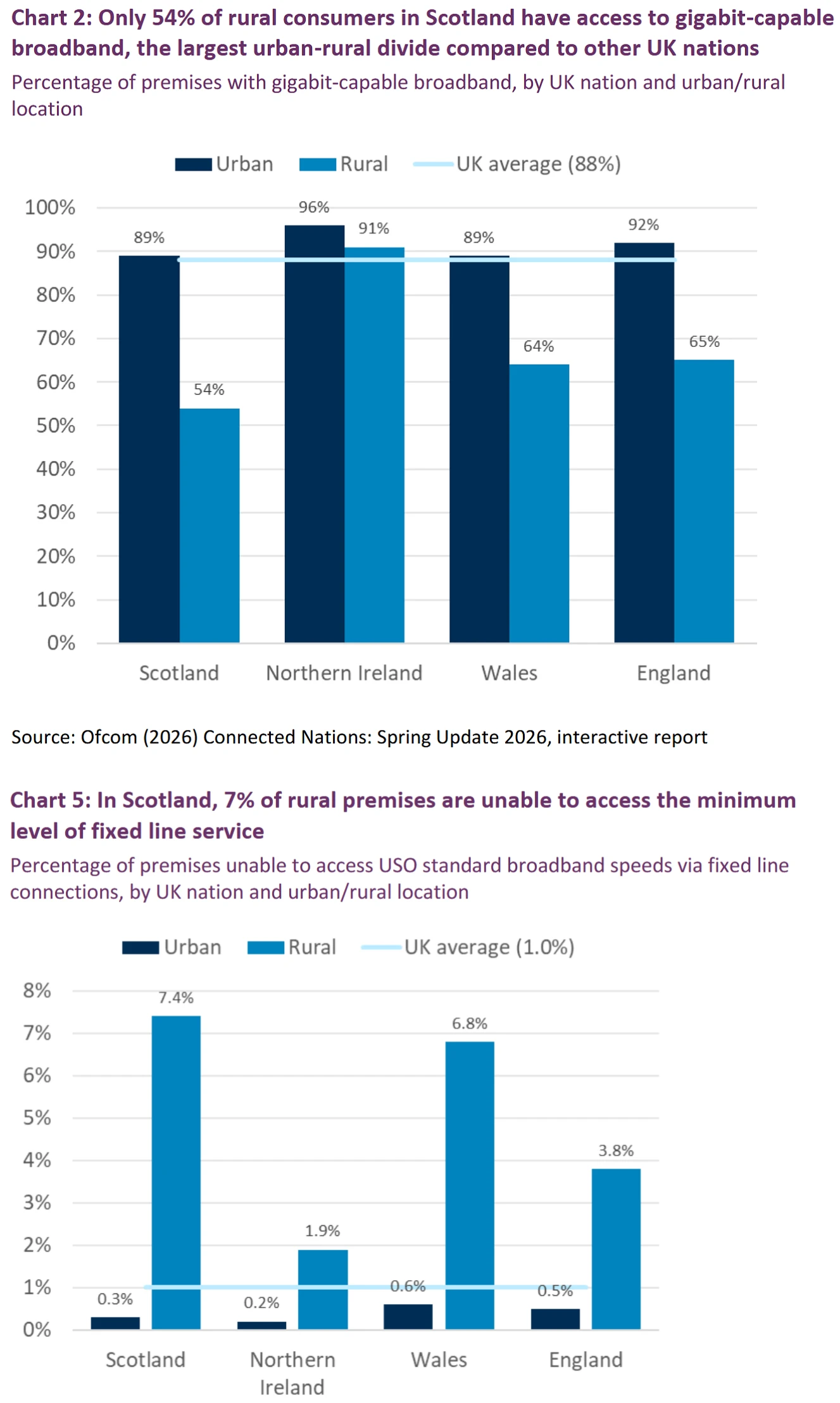
The report does recognise that both the Scottish Government (SG) and the Government in Westminster are actively working to close these gaps through various programmes. For example, the SG is currently expanding the coverage of full fibre (FTTP) networks into remote areas via Openreach under the £697m Reaching 100% (R100) project, which aims to cover a total of 112,939 premises by March 2028 (100,217 premises have already been done).
The R100 roll-out is still ongoing, but Openreach (BT) and GoFibre have more recently also secured several additional publicly subsidised gigabit broadband roll-out contracts for Scotland under the UK’s wider £5bn Project Gigabit scheme (here, here and here). Over the next few years this will extend FTTP to an additional 139,000 premises in remote rural areas of Scotland via an additional public subsidy of around £288m (i.e. focusing on the bits that R100 fails to reach).
However, challenges also remain in the mobile network market. Scotland is said by the report to have the highest proportion of landmass without 4G mobile coverage in the UK, with 9% lacking coverage compared with a UK average of 4%. The availability of 5G also lags behind other UK nations.
Advertisement
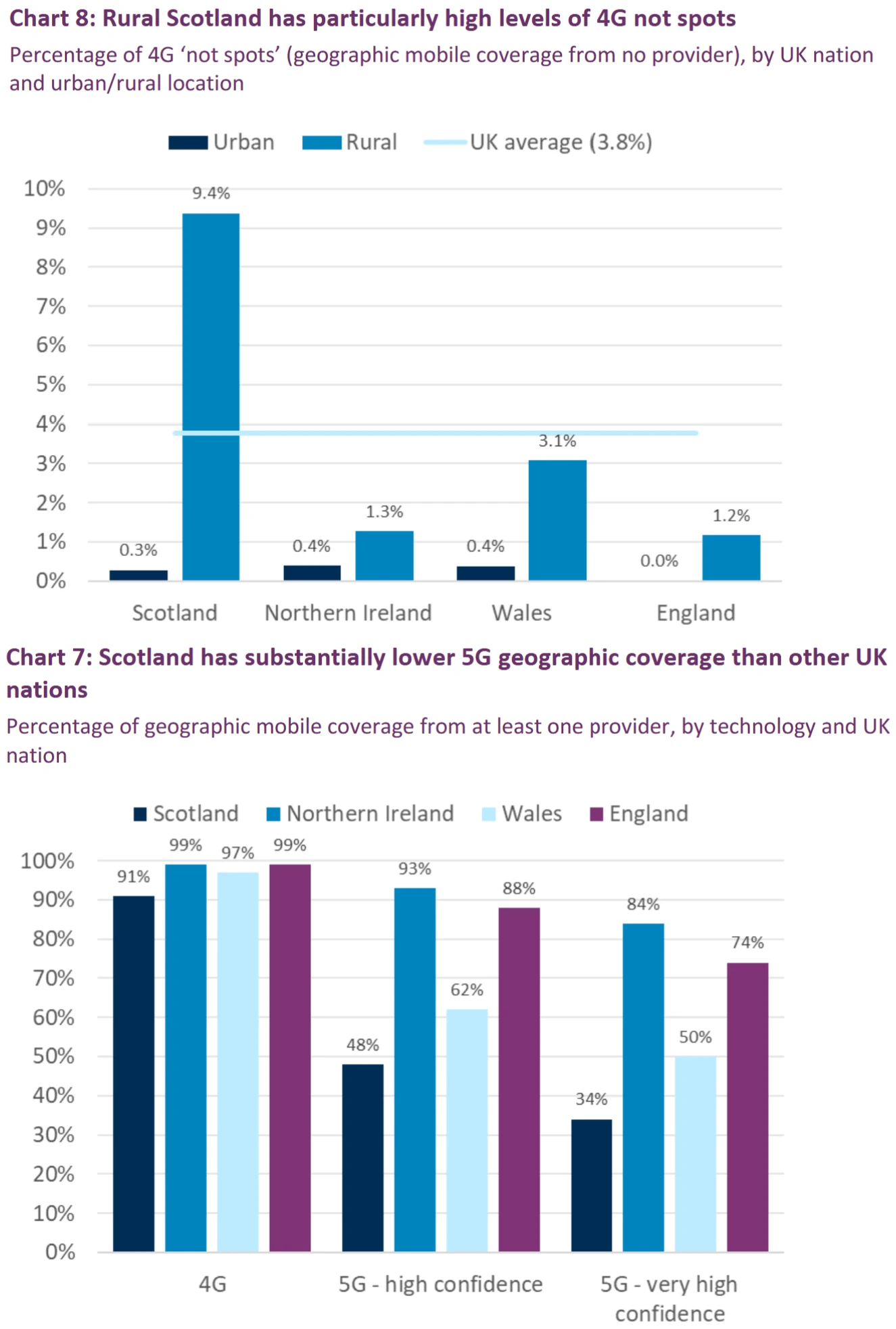
The industry-led £1bn Shared Rural Network (SRN) project is currently still working to expand 4G coverage across remote rural areas, although this is due to complete next year. After that the Government has long set an ambition “for all populated areas” to have access to 5G+ (5G Standalone) mobile broadband networks by 2030, although we would have preferred they set a more credible geographic coverage target.
At this point it’s worth noting that the responsibility for broadband in Scotland is reserved to Westminster. But as with the R100 programme above, that doesn’t stop local and devolved authorities from making their own investments, if they so wish.
Fraser Stewart, Head of Consumer Markets at Consumer Scotland, said:
“Telecommunications services are essential to how people access healthcare, education, banking, work opportunities and vital public services.
They also enable businesses to operate efficiently, communicate with customers and suppliers, access digital markets and remain competitive in an increasingly online economy.
While positive progress has been made in extending broadband and mobile coverage across Scotland, consumers in too many rural areas across Scotland continue to experience slower or more limited services that those in urban areas.
As the range of goods and services that consumers can access through digital technology becomes rapidly more sophisticated, there is a risk these consumers are being left behind unless the technology roll out can keep up.
Improving connectivity, strengthening digital inclusion and ensuring consumers can access fast, affordable services will help people participate fully and equally in Scotland’s economy and society.”
The full report goes on to make a series of twelve recommendations to help improve the situation, although a big focus of this seems to be centred around calls for Ofcom and the UK Government to raise the minimum speed of their broadband USO from 10Mbps to 30Mbps or more. Back in 2023 the previous government did reveal their intention to review the USO (here), but this work seems to have stalled since 2024’s change in government.
Advertisement
In fairness, Ofcom did recently confirm that Starlink’s LEO satellite ultrafast broadband service can now also act as a viable alternative to the USO. BT are only obliged to provide a USO connection if no other alternative that meets the criteria is available, which has previously resulted in quite a few rural connections being tackled via 4G/5G based mobile broadband links (note: connections deemed to have been delivered under the USO itself tend to only use FTTP).
The above creates a caveat for the USO, since Starlink is now an acceptable quick-fix and that wouldn’t change if the USO speed were increased to 30Mbps+ (Starlink’s download speeds in the UK tend to average at around 100Mbps). The report below also seems to ignore that the USO already takes a largely technology agnostic approach.
Recommendations
Recommendation 1: Consumer Scotland recommends that Ofcom and the UK Government ensure that the Broadband USO review commences promptly in 2026. The review should:
• commit to raising the speeds specified in the USO to at least Superfast level
• take a technology agnostic approach to how the USO can be fulfilled, drawing on the possibilities offered by the rollout of satellite technology, standalone 5G and 6G mobile services
• continue to include reference to affordability measures as part of the USO criteria to ensure services are accessible to as many consumers as possible and to prevent detriment.
Recommendation 2: Ofcom should:
• continue to monitor access to any revised USO, reporting on coverage by nation, and local and constituency areas, and with coverage also broken down by rural and urban areas
• extend consumer facing information to include information on when various technologies are expected to be available to consumers, based on their postcodes. This information should draw together work by providers and by both governments to provide a more comprehensive picture than currently exists, across a wider range of technologies and expressed in more accessible ways.
Recommendation 3: The Scottish Government should refresh Scotland’s Full Fibre Charter in the light of any revised USO obligation and planned network deployments by providers, clearly identifying the actions it will take to improve connectivity, whether alone or working with partners.
Recommendation 4: Following the publication of the most recent work on planned network deployments, and the conclusion of the Mobile Markets Review, Ofcom should establish nations-level benchmarks for mobile performance to accompany its proposed 90% UK benchmark to ensure delivery of significant performance improvement in Scotland and the other UK nations. The Scottish and UK Governments should work together to identify and agree priority areas for further investment both by providers and governments to meet these benchmarks.
Legacy technology and network resilience issues
Recommendation 5: In the lead up to the 2G switch-off, Ofcom should undertake active monitoring of consumer awareness of the changes. Where awareness levels are low this should trigger further, government backed, communication measures both directly to consumers and through trusted intermediaries to raise awareness, as has been the case with digital calling.
Recommendation 6: Ofcom should set out a detailed timetable for concluding its engagement with providers and power distribution networks to assess which sites are most at risk of continuing outages. Following this the regulator should set out a plan of action, by the end of 2026, to ensure that the effects of outages on consumers can be reduced.
Consumer Protection
Recommendation 7: Ofcom should:
• undertake further research on consumer understanding of pricing practices and other key contractual provisions
• monitor switching, price and other recent reforms to ensure that they are effective in protecting consumer interests and publicly report on the actions they will take to ensure this
• consider how to give consumers more information about their usage so that they have more control when negotiating contracts
• consider whether assisted digital services could help consumers who are not currently engaged in switching or who have trouble resolving issues with providers.
Recommendation 8: Ofcom should urgently refresh its guidance on supporting consumers in vulnerable circumstances. This guidance should build on the Charters developed by the UK Government and
• set out protocols in relation to provider practices on issues such as pricing and contractual terms and debt recovery practices
• define Ofcom’s approach to how consumers can be supported to share relevant information about their needs with providers and Ofcom’s expectations of how providers will respond to these disclosures
• take account of best practice in sectors such as energy and financial services.
Recommendation 9: Providers should be required to provide consumers with advice on their usage and on the best available deal across a wider range of communication channels, including any app or website accounts, to ensure the contractual process better meets consumer needs.
Inclusion and Affordability
Recommendation 10: The Scottish Government should address issues around access to services in its work on digital inclusion and on public service reform. It should:
• ensure that reform of public services delivery is rigorously impact assessed and user tested to ensure inclusive design
• ensure that provision of assistance to access digital public services is built in to service design from the start to avoid exclusion from services
• work with Ofcom and the UK Government to help consumers improve digital skills which can boost consumer confidence in using online services.
Recommendation 11: We recommend that the UK Government and Ofcom:
• continue to work with providers to ensure prominent placement of social tariff offers in a range of communication tools including ECNs, websites and apps
• monitor take up of social tariffs and
o consider whether their makeup and the allowances included reflect what consumers need to undertake work, engage socially and access public services
o consider what further measures can be taken to raise consumer awareness of social tariffs
o consider what measures can be taken to make the process of moving to a social tariff easier for consumers, whether by automating processes, increasing channels for enquiries, or otherwise supporting consumers to navigate processes.
• take action to zero rate essential public services websites so that consumers can access these without the need for data.
Recommendation 12: The Scottish Government should:
• work with providers, local authorities, third sector partners and the UK Government to boost affordable access to devices and access to affordable (and where necessary free) data
• ensure that affordability and access issues are addressed as part of its digital action plan and strategy.






Mark is a professional technology writer, IT consultant and computer engineer from Dorset (England), he also founded ISPreview in 1999 and enjoys analysing the latest telecoms and broadband developments. Find me on X (Twitter), Mastodon, Facebook, BlueSky, Threads.net and Linkedin.












Advertisement
Leave a Reply
Privacy Notice: Please note that news comments are anonymous, which means that we do NOT require you to enter any real personal details to post a message and display names can be almost anything you like (provided they do not contain offensive language or impersonate a real person's legal name). By clicking to submit a post you agree to storing your entries for comment content, display name, IP and email in our database, for as long as the post remains live.
Only the submitted name and comment will be displayed in public, while the rest will be kept private (we will never share this outside of ISPreview, regardless of whether the data is real or fake). This comment system uses submitted IP, email and website address data to spot abuse and spammers. All data is transferred via an encrypted (https secure) session.

















Well what do we expect, all the easy low hanging fruit gone, now the hard bits, and not managed planned and reported on at the outset, any bets on the great BDUK fizzling out before 100% acgross geography / postcodes (oh don’t mention the not so easy not such ‘good news’ , most likley leaving BT to have to pick up the not-so proffitable as all the others dis the ‘easy’ stuff?
Aberdeenshire has ~11,000 premises which will be missed by Project Gigabit – these premises are too expensive to build FTTP to, even with public subsidy. 3,000 of those are also missed by the R100, and are sub-superfast, so they have the SBVS vouchers to use. The USO is a white elephant for these rural premises. The only way to get better broadband now is to look at fixed wireless, satellite, or mobile broadband solution. The SBVS can be used to install these solutions. And we are still waiting…and waiting, for a Very-Hard-to-Reach policy from UK Gov on what will be available to these premises missed by Project Gigabit.