Airborne UK 5G Mobile Broadband Network Enters Install Phase with BT
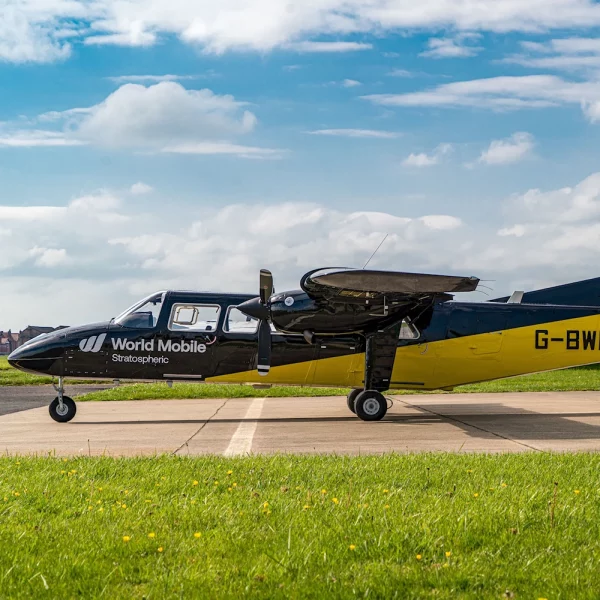
Aircraft manufacturer Britten-Norman has announced that their efforts with World Mobile Stratospheric to develop advanced airborne 5G mobile connectivity system, which could be used to help extend mobile broadband coverage into remote rural areas or to provide coverage during disasters, has progressed beyond R&D and to the installation phase.
The goal of this project, which we’ve covered before (here and here), is ultimately to deliver an unmanned (HAPS) aircraft that will, due to its lightweight structure and power source, enable a flight endurance of over a week and cover a much wider area (i.e. more than 500,000 users over a 15,000 km2 footprint from 60,000 feet). But before that they’ve been developing the Stratomast tech using a specially adapted UK made Britten-Norman aircraft.
The early R&D technology trials and tests have already helped to develop a system that should be able to integrate with terrestrial telecoms networks at 5G connection speeds of up to 200Mbps. The aircraft is now ready for installation of the airborne 5G antenna system, marking a significant step forward in the development of the solution.
Advertisement
The installation of the advanced phased-array antenna system represents a complex integration challenge, supported by over 100 individual engineering drawings produced by Britten-Norman’s Design Office. Work on this is now underway at Britten-Norman’s MRO facility, with test flights scheduled to commence in the summer 2026.
Once fully equipped, the aircraft will be used to validate how airborne, aircraft-based 5G systems can deliver real-time mobile connectivity. Flight assessment will be conducted by Britten-Norman’s flight operations team in collaboration with WMS and in cooperation with BT (EE) at its Adastral Park R&D facility near Ipswich.
Mark Shipp, Britten-Norman, said:
“Reaching the installation phase is a significant milestone for the programme. The scale of the design effort reflects the complexity of integrating advanced communications systems onto the Islander platform and demonstrates the depth of engineering capability within Britten-Norman. We now look forward to progressing into flight assessment and validating the aircraft’s role in enabling airborne connectivity.”
Richard Deakin, CEO of World Mobile Stratospheric, said:
“We are very happy to have reached this important milestone in our joint work with Britten-Norman to deliver connectivity from the sky – both for disaster resilience using the Islander platform and, ultimately, for wider communications coverage from our future stratospheric aircraft. Working with the highly capable and professional team at Britten-Norman has proven to be a real pleasure. Now we look forward to the next stage in this complex and important programme.”
The manned aircraft trials won’t operate to quite the same extremes as are eventually planned for the unmanned aircraft, but it will still provide the same 5G communications from 22,000 feet over a smaller footprint, focused on “disaster resilience” and “surge coverage” requirements. You can get an idea of what the unmanned aircraft might eventually look like below:






Mark is a professional technology writer, IT consultant and computer engineer from Dorset (England), he also founded ISPreview in 1999 and enjoys analysing the latest telecoms and broadband developments. Find me on X (Twitter), Mastodon, Facebook, BlueSky, Threads.net and Linkedin.













« BT Wholesale Set to Launch 1.8Gbps UK FTTP Broadband Later in 2026

















Are UAVs even legal here? I know drones are but whole planes?