Alternative UK Broadband Networks May Have to Hike Prices to Survive

The Senior UK Plus Analyst for Point Topic, Veronica Speiser, has reportedly warned that smaller alternative broadband networks may have to raise their average revenue per user (ARPU) to approximately £45 per month just to breakeven. But most altnets are currently said to have ARPU’s of between £25 and £35, while larger operators operate within a wider range of £30 to £50.
The amount that altnets charge for broadband can vary quite a bit between networks and their associated retail providers, but most of them have historically positioned their packages to undercut those of the larger and more incumbent networks (e.g. Openreach, Virgin Media etc.).
The strategy here is simple enough to understand – offer faster speeds for less and rapidly grow your customer base (this usually also comes alongside pledges not to hike prices mid-contract), which works particularly well in an environment where so many of the largest ISPs have adopted ugly mid-contract price hikes that are applied unfairly (i.e. the same flat £3-£5 monthly hikes get applied to those on both the cheapest and most expensive plans, disproportionately hurting those least able to afford them).
Advertisement
Furthermore, the evidence suggests that this strategy is helping. For example, between 2024 and 2025, Openreach reported approximately 860,000 net line losses, which is closely balanced by around 850,000 net additions by altnets over the same period. But it should be said that most of those line losses came from areas where Openreach had yet to deploy FTTP, and they’re building feverishly to tackle that (c.1m premises per quarter).
The catch, at least according to Veronica Speiser’s remarks to TechRadar, is that “the current pricing models are not fully sustainable for many ISPs … and they will need to be bringing this up to around £40 — £45 per month to keep up with its current high operating costs per subscriber.”
Analyst firm Enders Analysis underlined this at the end of 2025 by calculating that the UK’s largest alternative gigabit broadband networks (i.e. BT / Openreach challengers) collectively suffered losses of £1.5bn in 2024 (up from £1.304bn in 2023 and £755m in 2022) – driven by high interest rates and rising build costs.
The same report suggested that many altnets may never make a profit and, as we’ve recently seen, several operators have since seen lenders taking a haircut and investors losing money to help rebalance the ship (e.g. lenders taking control of Gigaclear (here) and G.Network emerging from administration “debt-free” (here)). But while those operators were quick to put a positive spin on things, losing money always causes some harm, such as to creditors/suppliers and investors/lenders (e.g. some parts of a supply chain can even end up going out of business due to unpaid bills etc.). Suffice to say, surviving carries a cost too, even if it may fall on the shoulders of others.
Advertisement
On the flip side this does make such networks more attractive, such as in terms of becoming consolidation targets (building greater scale is one way to help move altnets into more viable territory). But consolidation requires money too, not only in terms of the amount you pay for the network, but also in the cost of complex network integrations, and there’s not as much of that flowing around right now. In the end even bigger altnets that grow their scale still need to make money, which once again seems likely to put pressure on the prices we all pay for the service.
One size doesn’t fit all
The catch here is that not all networks are the same. For example, some altnets have significantly lower network build costs than others (e.g. Grain, Netomnia), which in turn means they can continue to be a bit more aggressive on pricing (or alternatively may be more tolerant of lower take-up). Some other commercial altnets (e.g. Wessex Internet) are also more rural centric and have maintained higher pricing to reflect their higher build costs, while still being able to grow take-up at a reasonable pace.
Suffice to say that there’s a lot of variation, which won’t be fully apparent from the average pricing suggestions being tabled above by Point Topic’s analyst. The figures provided by Point Topic also aren’t attached to any particular service level and prices do vary quite a bit by service speed etc. In addition, there can be other differences to consider, depending upon whether you’re looking purely at pricing at the retail ISP or wholesale level (wholesale is arguably more important for network sustainability, assuming the altnet actually offers such a solution).
Just for a bit more context. One of CityFibre’s Strategy Directors, Clayton Nash, recently gave a presentation (here) that indicated how their wholesale full fibre (FTTP) broadband products are up to around 40% cheaper than Openreach’s comparable products, which varies across the tiers. At speeds of 160Mbps, CityFibre is shown to be 24% cheaper, while at 1000Mbps it’s 37% and for Multi-Gigabit this falls back 25%.
Advertisement
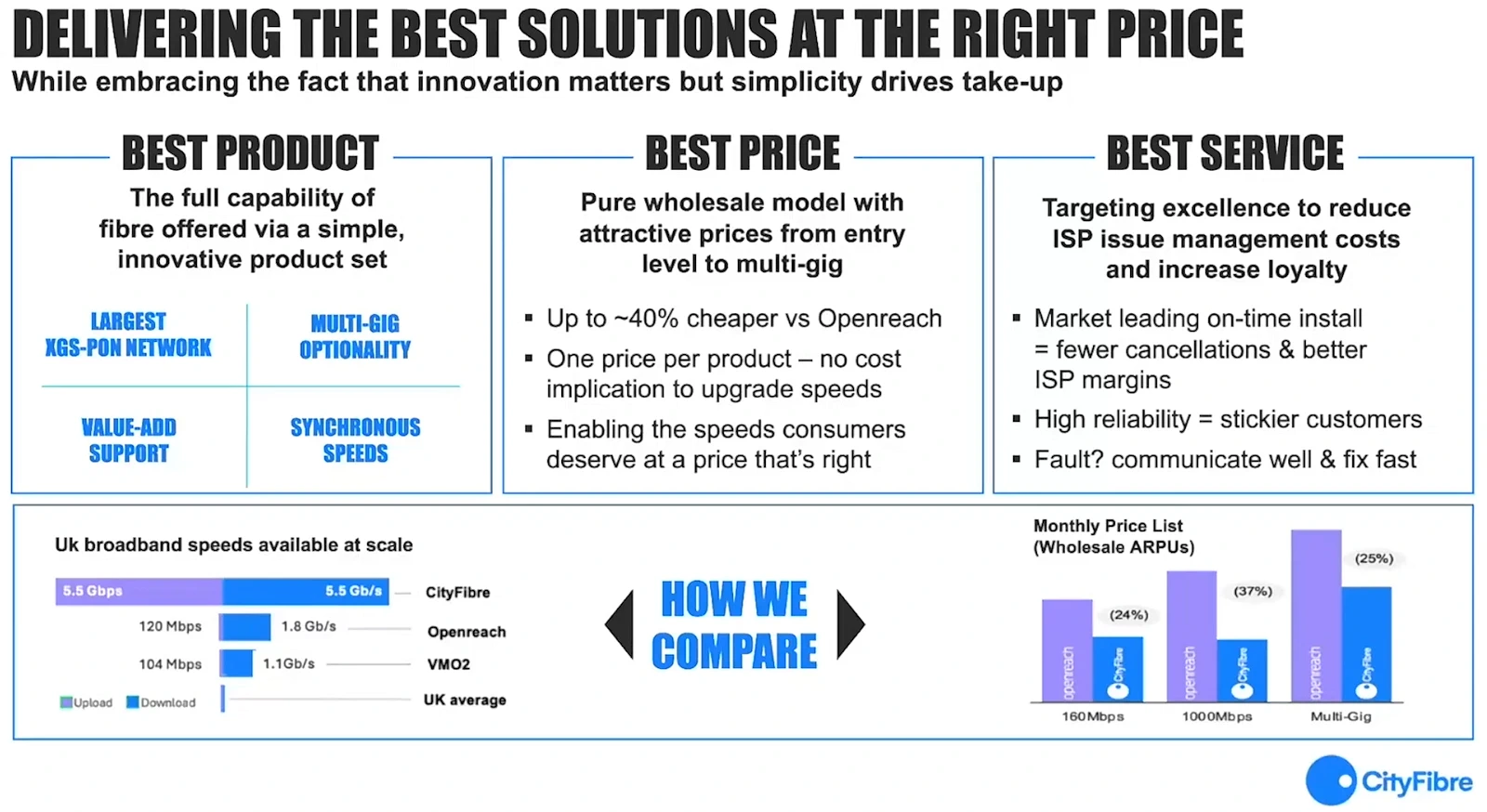
The above will of course vary as both Openreach and CityFibre have been known to tweak their pricing, but it does at least give you a rough idea of how much room for future movement may exist. The reality here is that in order to maintain some competitive advantage as the market evolves, most altnets will probably continue to be a bit cheaper than the incumbents, but over time we may see that gap shrink as the market matures.
Such an outcome has of course long been expected as this is just how things usually work – offer a cheaper service at first to undercut the established players and then rationalise the pricing over time, raising it back toward a more sustainable level.
The challenge is in identifying how much is sustainable for any given network and when to adopt that, particularly with so many altnets already walking on unstable ground and being primarily now focused on commercialisation to grow take-up. Raise prices too high and customers may start leaving faster than you can add them (churn), but keep them too low and you undermine future sustainability.
The answer from every network to this problem will be different because they’re all in different places, albeit still sharing in some of the same wider economic strains.






Mark is a professional technology writer, IT consultant and computer engineer from Dorset (England), he also founded ISPreview in 1999 and enjoys analysing the latest telecoms and broadband developments. Find me on X (Twitter), Mastodon, Facebook, BlueSky, Threads.net and Linkedin.













« Broadband ISP Zen Internet UK Bring eero Router to Business Plans















Point Topic report.
https://www.point-topic.com/post/q4-2025-uk-isp-and-network-supplier-metrics-a-market-overview
… but with e.g. Sky offering a gigabit on Openreach for £30 per month, is there even any headroom for AltNets to hike their prices?
Trouble is most of them have a cost per premise passed substantially more than Openreach’s £300. Their saving grace being that Ofcom is putting the brakes on Openreach discounting their wholesale rates. Assuming the VMO2/Nexfibre – Netomnia merger goes ahead it will be interesting to see if they come up with a genuinely competitive wholesale proposition and whether Ofcom starts to take an interest in them as an operator with significant market power.
Makes sense. With the supply of cheap money drying up, the AltNets will no longer be able to use debt to subsidise price. A pity for them, as that is often the only thing making them stand out.
as long as the altnets offer a better symmetrical network, people will come. I pay £40 for my gigabit altnet. I wouldn’t mind if that was up to £60 for top speeds. I used to pay that to virgin media for their gigabit package which is now only £27.
altnets grew from not following the herd. if they start to follow the herd now they’ll die. put prices up and invest 60% of those price increases into building out better networks to improve speed. stay ahead of the curve. don’t sweat copper for decades like BT.
zen I think are a good example of someone who historically didn’t race to the bottom on price. unfortunately i fear they are now changing that, so i’m not certain there either.
on some levels it seems like business 101, if the majority of the market is competing on price, pick something which they aren’t. compete on quality / throughput.
When the reason you need the higher ARPU is because your take up isn’t meeting expectations I’m not sure how reducing the take up lower by charging more and appealing to fewer people is going to work. The costs to operate do not scale linearly with the number of customers there are tons of fixed costs baked in.
Connect the uber-nerd happy to pay £50 a month for 5 Gbit out of 30 properties in the street or connect the 12 regular folks in the street for £25 a month you’re still trying to pay off the same loans for the network construction, just one of those brings you £300 a month the other £50. It’s not going to cost £250 a month more to serve the extra 11 people and install costs aren’t a major concern relative to construction for most.
Appealing to a niche only works when your costs largely scale with your customer numbers and the profit margin justifies it. The majority of the market competes at least partially on price because that’s where the custom is. ARPU in the UK is always going to be pretty low as Internet is to most a commodity.
I joined YouFibre. £35 a month for the You2000 plan. Dropped from £45 apparently. A couple of weeks later, I saw the same You2000 plan advertised for £30 a month.
To quote the old BT CEO:
“It will all end in tears”.