EE come top in Streetwave study of Cornwall UK’s mobile broadband performance
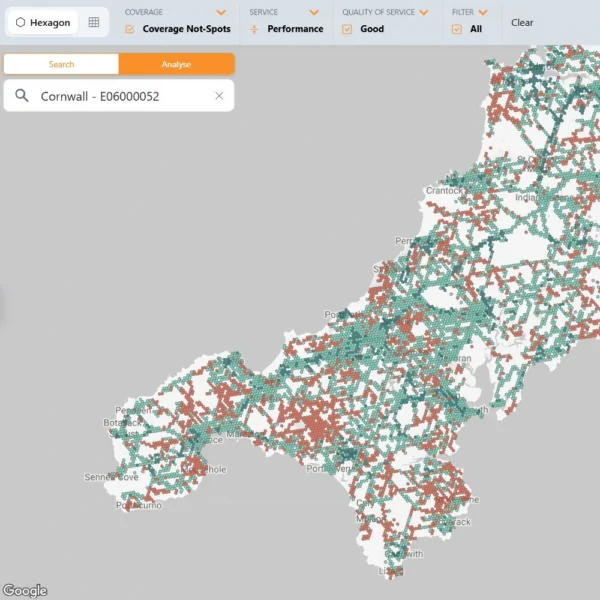
Network analyst firm Streetwave has published the results from their recent survey of mobile network coverage and data (4G, 5G) performance across Cornwall in England, which tracked the capabilities of EE, O2 and VodafoneThree (Vodafone and Three UK) across more than 5,000km of the county’s roads between 27th July and 7th October 2026.
Streetwave typically works by harnessing council waste collection vehicles to map mobile network coverage and data speeds across various parts of the UK (e.g. here, here, here, here and here). In this setup, bin trucks are installed with several off-the-shelf Smartphones using special software, which run continuous network tests (once every 20 metres in rural areas and 5m in urban areas) as the vehicles go around their routes.
The data they collect is often then used by local authorities to help identify areas that may require additional intervention in order to improve local mobile coverage and or network capacity, while also giving locals access to some of this data via address-based coverage checkers and interactive maps (https://app.streetwave.co/coverage-checker/). Cornwall has been live on that service for the past week or so.
Advertisement
In terms of the overall results, Streetwave typically uses two measures – ‘Basic Performance‘ and ‘Good Performance‘. Basic Performance reflects locations where the mobile network provides users with broadband speeds of above 1Mbps download, 0.5Mbps upload, and less than 200ms (milliseconds) of latency / RTT (i.e. supporting only the most basic of use cases or needs).
As for Good Performance, this is defined as the percentage of locations surveyed where a user receives at least 5Mbps download, 1.5Mbps upload speeds and less than 100ms latency (RTT) – allowing most use cases like HD video streaming or conference calls to be run. Granted this is still pretty slow, but for most Smartphone use cases it’s just about enough.
Cornwall’s Basic Performance results by mobile operator
➤ EE 77%
➤ Vodafone 65%
➤ Three UK 45%
➤ O2 39%
Cornwall’s Good Performance results by mobile operator
The results are clearly positive news for mobile operator EE (BT), which in a rural county like Cornwall seems to have delivered the best overall performance and often by quite a sizeable margin. Admittedly the scores here are still a bit “glass half full or half empty“, especially given how the 61% rating for Good Performance still means that 39% fell outside of that – a fairly significant proportion.
On the other hand, the situation for the other mobile providers ranged from passable to downright abysmal. Both Three UK and O2 were particularly awful and failed to get above the 50% mark in either grade. Clearly there’s a lot of work for some of the operators still to do in this county.
Advertisement



Mark is a professional technology writer, IT consultant and computer engineer from Dorset (England), he also founded ISPreview in 1999 and enjoys analysing the latest telecoms and broadband developments. Find me on X (Twitter), Mastodon, Facebook, BlueSky, Threads.net and Linkedin.












« Oct 2026 Contract Progress of UK’s Project Gigabit Broadband Rollout
Advertisement
Leave a Reply
Privacy Notice: Please note that news comments are anonymous, which means that we do NOT require you to enter any real personal details to post a message and display names can be almost anything you like (provided they do not contain offensive language or impersonate a real person's legal name). By clicking to submit a post you agree to storing your entries for comment content, display name, IP and email in our database, for as long as the post remains live.
Only the submitted name and comment will be displayed in public, while the rest will be kept private (we will never share this outside of ISPreview, regardless of whether the data is real or fake). This comment system uses submitted IP, email and website address data to spot abuse and spammers. All data is transferred via an encrypted (https secure) session.















Interesting set of data points on Streetwave – looking at a couple of the regions they have done up and down the country, there is a clear pecking order of EE -> Vodafone/Three -> O2. O2 particularly abysmal in the south, but usually bottom in most areas. Vodafone/Three can now cannibalise sites and coverage off each other as they consolidate, making the gap even more significant. Where do O2 go from here? It looks like a dead duck of a network.
This is a great way of checking good coverage and signal strength. The only problem is the waste is usually collected between around 7am and midday.
The networks not going to be maxed out capacity wise at those times. Results would look a bit different at 7pm.
Very true – but I guess it’s as level a playing field as you’re going to get; if at 7am o2 is dire, it’s not going to be much better at 7pm!
Most places i go in Cornwall on lebara (vodafone) are ok to be fair. When I was on an 02 based network it was awful and didn’t work at all data wise most of the time. Mind you I get similar results across the bridge in Plymouth, where 02 only works outside of the city centre area