Study compares UK 5G fixed wireless broadband performance to Starlink

A new study from Opensignal has compared the performance of 5G and 4G powered Fixed Wireless Access (FWA) broadband to that of Starlink’s LEO satellite network across 14 European markets, including the United Kingdom. In the UK, Starlink comes out top for rural broadband, but it’s a much more mixed picture in urban areas, where Three UK is strongest for 5G FWA.
The study, which is based on crowdsourced data collected via users of Opensignal’s App, focused on two key measures – Download Speed and Consistent Quality (CQ) – to capture different sides of the experience. “Speed shows the network capacity of the service, while Consistent Quality shows how often it is good enough during everyday use,” said Opensignal.
Starlink ultimately came out as the fastest rural broadband option in all 14 markets analysed – users on Starlink measure twice the speed (82Mbps) of the average FWA provider. In half of these markets, Starlink also matches or beats urban FWA speeds, where mobile operators normally have good coverage and plenty of spectrum. The leading FWA providers do, however, outperform Starlink on Consistent Quality throughout urban and rural areas of most markets.
Advertisement
Part of that speed gap stems from commercial reality. For example, Vodafone’s 5G based home broadband service caps the max speed of their plans to 50Mbps and 150Mbps. Starlink’s plans also cap their speeds, but there’s greater performance at the entry-level (100Mbps on their first residential plan). On the flip side, Starlink’s prices start at £40 per month, whereas Three UK and Vodafone sell 5G home broadband from £18 a month.
A closer look at the UK’s results
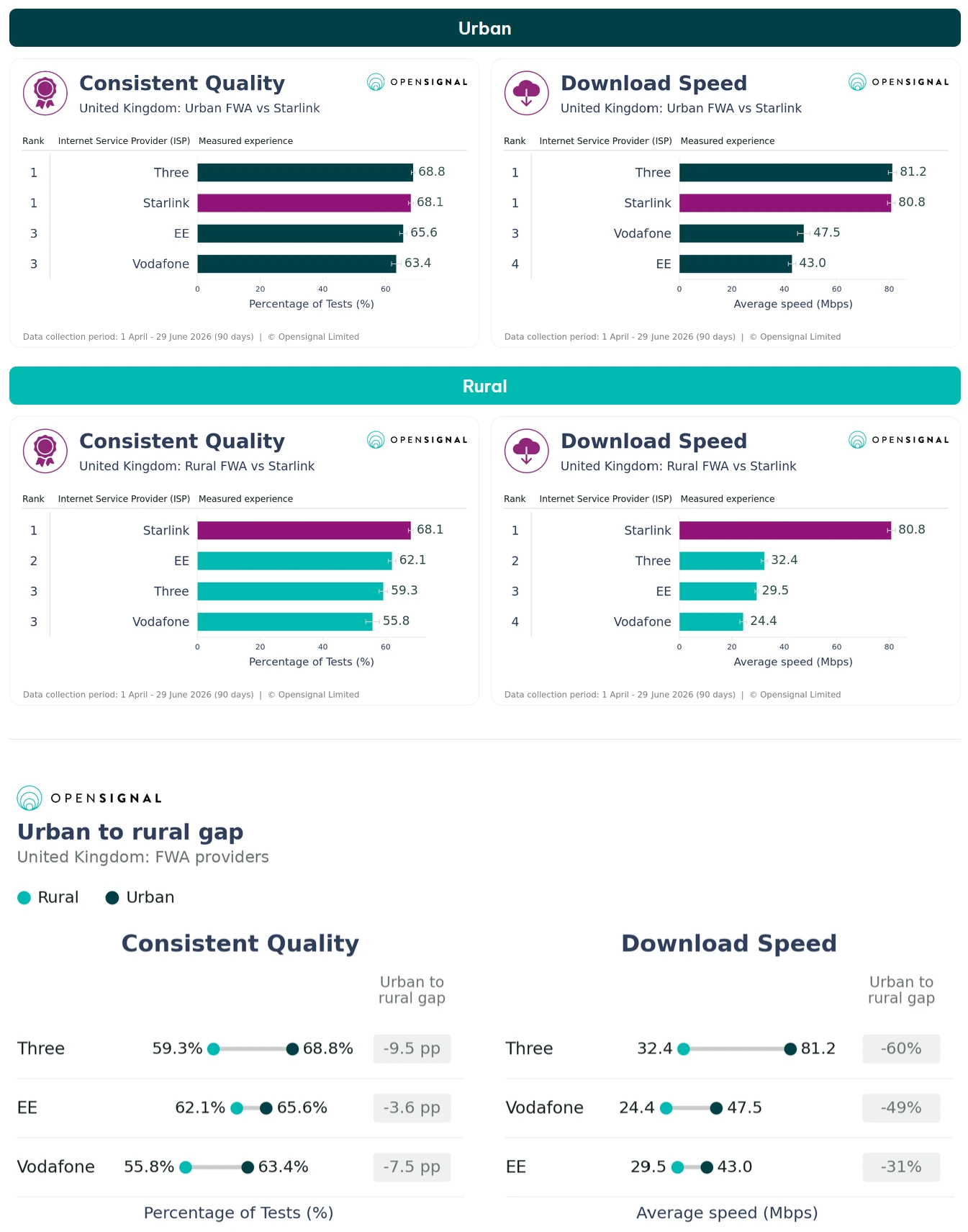
The study found that the fastest urban FWA provider in the UK was Three UK on a download speed of 81.2Mbps. The same operator also came top for FWA providers in rural areas, albeit with a much slower speed of 32.4Mbps, due to the limitations of rural spectrum and network density etc. By comparison, Starlink’s speed in both urban and rural areas was 80.8Mbps, which is on par with FWA in urban areas, but significantly faster in rural locations.
In terms of the CQ scores, Three UK came top in urban areas with a score of 68.8%, while EE were strongest for FWA in rural areas with a score of 62.1%. By comparison, Starlink delivered urban and rural CQ score of 68.1%, which is on par with FWA for urban areas and much better than FWA in rural areas, which is of course Starlink’s primary focus.
Advertisement
The study concludes that 4G/5G based FWA is unlikely to be able to compete with Starlink’s rural speed advantage in the near term. Rural FWA speeds are limited by the number of mobile sites in an area and the spectrum available, both of which take years of investment to expand. In the UK and Poland, FWA’s rural experience was found to be significantly weaker than Starlink’s.
Take note that O2 is excluded above as they don’t have an FWA style home broadband plan.






Mark is a professional technology writer, IT consultant and computer engineer from Dorset (England), he also founded ISPreview in 1999 and enjoys analysing the latest telecoms and broadband developments. Find me on X (Twitter), Mastodon, Facebook, BlueSky, Threads.net and Linkedin.












« LINX launches Cloud Connect service at Manchester internet exchange
Advertisement
Leave a Reply
Privacy Notice: Please note that news comments are anonymous, which means that we do NOT require you to enter any real personal details to post a message and display names can be almost anything you like (provided they do not contain offensive language or impersonate a real person's legal name). By clicking to submit a post you agree to storing your entries for comment content, display name, IP and email in our database, for as long as the post remains live.
Only the submitted name and comment will be displayed in public, while the rest will be kept private (we will never share this outside of ISPreview, regardless of whether the data is real or fake). This comment system uses submitted IP, email and website address data to spot abuse and spammers. All data is transferred via an encrypted (https secure) session.















Both Starlink and FWA can suffer from contention/congestion and weather impacts. YMMV.
I think many with SL would probably be able to get a decent enough connection with the correct 5G setup.
Even if that did mean an external Poynting mounted somewhere IMHO it’s far better to invest in that than paying the monthly Starlink cost.
I’d highly recommend anybody pondering Starlink to reconsider the more premimum 5G kit first as the investment only hurts once and the 5G data market is highly competitive.
Question: If you *know* that there is only 1 mast in range witgh decent signal for 4G/5G, would a directional antenna (e.g. a YAGI type) be the best option (vs a directional or omni “antenna in a box” like a Poynting)?
Is there a free data source to check polarisation? or if you have a 2 x MIMO inputs would you buy 2 x YAGI type and install one with the “fins/rods” perpendicular to ground and the other parallel to ground (one on each aerial input on the wireless hub)?
Although I get OK signal indoors in a ground floor window facing the mast (700m line of site to a good tall mast), I am shadowed a bit by 2 story houses across a broad street and I think I could do better putting aerial(s) onto my existing exterior TV aerial pole at the very top to mitigate the shadowing (move the TV log periodic aerial down a bit on the pole to avoid any wierdness in antenna performance, I’m not really using it that much anyway).
I have the Three hub from a couple of years ago (Zyxel); I know Three have offered an external antenna hub since but I’m not sure that’s the best option in my situation (pole mount the powered Antenna/modem, resets would need a power cycle by plug/unplug, and the physical SIM is inthe external box which is awkward if it is on a pole outside needing a ladder)
I am aware that RF aerial work can be a bit trial and error/dark art rather than “cookbook”
What people usually forget when comparing cost is electricity consumption. 20w idle and up to 100w when active for Gen3. Compare that to around 10w for a 5g router. That’s around £10 per month extra on your electricity bill.
And Starlink (high bandwidth) is therefore also prohibitively expensive upfront in terms of a solar/battery install if you don’t have mains power to ensure 24×365 operations (around 15k UK properties have a phone line, many also don’t have useable data speeds 4g/5g or other FWA service).
Starlink on a mobile phone? Viable powerwise, but currently very limited data speed and £3 on top of an already “spendy” monthly o2 mobile tariff.
Basic problem with current deployment of 5G is patchy coverage even in London.
In W11 area (zone 2) i barely get signal on 5G in my front room.
In Balham SW12, i often have to go to my garden to get a signal.
All mobile provider claim that signal is amazing in these areas of London.
Total farce.
How are we going to have self driving cars with 5G like that?
I forgot to say that i have 2 SIM cards.
EE and TalkMobile (physical Vodafone).