SignalTracker highlights poor mobile broadband speeds in central London
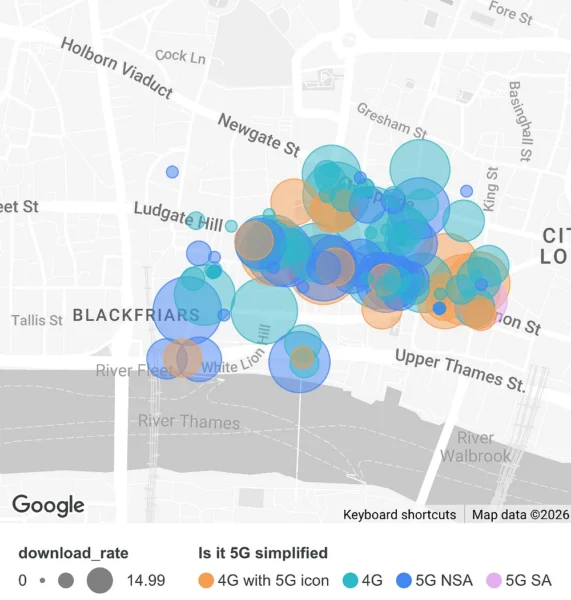
A new study from SignalTracker, which operates a popular Android mobile app (not iOS) for monitoring and testing mobile network performance, has used its own data to support a separate BBC News article, which this week wrote about the problems of poor mobile network (4G and 5G) performance across key parts of the UK’s capital city.
According to a separate data study from Inakalum, which was commissioned by BBC London, some of the worst areas of the city for mobile reception and performance were Liverpool Street and Covent Garden. The study surveyed three streets all within a few minutes’ walk of Covent Garden, on a weekday evening. The results showed that more than one in four data tests across EE, O2, Three UK and Vodafone failed outright.
Even when the networks worked, the mobile broadband speed was found to be unreliable or slow – typically coming in below 15Mbps (Megabits per second). Interestingly both EE and O2 delivered the strongest performance here, while Vodafone and Three UK tended to fight over the slowest two spots. Three UK was also the operator with the greatest proportion of tests that returned no data connectivity at all (between 95-100%).
Advertisement
However, most of those tests took place at peak (busy) times, but when the same study was conducted during off-peak (less busy) periods all four mobile networks were said to have performed well. In other words, many of the issues could perhaps be put down to problems of network congestion rather than signal coverage.
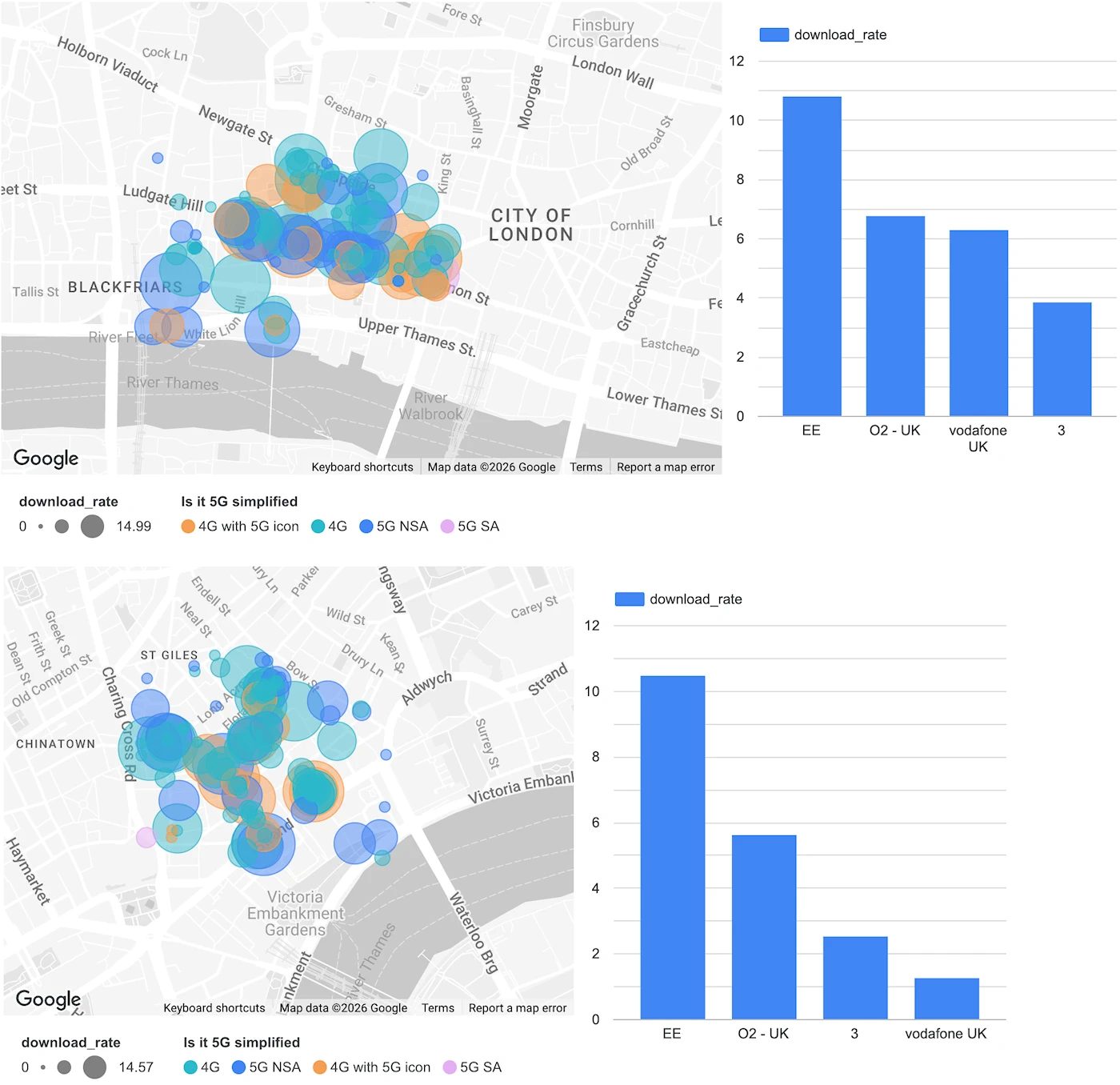
The trade association that represents the UK’s major mobile networks, Mobile UK, acknowledges that London’s mobile phone connectivity “continues to lag frustratingly behind other international hubs“. The situation has now been confirmed by separate independent testing by users of SignalTracker’s app, which similarly examined the streets around both Covent Garden and St Paul’s.
“Of our signal strength and download speed readings in Covent Garden, 29% measured download speeds of less than 15 Mbps. Vodafone Three recorded the lowest download speeds. In the City of London near St Paul’s, SignalTracker data suggested that 44% of all recorded tests measured under 15 Mbps,” said Laura Sear of SignalTracker.
Advertisement
One of the key problem areas is known to be infrastructure planning, including a lack of resources in local planning departments and other things like the Notices to Quit (NTQ) planning measure. The latter has been in the news a couple of times recently after O2 and Vodafone separately complained that it sometimes forces them to take their cell sites offline (masts and other rooftop sites), often without first being given enough time to ensure an appropriate replacement site.
The above is a particular problem when it impacts rooftop sites on existing buildings, such as when the property owner seeks to renovate, redevelop or demolished a building. However, as we’ve said before, mobile operators can hardly expect to hold much sway over major property developments, particularly when they’re often paying only relatively small rental sums to the landowners (holding up major developments at huge cost doesn’t seem like the fairest of balances).
Similarly, mobile infrastructure isn’t installed in a vacuum and planning authorities also have to consider other issues, such as public opinion, visual impact, safety and so forth etc.
A government (DCMS) spokesperson said:
“Fast, reliable digital infrastructure is fundamental to a growing economy, keeping people connected wherever they live, work or commute. That’s why we are working with industry to deliver our ambition for higher-quality standalone 5G coverage across all populated areas of the UK by 2030.
We recognise that demand on mobile networks is growing, particularly in busy urban areas, and are reviewing planning rules and working through our Mobile Market Review to support investment, improve network performance and make it quicker and easier to build the infrastructure consumers and businesses need.”






Mark is a professional technology writer, IT consultant and computer engineer from Dorset (England), he also founded ISPreview in 1999 and enjoys analysing the latest telecoms and broadband developments. Find me on X (Twitter), Mastodon, Facebook, BlueSky, Threads.net and Linkedin.












« Broadband altnet FullFibre Ltd to cut more jobs and outsource UK support
Winners of the Mobile Industry Awards 2026 Announced »
Advertisement
Leave a Reply
Privacy Notice: Please note that news comments are anonymous, which means that we do NOT require you to enter any real personal details to post a message and display names can be almost anything you like (provided they do not contain offensive language or impersonate a real person's legal name). By clicking to submit a post you agree to storing your entries for comment content, display name, IP and email in our database, for as long as the post remains live.
Only the submitted name and comment will be displayed in public, while the rest will be kept private (we will never share this outside of ISPreview, regardless of whether the data is real or fake). This comment system uses submitted IP, email and website address data to spot abuse and spammers. All data is transferred via an encrypted (https secure) session.
















Not only central, W London and SW London.
Not really surprising, high rise buildings, exceptionally high density of people using mobile services must create a significant challenge to delivering the services.
If you travel in Asia (Korea, Japan, china) there is an antenna literally every 2 building.
There your phone last the 32 hour they say during presentation.
Here in the UK it’s just bad planning and cost saving.
Correct about bad Planning
and Cost Savings