Ookla – London ranks last among 18 European capitals for mobile broadband speed

Network benchmarking firm Ookla, which collects data from consumers via their Speedtest.net site and app, has revealed the results of a new study that shows how 4G and 5G mobile network performance in London has declined relative to 18 of Europe’s capital cities. The city now sits at the very bottom of the table across almost all the key measurements.
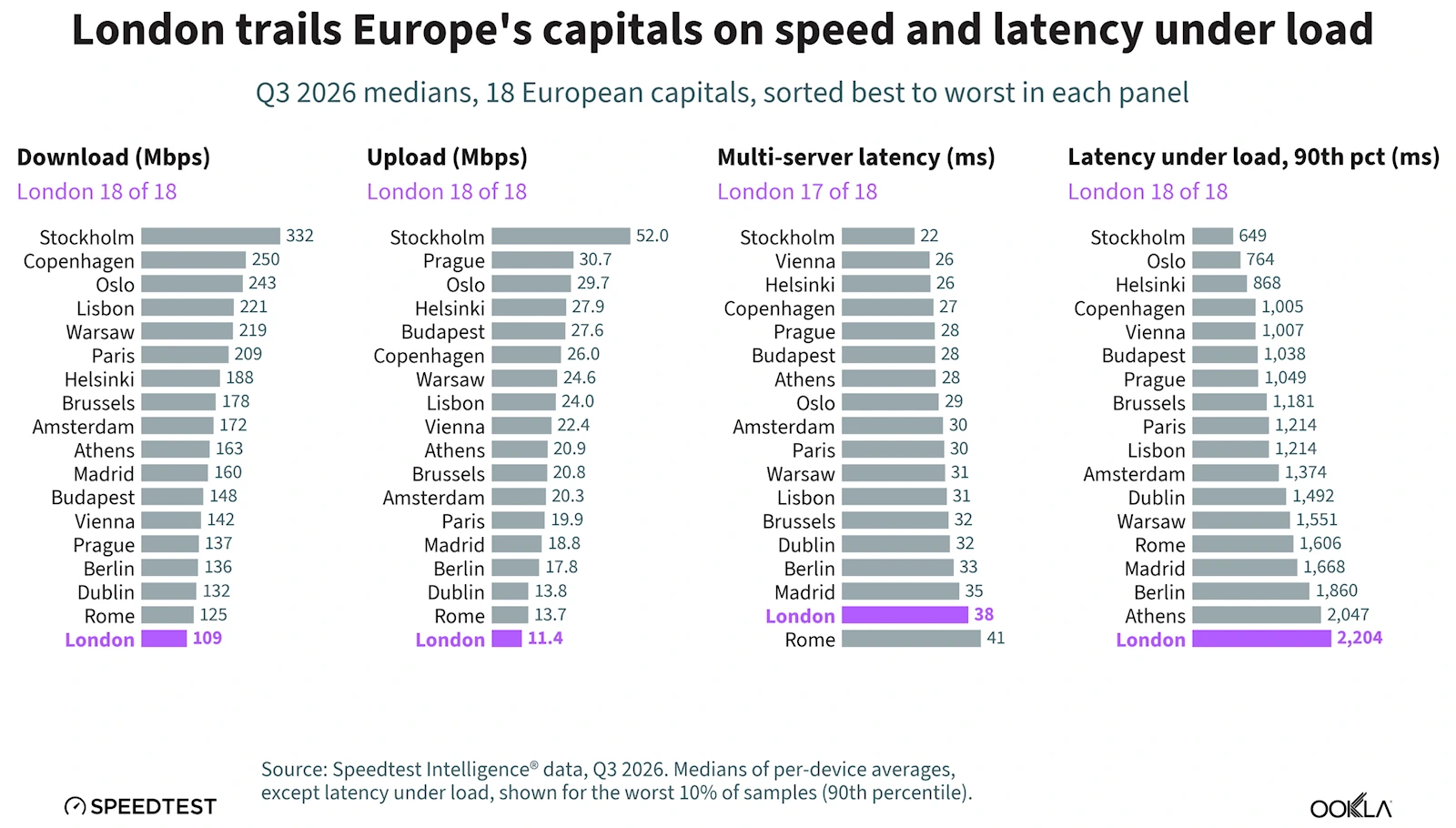
According to the study, London was originally one of the first European capitals to launch 5G services, which initially lifted it to 7th out of 18 capital cities for median download speed by mid-2021. But the city’s average (median) 5G download speed has since fallen from 200Mbps in Q2 2021 to 133Mbps in Q3 2026 as the share of tests on 5G nearly doubled to 80%.
The latest data for Q3 2026 shows that London today has the slowest median download speed of all the tested European capital cities at 109.43Mbps, while Stockholm tops the table on 332Mbps. The median average speed of the other capitals is 172.22Mbps.
Advertisement
Sadly, the problems aren’t limited to download performance. London was also found to have the slowest median upload speed (11.40Mbps) and the highest latency under load for the worst 10% of samples (2,204 milliseconds). Latency is the time data takes to make a round trip across the network, while latency under load measures this while the connection is busy with a large download (i.e. helping to show how networks cope when under load).
The busiest parts of the city also struggle with network congestion. The central areas – reflecting the City of London and Westminster – hold about 1.5 million jobs but only 213,000 residents. On weekdays, their median download speed falls through the morning to 80.07Mbps at 1pm, 27% below the same hours at weekends, while latency under load rises 26%. As commuters arrive, more phones share the same cells, and each gets a smaller slice of capacity.
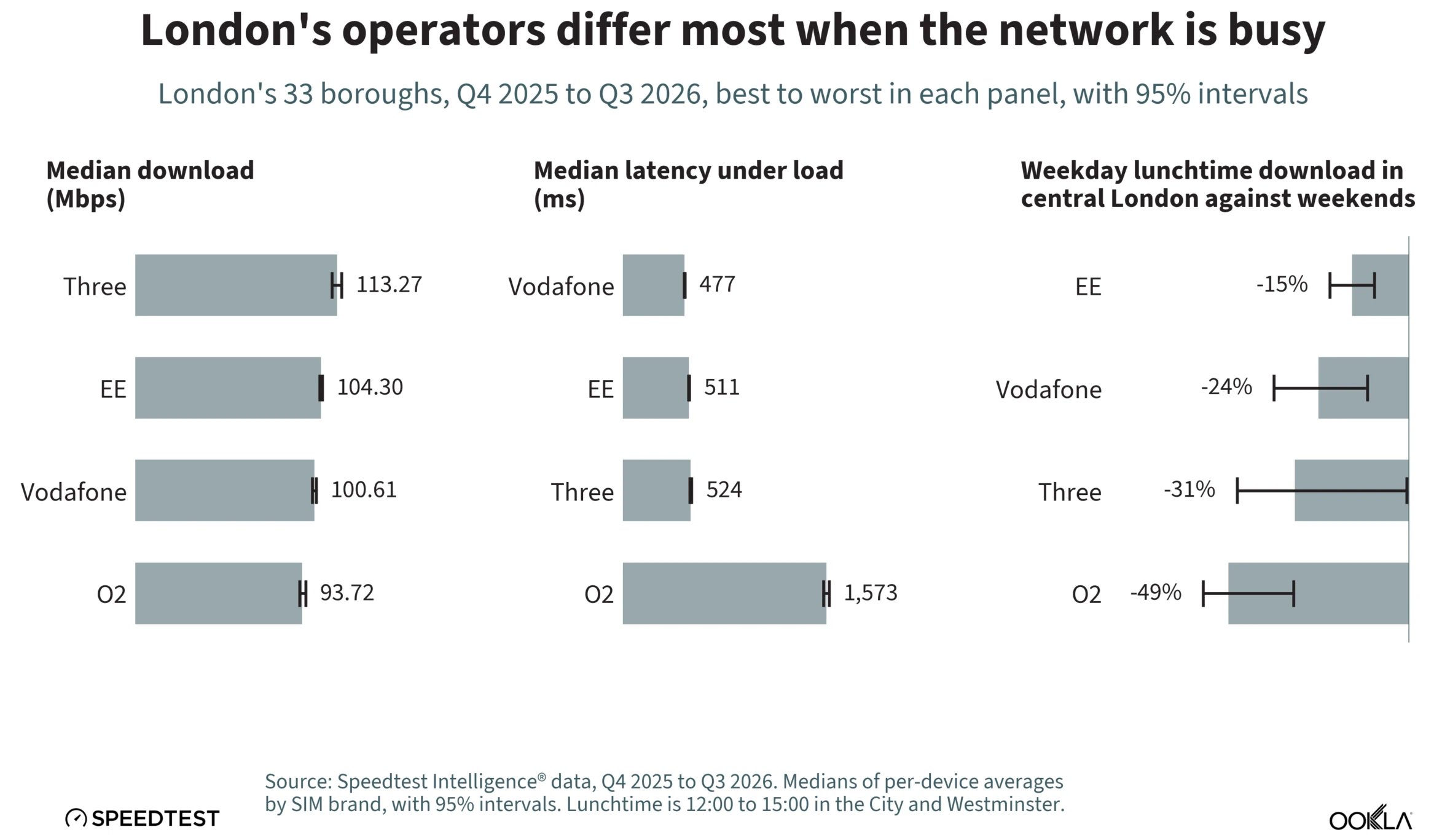
Mobile network performance in London also varies between the primary networks of EE, O2, Vodafone and Three UK (full integration of Vodafone and Three UK will take time post-merger). Over the past year, EE customers saw the smallest weekday lunchtime slowdown in central London (15%), but Three UK customers benefitted from the highest median download speed across the whole of London (113.27 Mbps).
Advertisement
Interestingly O2’s median latency under load of 1,573ms is about three times that of its rivals’, but the gap stays as wide overnight, when networks are quietest, which points to how its network queues traffic during downloads (bufferbloat) as well as to congestion.
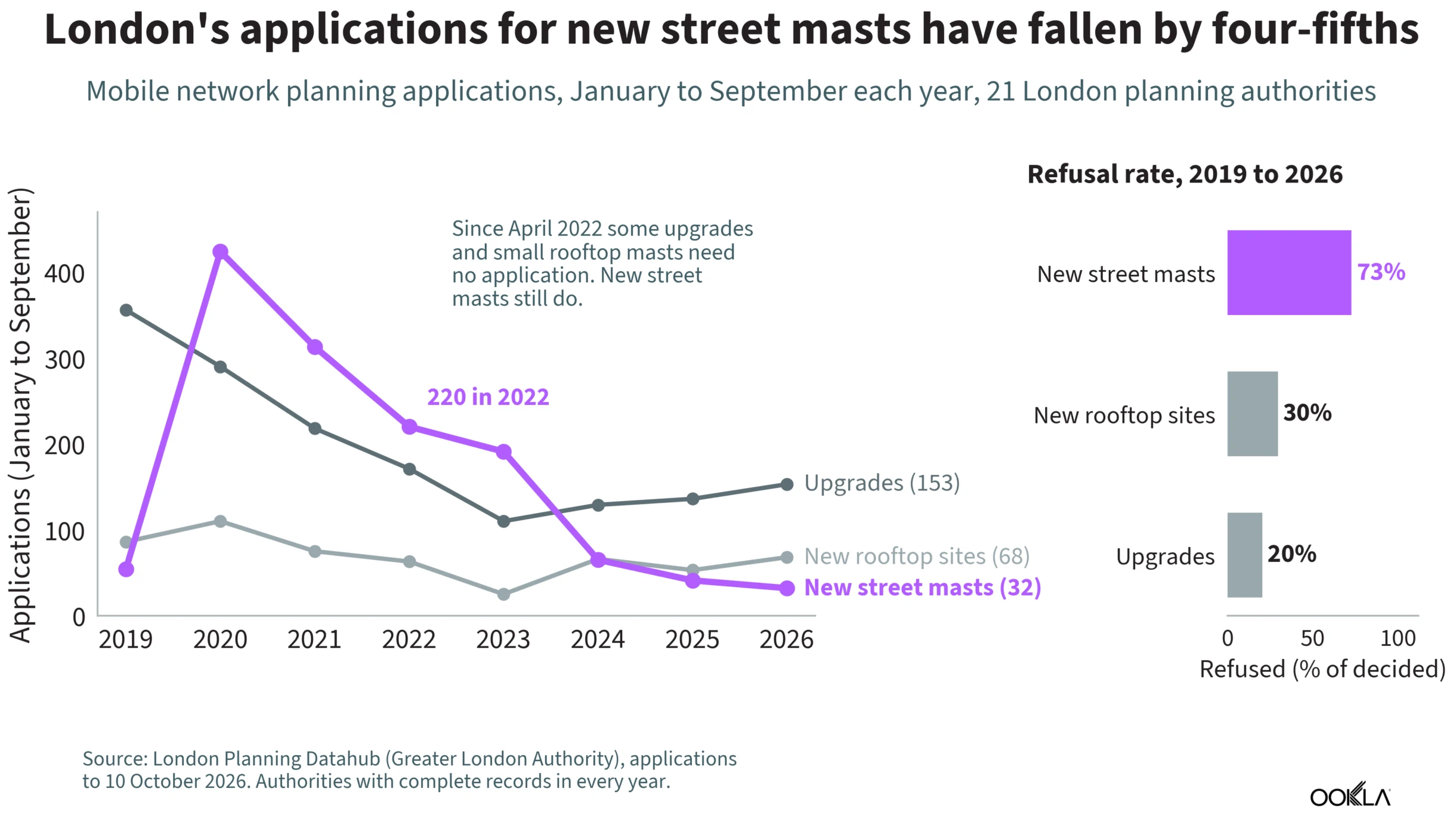
So why is London now so slow when compared with 2021? Part of that likely stems from the fact that other cities have simply improved at a faster pace. The Government’s earlier demand for Huawei’s kit to be removed from mobile networks also caused plenty of costly delays (here and here). In addition, Ookla’s study notes that applications for new street masts in the city have also fallen by four-fifths in recent years.
Part of the problem here stems from past changes to the Electronic Communications Code (ECC), which slashed rents for mast sites (including rooftop sites on buildings that mobile operators don’t own). For example, a 2019 tribunal ruling valued a London council rooftop at £1,000 a year, against £21,000 under the old regime. Since April 2026, the same approach has applied to renewals of older leases.
Advertisement
Put another way, building owners now have less reason to host mobile antennas as the caveats are increasingly perceived to outweigh the benefits (i.e. alternatives like rooftop solar or gardens may bring greater benefits).
On top of that there’s the problem of the Notice to Quit (NoT) planning measure, which has recently been raised by O2 and Vodafone (here and here). The NoT occurs when a land or property owner who may, for example, be seeking to revamp or demolish a building that currently hosts mobile equipment, essentially forces a mobile operator to remove their kit within 18 months.
However, both O2 and Vodafone say that it often takes several years to identify and deploy to a suitable replacement site (partly due to delays in the planning system), which creates a gap that can result in weaker signals and notspots.
In response mobile operators are seeking greater engagement from landowners and planning reform to ensure connectivity is protected when a building is renovated, redeveloped or demolished. At the same time, they’re also putting pressure on the government to help ease planning pressures and extend the permitted duration of temporary mobile sites to 36 months (i.e. helping to provide coverage while permanent replacements are identified).
The reality here is that mobile operators can hardly expect to hold much sway over major property developments while at the same time only paying relatively small rental sums to the landowners. Mobile infrastructure isn’t installed in a vacuum and planning authorities also have to consider public opinion, visual impact, safety and other factors etc. Not to mention the arguably bigger challenge of delays caused by under-resourced planning authorities.
In the meantime, the Mayor of London, Sadiq Khan, last week published a new report and map to help show where 4G and 5G mobile (mobile broadband) networks are falling short. In addition, the mayor proposed ten “practical steps” – via a new framework – that the city’s boroughs can take to support improvements.
As another mitigation, operators are also adding lots of small cells on lampposts and street furniture, including about 3,400 on TfL’s roadside assets. London is thus well ahead of many European cities on the depth and breadth of small cell deployment. But these have limited coverage and so only really help to serve the busiest areas of a city.



Mark is a professional technology writer, IT consultant and computer engineer from Dorset (England), he also founded ISPreview in 1999 and enjoys analysing the latest telecoms and broadband developments. Find me on X (Twitter), Mastodon, Facebook, BlueSky, Threads.net and Linkedin.












« Hints of IPv6 adoption show up at broadband ISP Virgin Media and O2 UK
Advertisement
Leave a Reply
Privacy Notice: Please note that news comments are anonymous, which means that we do NOT require you to enter any real personal details to post a message and display names can be almost anything you like (provided they do not contain offensive language or impersonate a real person's legal name). By clicking to submit a post you agree to storing your entries for comment content, display name, IP and email in our database, for as long as the post remains live.
Only the submitted name and comment will be displayed in public, while the rest will be kept private (we will never share this outside of ISPreview, regardless of whether the data is real or fake). This comment system uses submitted IP, email and website address data to spot abuse and spammers. All data is transferred via an encrypted (https secure) session.















Let residents, businesses and councils easily sign up to host small cells. It’s not as nice a fix as getting proper macro sites sorted out but it seems like we’ve been ‘trying’ for years to solve that and not got anywhere.
I have been waiting for fibre since 2012, Openreach announced it, then didnt, then did, then didnt. They have at least laid the fibre outside my flat. Now got to wait for the landlords to shift themselves as the POTS is going bye bye in January. I have Virgin Media but they are too expensive for what they have. In Camden BTW.
Bduk caused this by giving money to build sparse expensive rural rather than the less expensive but still hard to reach urban
The NIMBYs are winning.