Ofcom Study Finds Mobile Networks on UK Trains Offer Poor Quality UPDATE
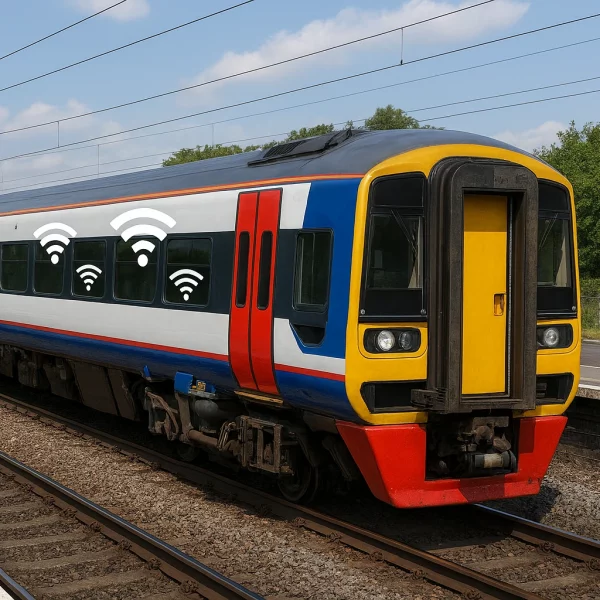
The UK telecoms regulator, Ofcom, has today published a new study that measured mobile (4G / 5G) network performance across 24 segments of key railway lines covering England, Scotland and Wales. The results found that performance was poor on between 58% and 83% of tests carried out on trains, depending on mobile operator.
Regular readers will already know that quite a few of Britain’s train services still suffer from patchy mobile connectivity, which is often also used to help fuel onboard Wi-Fi services. Back in 2017 the previous Government did set out an ambition to make “uninterrupted” Wi-Fi and 5G Mobile broadband speeds of up to 1Gbps (Gigabits per second) available on-board all UK mainline train routes by 2025, but that was never achieved.
Ofcom’s new study – conducted using real-world testing from Streetwave – underlines today’s issues by looking at how often a mobile phone could achieve “good performance” – defined as minimum download speeds of 5Mbps, upload speeds of at least 1.5Mbps, and a response time (latency) of 50 milliseconds (ms) or less, which they said “would typically let people make video calls, stream content or scroll social media“.
Advertisement
The research found that EE (BT) met those standards on 42% of the segments of railway lines that were measured, which dropped to 21% on Three UK, 20% via O2 (Virgin Media) and Vodafone came last with just 17%. On-board Wi-Fi provided by train companies was also measured, but it only “performed well” 1% of the time. “This was largely due to outdated technology delivering the service, as well as speed caps,” said Ofcom.
All of this is despite the fact that, since 2020, mobile network operators (MNOs) are said to have invested around £10bn into their networks. At the same time, the prices paid by an average user are estimated to have fallen by 20% in real terms, although this will vary between individuals (i.e. those who switch around to better deals are more likely to see such a benefit).
Ofcom’s Group Director for Infrastructure and Connectivity, Natalie Black, said:
“People rightly expect connectivity they can count on — and delivering it will require a joined‑up national effort.
We are determined to play our part and will work closely with industry, government, local authorities and others to break down barriers standing in the way of progress, so we can enable economic growth, make everyday life more seamless, and ensure people get more out of the service they pay for.”
Ofcom has also today published a new discussion paper – Connectivity You Can Count On, which more broadly debates the topic of overhauling the quality of UK mobile network services wherever people live, work or travel. The paper is said to “form the basis of our engagement on these issues with stakeholders” and to support improvements in mobile connectivity.
The regulator, which is seeking written responses to the paper by 29th July 2026, intends to provide an update on this work in early 2027 – not least by setting out “what we have learned and how it will shape our priorities and next steps“. Aside from the schemes mentioned earlier, Ofcom has also highlighted several other developments that may help:
Advertisement
Key Areas of Improvement (Ofcom)
- Investment from mobile companies. VodafoneThree has made a legally binding £11bn investment commitment. We will monitor delivery and enforce compliance, alongside the CMA which holds the formal undertakings. We expect other networks to respond with their own investment, and collectively this will be a key driver of improvements.
- Local authorities stepping up. Refusal rates on applications by mobile networks to install or upgrade infrastructure vary significantly. We found that some local authorities, such as Richmond upon Thames, Glasgow and Cardiff, refused more than nine in 10 prior approval applications from mobile operators in the last five years. We want to help make sure they have the data they need to make informed decisions, and we’ll also support Government in its review of planning framework for telecoms developments in England.
- Developers and major landlords taking a more active role. The largest buildings, like shopping centres, would be best served by having dedicated mobile infrastructure indoors rather than relying on signal from outside, and we’ll look at how we can help facilitate more investment in these setting
- Raising the bar for mobile networks. We are proposing to update the way we measure how mobile networks are doing, using crowdsourced data to shine a light on whether they deliver a good performance at least 90% of the time.
- Government engagement on trains. Competition between mobile networks alone won’t be enough to improve mobile signal on trains, and Government is currently considering options for how it can help. As well as providing technical advice to Government to help inform its approach, we’ll also look at whether more spectrum – the airwaves all wireless technology relies on – is required.
- Harnessing new technology. Innovative solutions like satellite technology and spectrum sharing could be part of the answer, particularly in rural areas, and we’ll continue play our part in ensuring the UK is at the forefront of realising their benefits.
The regulator’s report is somewhat intended to help feed into the Government’s wider Mobile Market Review, which aims to ensure that their policy and regulatory frameworks are updated to support investment, innovation, competition and consumers. This is examining everything from regulation, to mobile network technologies, planning reform and net neutrality etc.
UPDATE 11:58am
We’ve just had a comment from trade body Mobile UK.
A spokesperson for Mobile UK told ISPreview:
“Mobile UK welcomes Ofcom’s research, which highlights the unique structural and capacity challenges of delivering consistent connectivity on moving trains. Building the advanced infrastructure requires the right enabling environment, and we urge the Government to act now through the Mobile Market Review and planning reform to establish a supportive policy and regulatory framework.
Dedicated public investment is also critical to tackle complex trackside blackspots, as commercial rollout alone cannot bridge the gap on the rail network. We look forward to working with Government and Ofcom to achieve this, balancing the need for major investment with Ofcom’s vital role in maintaining low costs for consumers.”






Mark is a professional technology writer, IT consultant and computer engineer from Dorset (England), he also founded ISPreview in 1999 and enjoys analysing the latest telecoms and broadband developments. Find me on X (Twitter), Mastodon, Facebook, BlueSky, Threads.net and Linkedin.











« CityFibre Top 1 Million Customers on UK Full Fibre Broadband Network

















In other news: water is wet. But maybe one day we’ll have better comms on trains; either WiFi or mobile data. It’s particularly frustrating knowing that several high speed long distance fibre optic routes run along train lines — so the connectivity is so close in some senses, but not accessible.
OfCom, always years behind…
Not remotely Ofcom’s job. Try reading it’s remit if you’re interested.
On a train it is temporary as they pass through a poor signal area, some of us live in poor signal areas and it is permanent. Why the fuss about trains with a temporary issue and not the locals with a permanent one ?
Agreed
Specific technical solutions exist to provide consistent coverage for “railways”, as demonstrated by London underground having 4G coverage in many tunnels and underground stations.
I understand this would not be cheap to deploy for long stretches of above ground railway but it could be used for “spot” infill (deeper cuttings), but there isn’t the business case to deliver this without public funds, short of OfCom mandating this as part of wider coverage mandates.
That’s what needs to happen.
Since they’re busy nationalising the TOCs they might as well have Network Rail (or GBR as will be) build out the infrastructure to support onboard Wifi with public money and recover through ticket prices. If the onboard Wifi is decent then mobile coverage from commercial providers is not such a priority.
This isn’t news. Can’t believe that OFCOM have only just spotted it, and hope they didn’t they didn’t incur any cost reporting what we’ve all know for 20 or so years.
Old news. Bla, bla, bla , followed by more bla , bla, bla. Other EU countries including elsewhere in the world, where you call them under developed, have Underground/metro coverage, have high speed trains with full internal on board coverage, underground car parks with full signal, etc. Those countries are not afraid to invest, legislation is on their side and of course the networks respect their customers.
The south west main line from Shawford to Winchester is a signal not spot for any operator other than EE. used to extend to Micheldever but Vodafone MOCN’d a site there but still unbelievable a station in Winchester having nearly no service. Not on.
3 used to cover Shawford but only during the 3G-only days. All other operators struggle to cover Winchester due to general weak signal and mainly over capacity reasons.