Point Topic Highlights Key Challenge for VMO2’s £2bn Netomnia Broadband Deal UPDATE
Telecoms analyst firm Point Topic has published further analysis of the £2bn acquisition of full fibre alternative UK broadband network Netomnia (Substantial Group) by the parents of nexfibre and Virgin Media (O2). The research highlights how much of a bearing a single piece of competition-law math – the Herfindahl-Hirschman Index (HHI) – may have on the deal being cleared or not.
The HHI is a widely used measure of market concentration and competitiveness, but working it out accurately requires a strong understanding of the networks, technologies, operators, coverage, and demographics across the UK market (inc. mapping exactly where networks physically overlap), which Point Topic believes is something it can do to a credible degree.
The above is important because the HHI figure will be one that the Competition and Markets Authority (CMA) must examine as part of their Phase 2 competition investigation (here), which could dictate how seriously they view the acquisition and the impact it may have on the wider market.
Advertisement
Critics of the deal, particularly CityFibre, which had also been trying to acquire Netomnia before the nexfibre move was announced, have previously stated that there was a lot of overlap between the nexfibre / Virgin Media and Netomnia broadband networks. A prior Point Topic study put the figure at 832,000 premises, albeit only when looking at the FTTP side of these networks (here); there’s much more overbuild with Virgin’s Hybrid Fibre Coax (HFC).
Now let’s take a look what the same analyst predicts for the HHI figure – both before and after the merger, which at first glance appears to exceed the “serious concern” threshold. But it’s important to reflect that this covers the “wholesale” FTTP market and Netomnia hasn’t yet become a major player on the consumer side of that (business wholesale is out of scope for the CMA), which may balance against this.
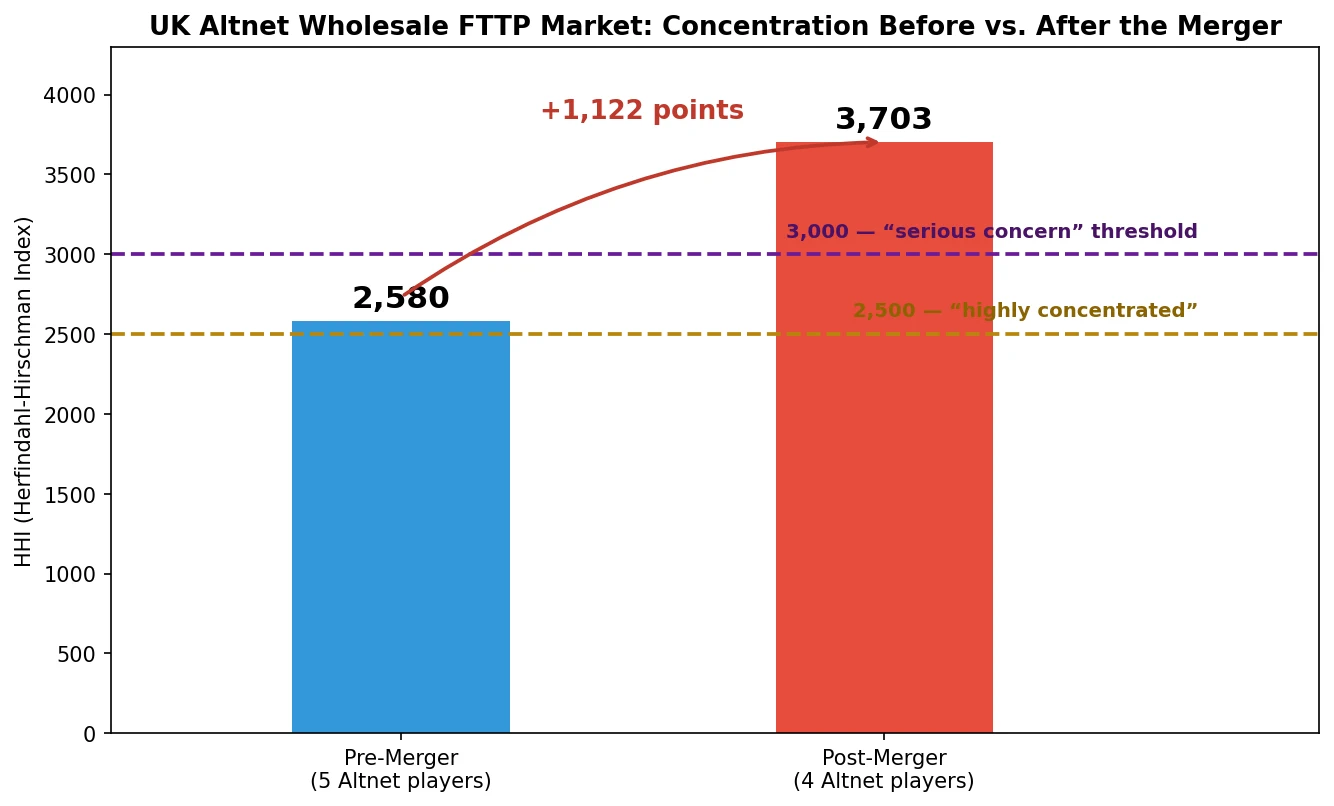
The full analysis is well worth a read and broadly highlights why the CMA may be likely to identify some real competition concerns with the agreement, at least when looking purely at the market for alternative networks (altnets). But the assessment does change a bit when you factor in Openreach’s deployment of FTTP broadband across 23 million UK premises and growing.
Advertisement
“Nexfibre’s lawyers will want to argue: how can a company controlling 16% of the real market be a competition problem, when the incumbent controls two-thirds of it?,” said Point Topic. But the analyst points out that regulators like the CMA don’t typically define markets by whichever framing makes a deal look best – “they look at where genuine competitive constraint operates today”.
Point Topic’s Conclusion
Openreach’s scale is real, but it was already priced into the market before this deal was ever proposed, and it doesn’t get more or less dominant because nexfibre buys Netomnia. What does change, directly and measurably, is how many independent wholesale options an ISP has within the Altnet segment specifically. That number drops from three meaningful independents (CityFibre, Netomnia, nexfibre) to two (CityFibre and the merged entity).
Expect the CMA’s Phase 2 assessment to centre on the narrower Altnet-only market as the primary competitive issue, with the Openreach comparison treated as useful context rather than the deciding frame.
What This Points To
An HHI increase this large, on a market this concentrated, rarely results in either an outright block or a clean, condition-free pass. The more probable outcome is conditional clearance – most likely paired with wholesale non-discrimination commitments toward independent ISPs, pricing safeguards in overlapping regions, or, in a firmer scenario, a mandated divestment of specific infrastructure to preserve a genuine third player in the market.
For anyone with a stake in UK fibre, investors weighing the deal’s odds, ISPs negotiating wholesale contracts, or rival Altnets thinking about their own M&A prospects, the HHI math is the clearest signal available right now for how seriously the CMA is going to take this one.
As we’ve said before. Given the CMA’s recent flexibility toward big telecoms mergers (e.g. Three UK and Vodafone), as well as the Government’s positive welcome, it’s perhaps not unreasonable to expect that the CMA may ultimately allow the deal through. But this is certainly not guaranteed and nobody would be surprised if such approval came attached to a few concessions, such as around certain wholesale requirements.
The CMA’s Phase 2 investigation must reach its conclusion before the statutory deadline of 15th December 2026.
Key Points of the Nexfibre + Netomnia Deal
➤ InfraVia, Liberty Global and Telefónica are committing £1bn in new net funding for nexfibre to fund the transaction – made up of £850m from InfraVia and £150m jointly from Liberty Global and Telefónica.
➤ Nexfibre will sell Substantial Group’s retail business, including the YouFibre brand (Brsk has been retired), to VMO2 for £150m – covering c.500,000 customers.
➤ Nexfibre will finance the FTTP upgrade of 2.1 million homes covered by Virgin Media’s old HFC network (i.e. those that are “adjacent” to the Netomnia footprint). We’ve already seen this process begin (here).
➤ VMO2 will pay wholesale fibre access fees on its customers within the 2.5 million VMO2 homes that overlap the Netomnia fibre footprint.
➤ In exchange for the wholesale traffic commitment on the 4.6m premises, Virgin Media O2 will receive 1) c. £1.1bn in cash and 2) an indirect 15% stake in nexfibre. The vast majority of the proceeds will be available for deleveraging and the £150m to finance the purchase of Substantial Group’s 500,000 customer base.
➤ VMO2 will provide a full suite of managed services to nexfibre – including construction – in return for ongoing management and construction fees.
UPDATE 22nd July 2026 @ 6:49am
Advertisement
One thing that we should have underlined above in the first draft is that Point Topic’s study is looking at the wholesale side of the FTTP market, where there’s a balancing factor to be considered. Regular readers may recall that Netomnia were moving into wholesale and had expressed plans for consumer wholesale options, but prior to the acquisition news they’d so far only covered business (B2B) wholesale products.
The catch is that B2B wholesale is largely out of scope for the CMA, although there may be a grey area here around consumer grade business wholesale products, but we won’t pretend to know the CMA’s perspective on that. The key point is that, from the nexfibre and Netomnia viewpoint, they see this deal as only increasing consumer wholesale competition and not reducing it. The fact that Netomnia didn’t do consumer wholesale before does play into this.
One difficulty is that nexfibre and VMO2 have yet to show they can attract any serious non-group ISPs to their consumer wholesale product (for this it must be competitive with the likes of Cityfibre and Openreach etc.), which is why nexfibre has been busy trying to entice Vodafone and others to join (here), albeit so far without much obvious success (such deals can be very tricky to reach).
The CMA will no doubt be taking a longer and deeper view of the market, but the type, availability and attractiveness of such a wholesale proposition are key factors too.






Mark is a professional technology writer, IT consultant and computer engineer from Dorset (England), he also founded ISPreview in 1999 and enjoys analysing the latest telecoms and broadband developments. Find me on X (Twitter), Mastodon, Facebook, BlueSky, Threads.net and Linkedin.












« Business Broadband Provider Clear Telecoms Acquired by Flotek Group
Advertisement
Leave a Reply
Privacy Notice: Please note that news comments are anonymous, which means that we do NOT require you to enter any real personal details to post a message and display names can be almost anything you like (provided they do not contain offensive language or impersonate a real person's legal name). By clicking to submit a post you agree to storing your entries for comment content, display name, IP and email in our database, for as long as the post remains live.
Only the submitted name and comment will be displayed in public, while the rest will be kept private (we will never share this outside of ISPreview, regardless of whether the data is real or fake). This comment system uses submitted IP, email and website address data to spot abuse and spammers. All data is transferred via an encrypted (https secure) session.

















Can’t be a coincidence netomnia have just decided to make 200 people redundant
Netomnia? Do you mean city fibre? I haven’t seen anything about Netomnia making 200 people redundant unless I missed it?
104 people at risk and it just points to being at risk due to the sale which is unlawful under TUPE. I see a lot of tribunals coming for Netomnia.
@annon – This has nothing to do with TUPE. The company is being acquired.
Sounds like an administrative nightmare or tax dodge.
We’ll give you some shares if you use our network but we’ll pay you to provide some management etc. etc. So long as we can convince everyone we’re not one big business just a collection of small ones and therefore don’t need the regulator’s involvement…..
There’s a small group of people left at Netomnia who are slowly removing the majority of staff hoping that the transaction doesn’t go through and therefore a larger slice of the pie. Maybe that should be investigated as it’s tactical redundancy
Does go through*