50 Publicly Funded 4G Mobile Mast Upgrades Now Live Across Wales
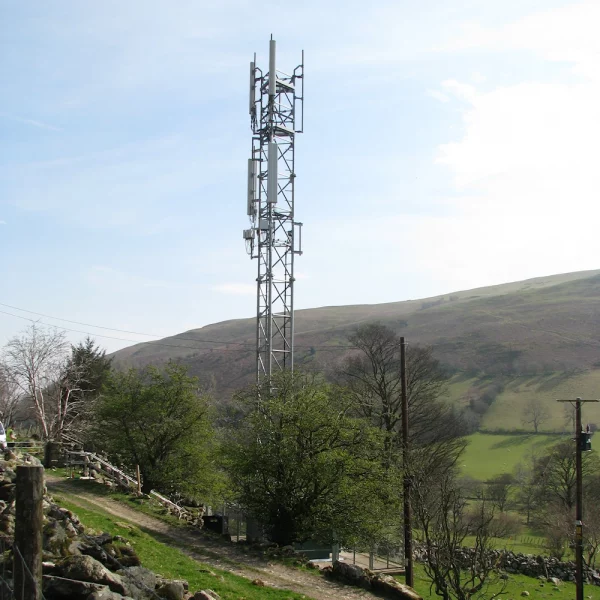
The UK Government has this morning revealed that a total of 50 publicly-funded rural 4G (mobile broadband) mast upgrades have now gone live across Wales as part of the industry-led Shared Rural Network (SRN) project (up from 30 in July 2025), which last year succeeded (here) in extending geographic 4G cover from at least one operator to 95% of the UK (aggregate).
The SRN – originally supported by a commitment of £501m in public funding and £532m of private investment from operators – involves both the reciprocal sharing of existing masts in certain areas and the demand-led building and sharing of new masts in others between the operators.
The SRN has already achieved its first target a year ahead of schedule by ensuring that 96% of the UK’s landmass can now access a 4G mobile network from at least one operator (here), although the coverage range drops to 89-90% when looking look across all operators (here). The project is now focused on tackling the second target to reduce Total Not-Spot (TNS) areas by January 2027.
Advertisement
Most of the early work on this project has typically involved private investment from the main mobile network operators – O2 (Virgin Media), VodafoneThree (Vodafone and Three UK) and EE (BT). But over the past three years we’ve also seen government-funded mast upgrades and new site builds taking place in other parts of the country. A total of over 119 mast upgrades have now gone live across the UK via government funding (up from 100 in Dec 2025) and some 50 of those are in Wales (up from 30 in July 2025).
Rural towns and villages throughout Wales are now benefiting from faster, more reliable mobile coverage, including in areas such as Ysbyty Ifan, Pentrefoelas, Capel Celyn, Painscastle, Hay-on-Wye, Llanigon, Tregoyd, Doly-y-Gaer, Clwydyfagwyr, Pontsticill, Torpantau, Llanddewi, Dolau, Llandegley, Crossgates and Abbeycwmhir. These activations also bring enhanced connectivity to Eryri National Park, Bannau Brycheiniog National Park and to the equivalent of over 3,477km of roads across Wales.
Ben Roome, CEO of Mova (representing mobile operators), said:
“Upgrading 50 EAS masts in Wales shows the strength of a shared, neutral programme. Every site benefits every operator, every community and every mobile user. Together, they represent practical steps toward fairer, more resilient connectivity across rural Wales. Since the launch of the Shared Rural Network, 4G coverage from all mobile network operators has increased from 66% to 81% of the UK, an expansion equivalent to the combined size of Wales and Northern Ireland.
With more upgrades planned, we remain focused on ensuring rural communities are included in a digitally connected UK.”
Secretary of State for Wales, Jo Stevens, said:
“Access to fast and reliable mobile coverage is increasingly important for residents, businesses and community organisations in rural communities all over Wales. Hitting this milestone is an important step in our mission to grow the Welsh economy, supporting businesses to succeed and creating opportunities in every corner of Wales.”
This phase of the work has tended to focus on the part of the SRN that sees the government providing a total of £184m from their pot to the Home Office and mobile network operators, which is helping to upgrade Extended Area Service (EAS) masts being built as part of the 4G Emergency Services Network (ESN) – these masts previously only connected EE customers and anyone making 999 calls. But the upgrade means that all mobile operators can now benefit from these sites.
Current SRN 4G Geographic Coverage Progress (March 2026)
Advertisement







Mark is a professional technology writer, IT consultant and computer engineer from Dorset (England), he also founded ISPreview in 1999 and enjoys analysing the latest telecoms and broadband developments. Find me on X (Twitter), Mastodon, Facebook, BlueSky, Threads.net and Linkedin.
























Comments are closed