Virgin Media UK Rollout 1Gbps Broadband for All on Network by 2021
Cable ISP Virgin Media (Liberty Global) has pounced on Boris Johnson’s appointment to the role of UK Prime Minister by revealing that it will make broadband download speeds of at least 1Gbps (1000Mbps) available to all 15 million premises on their network by 2021, which is thanks to their long-awaited DOCSIS 3.1 upgrade.
At present Virgin Media’s existing network is still dominated by Hybrid Fibre Coax (HFC) based EuroDOCSIS 3.0 technology, although around 2 million premises of their 3-4 million strong Project Lightning network expansion are anticipated to be reached via the much more capable Fibre-to-the-Premises (FTTP) technology. But even FTTP must still adhere to the EuroDOCSIS standard via Radio Frequency over Glass (RFoG).
However Virgin’s top package of 500Mbps+ (575Mbps for the theoretical max config rate) is already starting to strain EuroDOCSIS 3.0 and the long-term plan has always been to adopt the newer DOCSIS 3.1 standard for the whole network, although they’re repeatedly delayed this upgrade in favour of more gradual speed boosts (not to mention the greater focus on network expansion and underlying capacity upgrades).
Advertisement
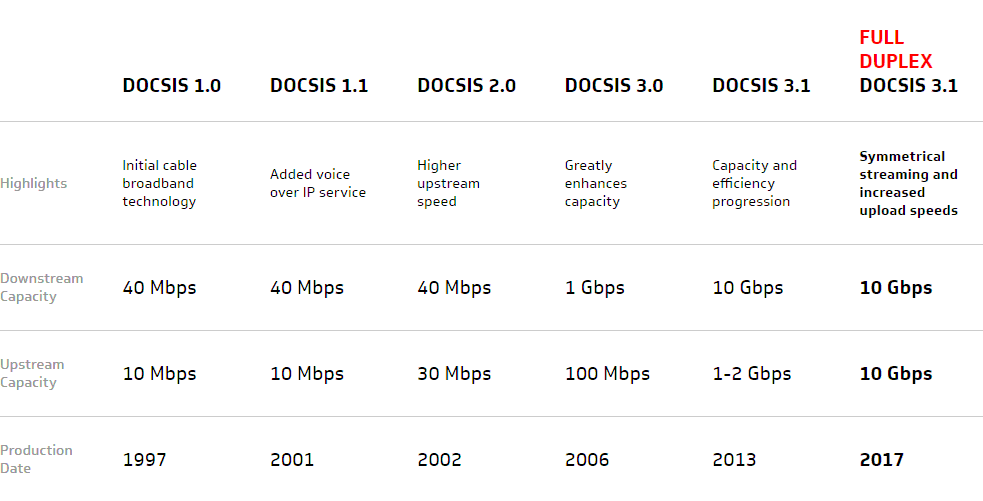
The 3.1 standard is theoretically capable of delivering a peak downstream speed of 10Gbps (or 10,000Mbps+ if you prefer) and uploads of 2Gbps, although end-user packages will obviously start at a much lower rate and the initial launch seems set to be sold alongside download speeds of 1Gbps (already being actively tested). In being an asymmetric technology we’d expect their upload speeds to be slower than download.
Much of Virgin’s network is already prepared for the DOCSIS 3.1 transition and so once their rollout begins then it won’t take too long before the rest of their network is covered. Certainly it will happen significantly faster than it would take Openreach to reach 15 million premises with FTTP, which is why Virgin has today stated the 2021 date (we assume this means “end of” 2021 but it’s unclear).
The move enables Virgin Media to show the new Government that, despite not being a completely “full fibre” network, they too can already deliver gigabit broadband speeds (albeit only for downloads) to around 55% of homes and businesses across the United Kingdom; predominantly in urban areas.
Advertisement
As such the timing of Virgin’s announcement is key because the only way we can see Boris’s 2025 target for nationwide “full fibre” coverage having even the remotest chance of success is if he waters that target down to include Virgin’s network. Even then it’s still a long shot because the other c.40% of premises will be the hardest, most expensive and slowest to tackle by 2025.
The Rollout Plan
At the end of February 2019 the boss of Liberty Global, Mike Fries, highlighted some of their plans for “2019 and beyond,” which included the “launch of two gigabit cities in the UK” to kick start the DOCSIS 3.1 rollout (here). However in May 2019 we leaked a list of several cities that were likely to be covered by their initial rollout and the first were predicted to include Manchester, Reading and Southampton (here).
Virgin Media’s UK Gigabit Cities (Leaked Rollout Plan to ISPreview)
Possible for 2019:
Manchester
Reading
SouthamptonPossible for late 2019 but early 2020 more likely (*):
Basingstoke
Bracknell* Reading is a big area and if Virgin’s main hubsite were enabled then we could easily see Basingstoke and Bracknell being added to the initial launch list (no testing taking place directly in those, yet).
Today’s announcement confirms that Southampton will indeed be the first the benefit and notes that more than 1 million UK premises should be able to access broadband speeds of 1Gbps by the end of 2019.
Lutz Schüler, CEO of Virgin Media, said:
“This is a giant digital leap forward for the UK.
Virgin Media has been the unparalleled speed leader for many years. Very soon, for the first time ever, millions of people right across the country will be able to experience hyperfast and reliable gigabit internet connections thanks to the latest technology and the power of our network.
This upgrade plan will see gigabit speeds rolled out at an unrivalled pace right across the country, bringing our customers the future-proof connections of tomorrow.”
Sharon White, Ofcom Chief Executive, said:
“We welcome Virgin Media’s commitment to investing further in its network, providing gigabit speeds to millions more households. This shows the race to roll out ultrafast speeds to people and businesses across the UK is really gathering pace.”
The expected move will also provide huge competition for Cityfibre’s fledging FTTH rollout with Vodafone (5 million premises by 2025) and particularly Openreach (BT), which currently holds an ambition to bring their own 1Gbps FTTP network to 15 million premises by around 2025 (four years later) and today only covers 1.5 million premises.
Advertisement
Openreach also has a c.300Mbps capable G.fast network and that currently aims to cover up to 5.6 million premises by the end of 2020 but we fear this may soon be scaled back again.
Clive Selley, CEO of Openreach, said:
“It’s great to see others working to upgrade their existing networks, but only full fibre to the premises technology can deliver the future-proof connectivity the UK needs.
We’re making full fibre broadband available to another 20,000 homes and businesses each week and we’re hugely ambitious about helping the Government upgrade the entire nation.”
We should add that the DOCSIS 3.1 is backwards compatible with earlier standards, so customers won’t all require the expected new Hub 4.0 router (rebranded Gigabit Connect Box from Liberty Global) to continue using their existing packages but you will need one of those if you expect to take one of the new DOCSIS 3.1 speed plans.
At this point it’s worth reminding readers that at the start of this year Virgin achieved a speed of 8Gbps on the FTTP side of their network as part of a trial in in the large Cambridgeshire village of Papworth (here), which made use of Ethernet Passive Optical Network (EPON) technology.
Virgin’s announcement also revealed that the broadband usage of their customers had increased by almost 40% in the last year alone and that they have “the capability to roll out multi-gigabit connections and further improvements over the next decade,” which is in keeping with the DOCSIS 3.1 standard as illustrated above.
The DOCSIS 3.1 standard is able to achieve all of this by making several big improvements, such as by harnessing the power of Orthogonal Frequency Division Multiplexing (OFDM) – used in all sorts of networks to split a single signal into multiple frequencies (each of which can carry data) – and improved error correction (Low Density Parity Check). On top of that they’ll also boost their radio frequency (spectrum) allocations.
Further details about future availability, packages and prices are expected to be revealed over the coming months.
UPDATE 29th July 2019
Some readers have been asking about upload speeds on the new 1Gbps packages. Unofficially the plan appears to reflect what we’ve seen in Liberty Global’s other markets, which we’re 99% sure will result in a 1Gbps download and 50Mbps upload (yes.. seriously) package at the top. Sadly this is a bit weaker than the 10:1 ratio being gradually adopted on their slower tiers.

Mark is a professional technology writer, IT consultant and computer engineer from Dorset (England), he also founded ISPreview in 1999 and enjoys analysing the latest telecoms and broadband developments. Find me on X (Twitter), Mastodon, Facebook, BlueSky, Threads.net and Linkedin.













« Openreach Trials 100% Electric Vans for their UK Engineers














Comments are closed