BT Wholesale Broadband Checker Adds Observed Speeds Data UPDATE
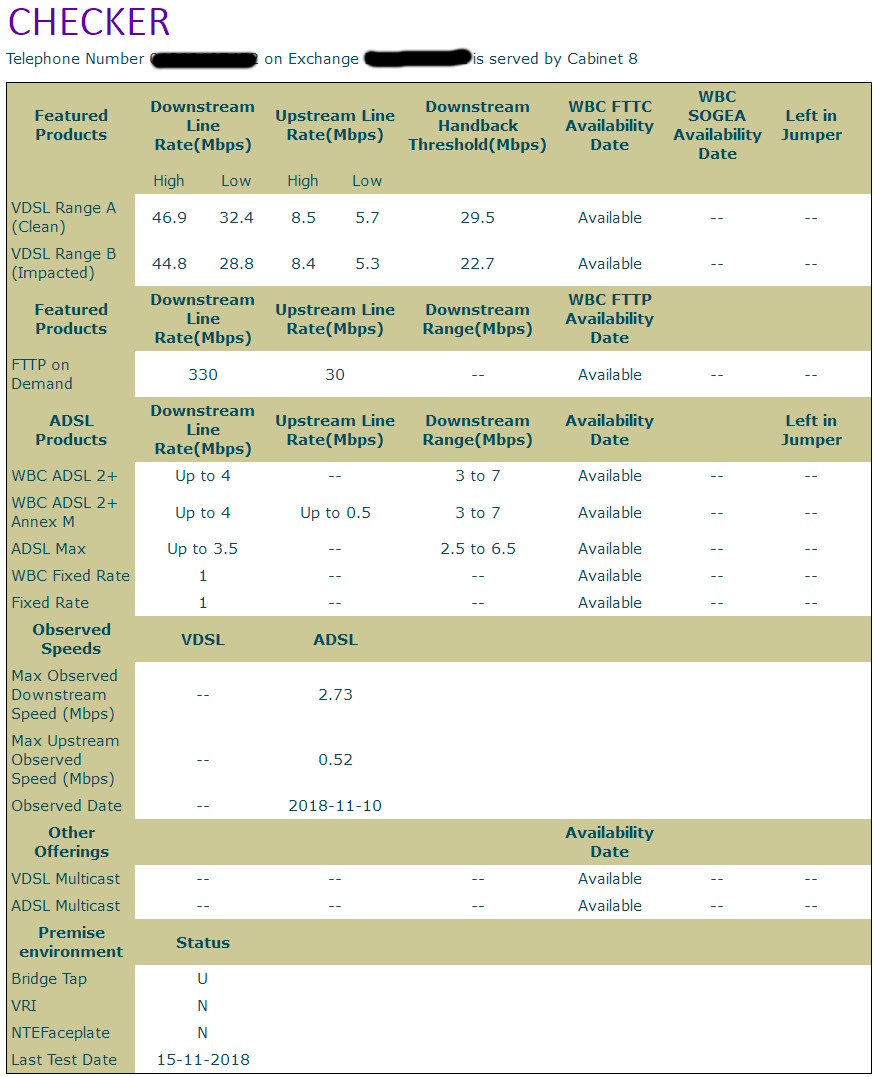
The official BT Wholesale Broadband Availability Checker (only applicable to ISPs and services on Openreach’s UK network) has received another small but interesting update, which adds a couple of new rows and columns in order to display “observed speeds” for your line.
We weren’t originally going to cover this, but enough people have been emailing in over the past week that we now think it’s worth mentioning. In addition, some people appear to be confused about the different measurements of speed being displayed in the new BTWholesale output.
At the time of writing we’re still awaiting an official statement on the output, but we believe that the new “observed speed” (downstream and upstream) figures relate to Ofcom’s new 2018 Voluntary Code of Practice (CoP) for broadband ISP speeds (details), which is due to be introduced from March 2019. We know that BT Wholesale planned to make related changes on 17th November and that’s when these were spotted.
Advertisement
The checker normally only returns rough estimates based on the operator’s understanding of the line itself, while the new “observed speed” output appears to display a “sync” speed for copper (ADSL2+) and hybrid fibre (FTTC / G.fast) broadband lines (i.e. the max possible connection speed that could be delivered to your home router / modem). A sync speed may thus also reflect any weaknesses in your home wiring, which can slow down the connection.
The extra data is intended, we believe, to help support ISPs as they implement Ofcom’s new code. The code itself requires signatories (BT, Sky Broadband, TalkTalk etc.) to display more detail on their personal estimates of broadband speed when you sign-up to a new provider. Member ISPs are thus required to test the actual speeds of a statistically meaningful panel of customers on each broadband package during peak time.
Admittedly this may be intended to help ISPs, but it’s also very useful for consumers who want to compare the standard line estimates against actual reported performance. One caveat here is that BT Wholesale can only report a sync speed for whatever services have been live on the line before, thus if you can get VDSL2 (FTTC) but have only ever used ADSL2+ then the only “observed” result you’ll see is for ADSL2+ (see below).
Mind you’re were a little wary of the fact that this will also enable anybody to find out whether a specific number has an ADSL or FTTC service attached, which could potentially be abused by scammers (nuisance calls).
Advertisement
UPDATE 27th November 2018
Openreach has confirmed that this relates to Ofcom’s planned Voluntary Code of Practice on broadband (BB) speed changes. In short Ofcom want ISPs to use existing BB speed information to support their Point of Sale discussions with customers where it exists rather than predicted speeds to underpin greater accuracy. Ofcom also plan to publish a further Annex to the Code in February 2019, which will set out how observed speeds should be used.
To help ISPs meet the requirements of the new code Openreach are sharing observed speeds in the form of actual sync speeds in Mbps or Max attainable line rates in Mbps on capped lines, for existing or recent BB services on a line through their enhanced Managed Line Characteristics Service (MLC) which is provided for free to established providers.
We further understand that Ofcom are running a workshop in January 2019 with the aim of agreeing use of observed speeds, and the relationship with the minimum guaranteed speed. They also expect there to be 1 year implementation window from publication of the Annex. However there is still some debate across the industry about how GDPR affects the use of observed speeds in some scenarios.
Advertisement

Mark is a professional technology writer, IT consultant and computer engineer from Dorset (England), he also founded ISPreview in 1999 and enjoys analysing the latest telecoms and broadband developments. Find me on X (Twitter), Mastodon, Facebook, BlueSky, Threads.net and Linkedin.











« TalkTalk Unveil UK FTTH Rollout Plan as Broadband Users Top 4.24M UPDATE

















Comments are closed