
- Fixed Line Narrowband
- Fixed Line Broadband
- Wireless Broadband

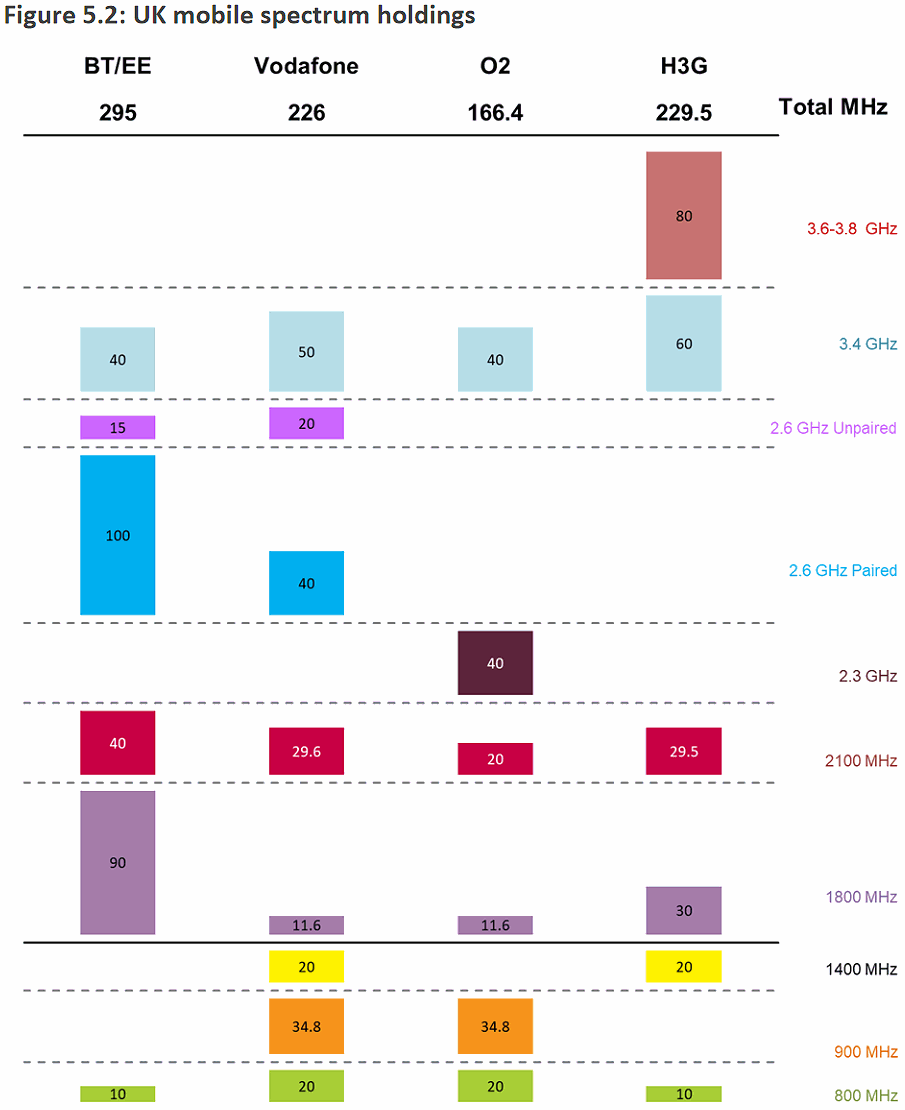
Mobile services are typically delivered over a wide range of radio frequency spectrum bands (e.g. 900MHz, 1800MHz, 2.6GHz etc.), most of which can also reach indoors; albeit only to a limited degree. As a basic rule, lower spectrum bands (e.g. 900MHz) can reach further with their signals and penetrate better through walls than higher ones (e.g. 2.6GHz).
It's worth pointing out that most mainstream mobile and fixed mobile operators in the United Kingdom make use of the 700MHz (Future Release), 800MHz, 900MHz, 1800MHz, 1900MHz, 2100MHz, 2.3GHz, 2.6GHz, 3.4GHz and 3.5GHz radio spectrum bands. These frequencies do not strictly have to be technology specific. For example, 900MHz used to only be for 2G services but then it was made available for 3G and operators can even use it for 4G etc.
The landscape may change somewhat as 5G services roll-out (started 2019/20) as these will have the capability to deliver ultrafast speeds, albeit by using much higher frequency ranges (e.g. 6GHz to 100GHz). The downside of this approach is that it would require a more complicated and thus expensive network infrastructure, otherwise the coverage and indoor penetration at higher frequencies would be far too weak. 5G will also be able to use existing mobile bands, but the performance differences vs 4G will be diminished.
At launch ultrafast 5G services will mostly use the 3.4GHz band, although more spectrum between 3.6-4GHz is due to follow and so is the 700MHz band (expected to be released in 2020/21). Over time though it's likely to harness some existing bands used for 3G and 4G etc.
Internet speeds range from 384Kbps (Kilobits per second) to 20-40Mbps+ (Megabits per second) downstream via the 3G (3rd Generation) based High Speed Packet Access (HSPA) technology and will go much faster with the latest 4G based LTE-Advanced (1Gbps) and future 5G (up to 20Gbps) services. In order to better explain this we've listed the best possible theoretical download speeds by mobile standard below (oldest first).
Mobile Standard - Download Speeds
➤ Basic GSM (2G) - 14.4Kbps
➤ GPRS (2G) - 48Kbps
➤ EDGE (2G) - 236Kbps
➤ UMTS (3G / IMT-2000) - 384Kbps [64Kbps upstream]
➤ HSPA (3G / IMT-2000) - 14.4Mbps [5.8Mbps upload]
➤ HSPA+ (3G / IMT-2000) - 84Mbps [22Mbps upload]
➤ WiMAX 802.16e (3G / IMT-2000) - 128Mbps [56Mbps upload]
➤ LTE (3G / IMT-2000) - 100Mbps [50Mbps upload]
➤ WiMAX2 802.16m (4G / IMT-Advanced) - 1Gbps
➤ LTE-Advanced (4G / IMT-Advanced) - 1Gbps
➤ 5G (IMT-2020) - 20Gbps [10Gbps upload]
➤ 6G - ?
G = Generation of Mobile Technology (e.g. 2nd Gen = 2G)
In reality mobile services can suffer from highly variable performance and, according to Ofcom, the current UK average download speed is just 6.1Mbps (1.6Mbps upload) for 3G and rising to around 33Mbps for 4G. Multiplayer gaming and VPN can sometimes also be problematic thanks to variable latency times and slow upload speeds in areas of network congestion or weak signals. Countering this is the fact that migration between different operators is very easy and coverage sometimes extends into areas that fixed line solutions might fail to reach.
Related mobile internet packages can also limit access to specific services (MSN, Skype etc.), compress web images far too much (O2) and impose harsh data usage caps with costly excessive use charges. Thankfully recent moves have seen prices coming down to almost fixed-line broadband levels, along with increasingly flexible usage policies and thus less blocking.
Mobile Broadband is often described as being the only real alternative to fixed line services because it has the advantage of being both affordable and widely available, from almost anywhere, to a significant portion of the UK population (around 98% if you believe the operators). But the best value monthly packages typically come with lengthy contract periods of 18 to 24 months and usage allowance could do with being a lot bigger.
- Reasonable data allowances.
- Easy to setup.
- Good coverage (especially inside the UK and EU).
- High or unstable latency.
- Some operators block VoIP, VPN etc.
- Stability (disconnections are not uncommon, especially when roaming).
Related ISPreview.co.uk Content:
* Mobile Broadband News
* Mobile Broadband ISP Listings
* Mobile Broadband ISP Reviews
* Mobile Broadband Discussion Forum
* NEWS: H1 2018 - Top 10 Fastest National UK Broadband and Mobile ISPs
* NEWS: Ofcom Identifies Candidate Spectrum for Future 5G Mobile Broadband
* NEWS: ITU Hands Future 5G Mobile Broadband Tech a Target Speed of 20Gbps
* GUIDE: How to Use Mobile Broadband
* GUIDE: Top Tips for Improving Mobile Broadband Performance










Latest UK ISP News





Helpful ISP Guides and Tips











- FTTP (7328)
- BT (4044)
- Politics (3281)
- Business (3006)
- Openreach (2845)
- Mobile Broadband (2727)
- Building Digital UK (2621)
- 4G (2309)
- Statistics (2289)
- Virgin Media (2203)
- FTTC (2171)
- 5G (1991)
- Ofcom Regulation (1908)
- Fibre Optic (1698)
- Wireless Internet (1665)